All Destinations
48 of 576 guides match

Lalibela
Ethiopia
Ethiopia's "New Jerusalem" — 11 monolithic churches carved DOWN into volcanic rock as single pieces in the 12th-13th century by King Lalibela. Pilgrimage heart of Ethiopian Orthodox Christianity, where white-shawled priests and pilgrims still gather daily. Bete Giyorgis (St. George), the cross-shaped final church standing alone in its pit, is the most iconic. Sits at 2,500m in the northern highlands. Genna (Ethiopian Christmas, January 7) and Timkat (Epiphany, January 19) are spectacular but expensive. Tigray war (2020-22) affected access — verify current security.

Lamu
Kenya
The best-preserved Swahili town in East Africa — UNESCO-listed since 2001, Lamu Old Town's coral-stone alleyways and 500-year-old carved wooden doorways have no cars, only donkeys and dhow boats. Founded in the 14th century, Lamu has been continuously inhabited since then. Shela Beach is 12 km of pristine Indian Ocean shore backed by massive sand dunes. The Lamu Cultural Festival in November is the island at its most alive.

Luxor
Egypt
The world's greatest open-air museum — ancient Thebes holds more monuments than anywhere on earth. The Valley of the Kings, Karnak Temple, and Hatshepsut's mortuary temple are staggering. Hot air balloon rides at sunrise over the West Bank are unforgettable.

Maasai Mara
Kenya
1,510 km² of rolling savannah in southwestern Kenya — the northern extension of Tanzania's Serengeti ecosystem and arguably the highest density of large mammals on Earth. The Big Five (lion, leopard, elephant, buffalo, rhino) are all resident year-round; July-October brings the Great Migration when 1.5 million wildebeest, 200,000 zebra, and 350,000 Thomson's gazelle thunder across the Mara River in crocodile-strewn crossings. Hot-air balloon safaris at dawn (300-450 USD), bush flights from Nairobi's Wilson Airport (45min — far quicker than the 5-6hr drive on bone-rattling C12), and conservancy stays in the bordering 14 community-owned reserves (Mara North, Olare Motorogi, Naboisho) which allow off-road driving and night drives forbidden inside the main reserve. Maasai cultural villages dot the perimeter.

Madagascar
Madagascar
The world's fourth-largest island drifted away from Africa 160 million years ago — 90% of its wildlife exists nowhere else. The Avenue of the Baobabs near Morondava, lemur-packed Andasibe-Mantadia rainforest, the jagged limestone tsingy at Bemaraha (UNESCO), and Nosy Be beaches off the northwest coast. Road network is sparse and slow — internal flights via Madagascar Airlines save days. Antananarivo (Tana) is the highland capital and transit hub. Best visited April-November (dry season).

Maputo
Mozambique
Mozambique's capital on Maputo Bay — the City of Acacias has broad Portuguese colonial boulevards, the Eiffel-designed Iron House (Casa de Ferro, 1892), and seafood restaurants serving piri-piri prawns since the 1940s. The Maputo Special Reserve protects elephants just south of the city. One of Africa's most underrated coastal capitals.

Marrakech
Morocco
Marrakech is a sensory explosion — the call to prayer echoing over terracotta rooftops, the maze-like medina packed with spice sellers and artisans, the Jemaa el-Fnaa square transforming nightly into an open-air theater of food stalls, musicians, and storytellers. Stay in a traditional riad and you'll feel transported centuries back in time.

Mauritius
Mauritius
Mark Twain wrote that heaven was copied from Mauritius — and the Indian Ocean island earns the comparison. Le Morne Brabant (UNESCO), the seven-coloured earths of Chamarel, Black River Gorges National Park with endemic pink pigeons and Mauritius kestrels, Blue Bay marine park, and the multicultural street food of Port Louis Central Market. The dodo's last home is now one of the world's most welcoming destinations.

Merzouga
Morocco
A tiny village at the edge of Erg Chebbi — Morocco's iconic dune sea, where apricot-coloured sand rises 150m above the pre-Saharan plain. This is the Sahara experience travelers mean when they say Sahara: a camel trek into the dunes at sunset, dinner under the stars at a Berber desert camp, and Gnawa drumming from the village of Khamlia. Budget tents and luxury glamping both exist here. Winter nights freeze; summer days exceed 45°C. Come in autumn or spring.

Nairobi
Kenya
Nairobi is the only capital city in the world with a national park inside its borders — where lions roam against a backdrop of skyscrapers. The city is the gateway to Kenya's incredible safari circuit (Masai Mara, Amboseli, Tsavo), but also has its own draw: the Giraffe Centre, Karen Blixen Museum, and a rapidly growing food and art scene.

Okavango Delta
Botswana
UNESCO World Heritage Site (2014) — the world's largest inland delta, 15,000 km² of wetlands where the Okavango River ends in the Kalahari rather than reaching the sea. The paradox season: floodwaters from Angolan rains peak in June–August, making Botswana's dry winter months the wildlife spectacle. Mokoro canoe safaris, luxury fly-in camps (Mombo, Vumbura, Duba Plains), Big 5 game plus African wild dogs, and Maun as the MUB gateway town.

Ouarzazate
Morocco
The gateway to Morocco's south and the Hollywood of Africa — Atlas Studios is the largest film studio in the world by area. Gladiator, Game of Thrones, The Mummy, and Lawrence of Arabia were all filmed within an hour's drive of here, most at the UNESCO ksar of Aït Benhaddou 30km west. Restored Kasbah Taourirt anchors the town; the High Atlas is behind you, the Sahara ahead. Calm, low, and built of rammed earth the same colour as the surrounding desert.

Rabat
Morocco
Morocco's capital since 1912 and a UNESCO World Heritage Site since 2012 — a city that feels both imperial and restrained. The 12th-century Hassan Tower overlooks the Mausoleum of Mohammed V; the Kasbah of the Udayas descends in cobbled blue-and-white alleys to the Atlantic; Chellah is a Roman-Islamic ruin where storks nest on 14th-century Merenid minarets. Rabat is the antidote to Marrakech chaos — cleaner, calmer, and much less targeted at tourists.

Serengeti National Park
Tanzania
The world's most famous safari destination — 14,750 km² of golden savanna where 1.5 million wildebeest and 200,000 zebra cycle clockwise each year. Mara River crossings draw the cameras July-October; the southern Ndutu plains host the calving in January-February. Big Five all present (rhino rare — Ngorongoro is the play). Standard "northern circuit" pairs Serengeti with Ngorongoro Crater + Tarangire from Arusha. Hot-air balloon safaris an Out-of-Africa indulgence.

Seychelles
Seychelles
115 islands scattered across the Indian Ocean, 1,600 km east of mainland Africa — the granite-boulder beaches of Anse Source d'Argent and Anse Lazio regularly top "world's most beautiful" lists. Mahé holds the capital Victoria and international airport; Praslin protects the Vallée de Mai palm forest where the coco-de-mer grows; La Digue is pedal-and-ox-cart slow. Among the most expensive island destinations on Earth — dive operators, private-island resorts, and honeymoons dominate the market.

Sharm El Sheikh
Egypt
Egypt's flagship Red Sea resort city, built around the southern tip of the Sinai Peninsula where the Gulf of Aqaba meets the Gulf of Suez. The combination of year-round 25-degree water, vertical coral walls metres from shore, and one of the planet's best wreck dives (the SS Thistlegorm, a WWII supply ship sunk in 1941) made Sharm a global diving capital. Naama Bay anchors the all-inclusive strip, Ras Mohammed National Park guards the most pristine reefs at the peninsula tip, and the Strait of Tiran islands sit a short boat ride offshore.

Siwa Oasis
Egypt
A Berber oasis of date palms and salt lakes 50 km from the Libyan border, marooned in the Western Desert at the bottom of the Qattara Depression. Siwa was the seat of the Oracle of Amun (consulted by Alexander the Great in 331 BC, who is said to have been told he was the son of a god) and is built around the eroded mud-brick ruin of Shali Fortress, which melted in three days of unprecedented rain in 1926. The Siwi people speak their own Berber language, eat their own food, and have kept the oasis culturally distinct from Arabic Egypt across the 8-10 hour drive from Cairo.
Sossusvlei
Namibia
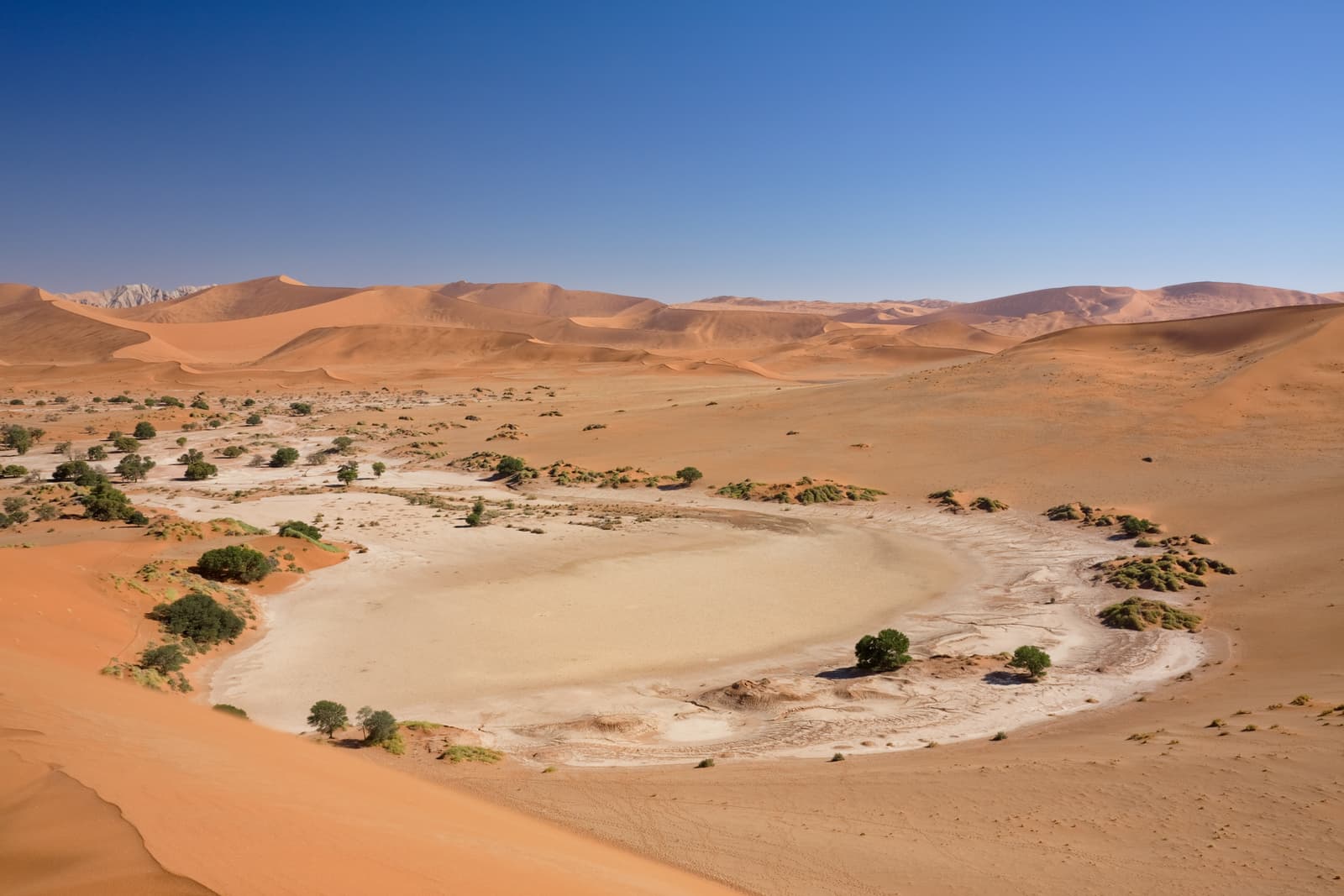
A salt-and-clay pan deep inside Namib-Naukluft National Park, ringed by the world's highest sand dunes — Big Daddy peaks above 325m and Dune 45 draws the sunrise crowds. The adjacent Deadvlei pan holds 900-year-old camel-thorn skeletons against blindingly white clay and orange dune walls — one of the most photographed landscapes on Earth. Access via Sesriem gate; the final 5 km requires 4WD or a shuttle. Part of the Namib Sand Sea UNESCO site.

Stellenbosch
South Africa
South Africa's wine capital sits 50 km east of Cape Town in a bowl of jagged granite mountains, with 200+ wine estates fanning out from a 300-year-old town centre of whitewashed Cape Dutch gables. Stellenbosch University, the country's oldest, gives the streets a young, café-heavy energy that softens the wine-tourism gloss. Boschendal, Spier, and Delaire Graff anchor the famous estate names, while quieter producers like Tokara, Waterford and Kanonkop reward a second day. The dorpscentrum itself, with its oak-lined Dorp Street and water furrows, is the photogenic core.

Stone Town
Tanzania
Stone Town is the old urban core of Zanzibar — a labyrinth of coral-stone alleys built over 1,000 years of Swahili, Arab, Persian, Indian, and Portuguese trade, and a UNESCO World Heritage Site since 2000. The intricately carved wooden doors (over 500 documented), the white-washed House of Wonders, the East African slave market memorial at the Anglican cathedral, Forodhani Gardens night food market, and the modest house where Freddie Mercury was born in 1946 are all within a 1-square-kilometre warren you can only navigate on foot. Most visitors combine Stone Town with the spice plantations inland and the white-sand east-coast beaches at Paje, Jambiani, and Nungwi.

Tangier
Morocco
Northern Morocco's port city stares across the Strait of Gibraltar to Spain (14km away). The medina + Kasbah climb the hill above the harbor; Cap Spartel marks where the Atlantic and Mediterranean meet, with the Caves of Hercules just below. International Zone era (1923-56) and a literary bohemian past — Bowles, Burroughs, Kerouac, Ginsberg all lived here. The Al Boraq high-speed train (Africa's only) connects to Casablanca in 2h10m. Easier ferry hop to Tarifa than most realize.

Tunis
Tunisia
Tunisia's capital is where the Arab Spring began — where Mohamed Bouazizi's December 2010 self-immolation in Sidi Bouzid triggered a revolution that toppled Ben Ali and spread across the Arab world. But Tunis's layered history runs far deeper: Carthage's ruins 15 km north, the UNESCO Medina of Tunis (one of the Arab world's finest, with Ez-Zitouna Mosque at its heart), the Bardo's extraordinary Roman mosaics (world's largest collection), and Sidi Bou Said's blue-and-white clifftop village above the bay.

Victoria Falls
Zimbabwe
The largest sheet of falling water on Earth — 1,708m wide and twice as tall as Niagara. Locally called Mosi-oa-Tunya ("the smoke that thunders"). Zimbabwe's side delivers ~75% of the views and the postcard panoramas; Zambia's side has the Devil's Pool experience at Livingstone Island in the dry season (Sep-Dec). Adventure capital of southern Africa: bungee from the 111m Victoria Falls Bridge, Zambezi Class V rafting, helicopter Flight of Angels, lunar rainbows on full moons. Hwange NP nearby for safari combos.

Zanzibar
Tanzania
Zanzibar is an Indian Ocean paradise with a rich cultural tapestry — Stone Town's labyrinthine alleys blend Arab, Persian, Indian, and African influences, while the east coast beaches offer powdery white sand and turquoise waters. The spice island lives up to its name with aromatic plantations, and the seafood is extraordinary.