
Asia
Thailand
The Land of Smiles, famous for temples, beaches, and street food.
Thailand at a glance
THB
Thai
$60–$130
Jan–Sep, Nov–Dec
30° / 25°C
74/100
Visa-free entry for 🇺🇸 US, 🇬🇧 UK, 🇪🇺 EU passport holders. Always confirm requirements with the embassy before booking.
Destinations in Thailand
13 guides available

Bangkok
Thailand
Bangkok is a sensory overload in the best way — ornate temples rise next to gleaming malls, street food sizzles on every corner, and the Chao Phraya River winds through it all. The city rewards both short visits and deep dives, with a mix of must-see landmarks and hidden neighborhoods that feel worlds apart from the tourist trail.

Phuket
Thailand
Thailand's largest island is a tropical playground of palm-fringed beaches, turquoise Andaman Sea waters, and lively nightlife. From the bustling Patong strip to the serene coves of Kata and Rawai, Phuket offers everything from luxury resorts to budget beach bungalows. The jumping-off point for Phi Phi Islands and Phang Nga Bay.
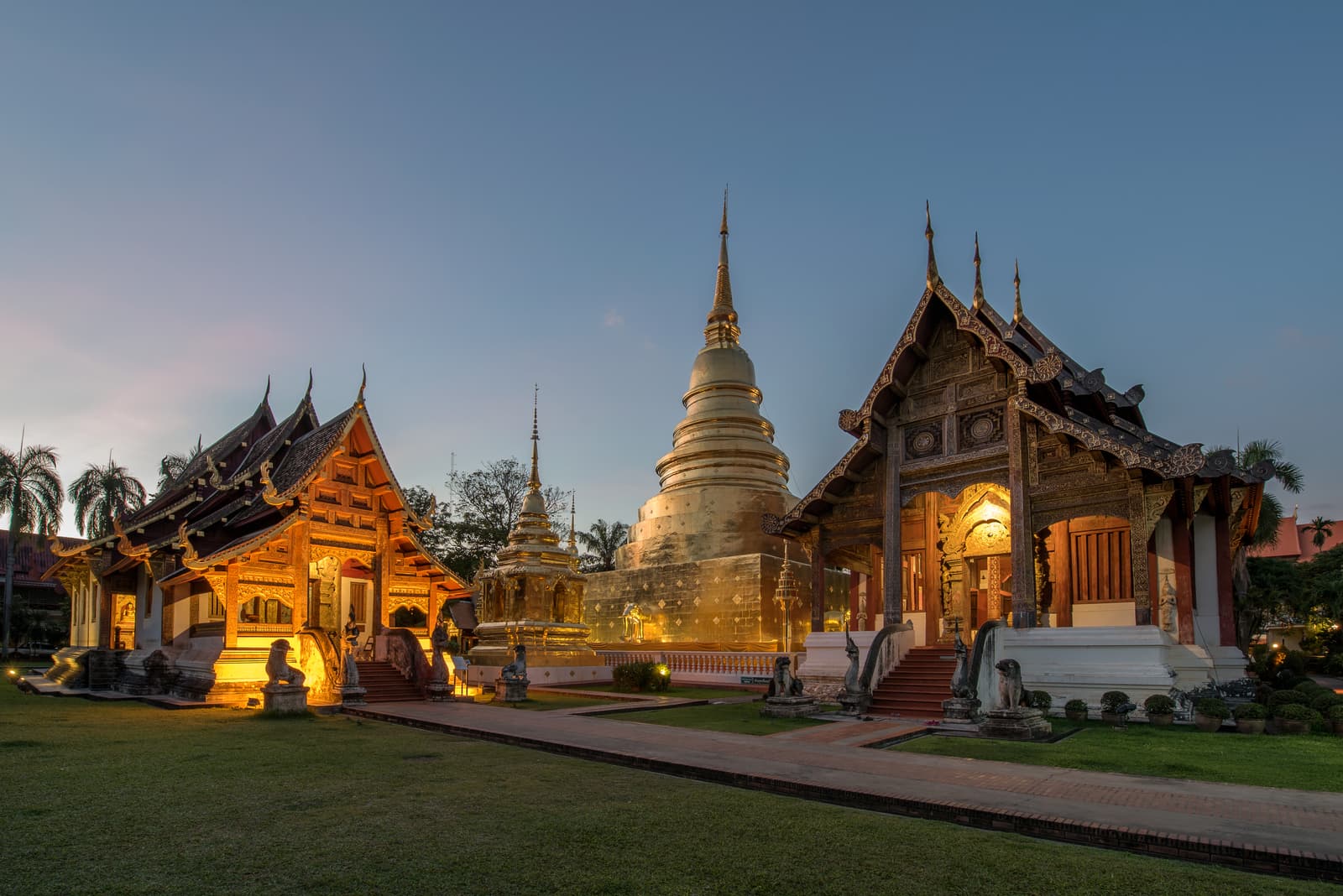
Chiang Mai
Thailand
Chiang Mai is northern Thailand's cultural capital — a laid-back city ringed by mountains and packed with over 300 Buddhist temples. The Old City's moat-enclosed streets, legendary night markets, and world-class cooking schools make it a favorite for long-stay travelers. The gateway to hill tribe treks and elephant sanctuaries.

Krabi
Thailand
Southern Thailand's Andaman coast is limestone-karst country — Railay's boat-only beach cliffs, Phra Nang Cave, Ao Nang's mainland base, and ferries to Phi Phi and Koh Lanta. The Tiger Cave Temple's 1,260-step climb rewards with the panorama. Rock climbing mecca, kayaking through mangroves at Ao Thalane, and roughly half the price of Phuket.

Pai
Thailand
Northern Thailand's backpacker mountain town, 762 curves from Chiang Mai (bring motion-sickness pills). Dawn hot-air balloons over karst ridges, the Pai Canyon, Mo Paeng Waterfall, Shan Chinese villages, and fire shows at the walking-street market. Cool year-round, but the burning season February to April turns the air hazardous — plan around it.

Chiang Rai
Thailand
Thailand's northernmost city is defined by its temples — the White Temple (Wat Rong Khun), an all-white private temple covered in mirror glass and under continuous construction since 1997, is unlike anything else in the Buddhist world; the Black House (Baandam Museum) is its dark counterpart. The Golden Triangle — where Thailand, Myanmar, and Laos meet at the Mekong and Ruak confluence — is 65 km north. Doi Mae Salong, a misty tea-growing mountain village founded by KMT Chinese Nationalist soldiers after 1949, is one of the most surprising detours in all of Southeast Asia.

Koh Samui
Thailand
Thailand's second-largest island after Phuket (228 km²), in the Gulf of Thailand off the eastern coast — circled by a single 50-kilometre ring road that takes about 90 minutes to drive in full and connects every major beach. There were no roads on Samui at all until 1970, and the Bangkok Airways-built Samui Airport (USM, 1989) transformed the island in a single generation. The 12-metre golden Big Buddha (Wat Phra Yai) on the connected islet of Koh Faan has greeted arriving flights since 1972 and remains the most visible landmark. Chaweng Beach is the longest and liveliest stretch on the east coast; Lamai is the second beach, calmer; Bophut's Fisherman's Village preserves Chinese-Thai shophouses. The Full Moon Party rave is on neighbouring Koh Phangan (20 minutes by ferry); Koh Tao for diving sits two hours further north. Crucially, Samui's weather is opposite to Phuket's — wet October through December (when Phuket is dry), dry January through September.

Railay
Thailand
Technically a peninsula on mainland Thailand (Krabi Province) but the towering limestone karst cliffs cut it off from road access — the only way in is by longtail boat (10–15 minutes from Ao Nang, 45 minutes from Krabi Town). No cars, no scooters, no traffic, and a small-island feel that makes Railay Thailand's most beach-paradise mainland destination. It is one of the world's most legendary rock-climbing destinations, with over 700 bolted routes split between Railay East, Tonsai, and Phra Nang Beach across grades from 5a to 8c. Phra Nang Cave at the southern tip contains a 'Princess Cave' shrine where local fishermen leave wooden phallus offerings (lingam) to the spirit of a princess believed to bestow fertility. The four beaches sit within 15 minutes' walk of each other but feel dramatically different — Railay West for postcard sunsets, Railay East as the climbing-and-mangrove backside, Phra Nang Beach (the most beautiful), and Tonsai (rougher, backpacker climbing zone). Closest airport: Krabi (KBV), 25 minutes by car to Ao Nang.

Phi Phi Islands
Thailand
A six-island archipelago in the Andaman Sea between Phuket and Krabi — protected within the Hat Noppharat Thara–Mu Ko Phi Phi National Park, with Permian-era limestone karst cliffs ringing turquoise water. Phi Phi Don is the only inhabited island; Phi Phi Leh holds Maya Bay (the famous beach from "The Beach" 2000), which closed entirely from 2018 to 2022 for coral recovery and reopened with strict daily caps (4,375 visitors/day, 60-minute slots, no swimming inside the bay), closing annually August 1–September 30 for further recovery. The classic Phi Phi day combines Maya Bay, Pileh Lagoon, Bamboo Island snorkelling, and the Phi Phi Viewpoint hike for the iconic double-bay photograph. No roads, no cars, no airport — everything is by boat from the wooden Tonsai Pier.

Pattaya
Thailand
Thailand's Gulf-coast resort city, 150 km southeast of Bangkok and 90 minutes by minivan from Ekkamai bus terminal. Pattaya is unapologetically commercial — the 4 km arc of Pattaya Beach faces the Walking Street nightlife strip while quieter Jomtien Beach stretches south for families and weekenders. Beyond the bars sit the half-finished 105-metre all-wood Sanctuary of Truth, the Nong Nooch Tropical Garden with its Thai dance and elephant show, Coral Island day trips from Bali Hai Pier, the Khao Phra Tamnak hilltop viewpoint, Cartoon Network water park, and more than 25 golf courses within an hour. U-Tapao (UTP) airport sits 30 minutes south, but most travellers still arrive via Bangkok BKK or DMK.

Koh Phi Phi
Thailand
Koh Phi Phi is six islands in the Andaman Sea between Phuket and Krabi, the most famous of which are Phi Phi Don, the inhabited backpacker hub with no roads and a maze of pedestrian sois, and Phi Phi Leh, the uninhabited limestone fortress whose Maya Bay starred in The Beach. Maya Bay reopened in 2022 with daily caps, mooring bans, and a strict no-swimming-on-the-bay-side rule that lets the coral recover. Ferries take 90 minutes from Phuket or Krabi. Days revolve around longtail island-hopping and snorkel stops; nights revolve around fire-show beach bars on Loh Dalum Bay and the cheapest bucket cocktails in Thailand.

Ayutthaya
Thailand
Ayutthaya is the brick-and-laterite ghost of the second Siamese capital, sacked by the Burmese in 1767 and never rebuilt. The historical park, a UNESCO site since 1991, sits on an island wrapped by three rivers 80 kilometres north of Bangkok, and the three signature ruins — Wat Mahathat with the Buddha head wrapped in fig roots, riverside Wat Chaiwatthanaram glowing at sunset, and royal Wat Phra Si Sanphet — are all rentable-bicycle distance from each other. Trains from Bangkok’s Hua Lamphong take 90 minutes and cost 20 baht in third class. The night market at Bang Ian draws the food crowd; the Khlong Sa Bua boat noodle stalls draw the regulars.

Hua Hin
Thailand
Hua Hin is the original Thai royal beach town, picked by King Rama VII for the Klai Kangwon summer palace in 1926 and treated ever since as Bangkok’s long-weekend coast. It sits 200 kilometres south of the capital on the Gulf of Thailand, a 3-hour drive or train ride that ends at a teakwood station with red and yellow gables. The five-kilometre town beach runs south to a clifftop temple at Khao Takiab, and the Cicada and Tamarind night markets on weekends draw the crowd that flies in for golf. Phraya Nakhon Cave, an hour south, hides the Kuha Karuhas pavilion built for King Rama V in 1890. Thailand’s golf capital, eight courses inside city limits.