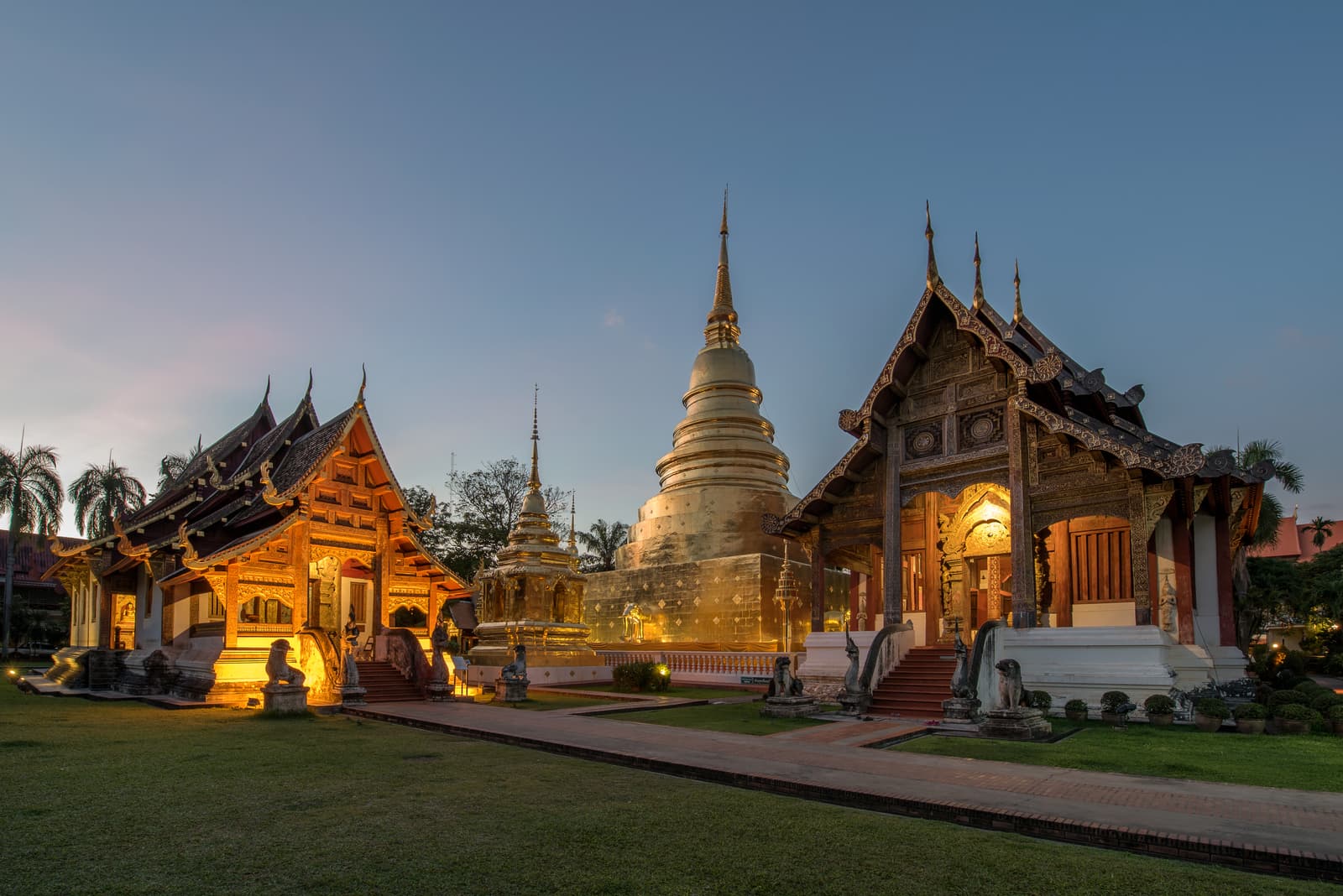
Chiang Mai
THE QUICK VERDICT
By Anthony · Updated June 2026
Choose Chiang Mai if you want northern Thailand's temple city — Doi Suthep sunsets, Sunday Walking Street, ethical elephant sanctuaries, and Songkran soaked to the bone.
- Best for
- khao soi at Khao Soi Khun Yai, Wat Phra Singh, Doi Inthanon trekking, Sunday Walking Street crafts
- Best window
- Nov–Feb
- Budget anchor
- $80/day mid-range
- Worth a look
- a month-long stay in a furnished condo runs under $700 including utilities
Chiang Mai is northern Thailand's cultural capital — a laid-back city ringed by mountains and packed with over 300 Buddhist temples. The Old City's moat-enclosed streets, legendary night markets, and world-class cooking schools make it a favorite for long-stay travelers. The gateway to hill tribe treks and elephant sanctuaries.
The two links below are affiliate links — MapSorted earns a small commission if you book through them, at no extra cost to you. How this works.
Tours & Experiences
Bookable tours, activities, and day trips in Chiang Mai
Where to Stay
Compare hotels and rentals in Chiang Mai
📍 Points of Interest
Doi Suthep Temple
Golden mountaintop temple with panoramic city views
Wat Chedi Luang
Massive 14th-century temple with evening monk chats
Wat Phra Singh
Revered temple with exquisite Lanna architecture
Sunday Walking Street
Sprawling night market with crafts and street food
Elephant Nature Park· 48 km NW
Ethical elephant rescue sanctuary
Chiang Mai Night Bazaar
Nightly market with handicrafts and souvenirs
Doi Inthanon National Park· 57 km W
Thailand's highest peak with cloud forests and waterfalls
★ Local Picks
Wat Umong
Forest temple with ancient tunnels and meditation paths
Warorot Market
Chiang Mai's oldest market with authentic local food stalls
Baan Kang Wat
Artist village with galleries and organic cafe
At a Glance
- Pop.
- 131K (city), 1M (metro)
- Timezone
- Bangkok
- Dial
- +66
- Emergency
- 191 / 1669
Chiang Mai was the capital of the Lanna Kingdom for over 700 years before becoming part of Siam in 1899
The Old City is surrounded by a moat and the remains of a 13th-century wall with five historic gates
There are over 300 Buddhist temples (wats) within the city and surrounding area
Chiang Mai is known as the "Rose of the North" for its beauty and cooler mountain climate
The city sits at around 300 meters elevation in a valley surrounded by Thailand's highest mountains
Chiang Mai has become one of the world's top digital nomad hubs, with hundreds of coworking spaces and cafes
Top Sights
Doi Suthep Temple (Wat Phra That Doi Suthep)
🏯A glistening golden temple perched on a mountain overlooking the city, reached by climbing 309 steps flanked by naga serpent balustrades. The panoramic views of Chiang Mai from the terrace are spectacular.
Chiang Mai Old City
🏘️A roughly square-shaped historic center enclosed by ancient walls and a moat, packed with temples, guesthouses, and street food vendors. Walking or cycling is the best way to explore.
Wat Chedi Luang
🏯A massive 14th-century temple with a partially ruined chedi that once stood 82 meters tall. The evening monk chats offer a rare chance to discuss Buddhism with resident monks.
Sunday Walking Street Market
🏪Ratchadamnoen Road transforms every Sunday evening into a sprawling night market stretching over a kilometer, with local crafts, street food, live music, and traditional dance performances.
Doi Inthanon National Park
🌿Thailand's highest peak at 2,565 meters, featuring twin royal pagodas, stunning cloud forests, dramatic waterfalls, and Hmong hill tribe villages. A must-do day trip from the city.
Elephant Nature Park
📌An ethical elephant rescue and rehabilitation sanctuary where visitors observe elephants in a natural setting rather than riding them. Advance booking is essential.
Wat Phra Singh
🏯One of the most revered temples in Chiang Mai, home to the Phra Singh Buddha image and featuring exquisite Lanna-style architecture with gilded woodwork and murals.
Chiang Mai Night Bazaar
🏪A nightly market along Chang Klan Road offering handicrafts, clothing, art, and food stalls. Several permanent buildings and side streets branch off the main drag.
Climate & Best Time to Go
Chiang Mai has a tropical savanna climate with three distinct seasons: hot, rainy, and cool. The city sits in a valley which traps heat and, unfortunately, smoke during the burning season (February-April).
Cool Season
November - February59-86°F
15-30°C
The most pleasant time to visit with comfortable daytime temperatures and cool evenings. Mountain areas can drop to 10°C at night. Clear skies prevail.
Hot Season
March - May77-104°F
25-40°C
Intensely hot and dry with temperatures regularly exceeding 38°C. The burning season (farmers clearing fields) creates severe air quality issues, particularly in March and April.
Rainy Season
June - October72-91°F
22-33°C
Afternoon thunderstorms are common but rarely last more than a few hours. The countryside turns lush green. September-October sees the heaviest rainfall.
Best Time to Visit
November through February is ideal — cool, dry weather with clear skies and comfortable temperatures. Avoid March-April when severe air pollution from burning season blankets the entire region.
Cool Season (November - February)
Crowds: High — peak tourist season, especially December and JanuaryThe peak travel season with daytime temps around 25-30°C and cool evenings that can dip below 15°C. Clear skies and low humidity make this perfect for temple-hopping and trekking.
Pros
- + Most comfortable temperatures of the year
- + Clear skies for mountain views
- + Loy Krathong and Yi Peng lantern festivals in November
- + Great for outdoor activities and trekking
Cons
- − Highest accommodation prices
- − Popular sites get crowded
- − Cooler mountain areas require a jacket at night
- − Book well ahead for December-January
Hot / Burning Season (March - May)
Crowds: Low — except during Songkran week in AprilTemperatures above 38°C combined with smoke from agricultural burning create hazardous air quality. March and April are the worst months. Songkran (Thai New Year water festival) in mid-April is the exception worth visiting for.
Pros
- + Lowest prices outside Songkran
- + Songkran water festival (April 13-15) is an incredible experience
- + Fewer tourists at attractions
Cons
- − Dangerous air quality — AQI regularly exceeds 200-300
- − Extreme heat makes outdoor activities miserable
- − Many outdoor tours and treks suspend operations
- − Visibility near zero on the worst days
Rainy Season (June - October)
Crowds: Low to moderate — shoulder seasonAfternoon thunderstorms are common but usually brief. The landscape is lush and green, waterfalls are at their most impressive, and tourist numbers drop significantly.
Pros
- + Lush green landscapes
- + Waterfalls at peak flow
- + Significant discounts on accommodation
- + Manageable crowds at all attractions
Cons
- − Daily afternoon rain showers
- − Some trekking trails become muddy or impassable
- − September-October sees the heaviest rainfall
- − Occasional flooding in low-lying areas
🎉 Festivals & Events
Yi Peng Lantern Festival
NovemberThousands of paper lanterns (khom loi) are released into the night sky, creating a breathtaking sea of floating lights. The main event coincides with Loy Krathong and is uniquely celebrated in Chiang Mai.
Songkran (Thai New Year)
AprilThe world's largest water fight. For three days the entire city turns into a water battle zone with hoses, buckets, and water guns. A joyful, chaotic celebration of the Thai New Year.
Flower Festival
FebruaryA three-day celebration of Chiang Mai's floral heritage featuring elaborate flower-decorated floats parading through the city, beauty contests, and garden displays.
Loy Krathong
NovemberDecorated banana-leaf boats (krathong) carrying candles and flowers are floated on the Ping River and moat to honor the water goddess and release misfortune.
Off the Beaten Path
Wat Umong
A forest temple with ancient tunnels containing faded murals, a crumbling stupa, and a peaceful lake surrounded by tall trees. Monks often meditate here away from city noise.
Unlike the heavily visited Old City temples, Wat Umong feels genuinely serene and is where locals go for quiet contemplation.
Jing Jai Market
A Saturday morning organic farmers market where local growers sell seasonal produce, artisan bread, craft coffee, and home-cooked northern Thai food.
Frequented almost exclusively by locals and long-term expats. The food stalls here serve some of the best khao soi and sai oua in the city.
Baan Kang Wat
A small artist village with gallery workshops, a pottery studio, organic cafe, and handmade goods set among traditional wooden houses at the base of Doi Suthep.
A genuine community of working artists rather than a tourist attraction. Weekend mornings are the best time to visit when artists are at work.
Huay Tung Tao Lake
A peaceful reservoir surrounded by mountains where locals rent bamboo huts on the water's edge, order grilled chicken and sticky rice, and spend lazy afternoons.
A beloved local hangout with almost zero tourist presence. The bamboo huts with mountain views cost just 50 baht to rent for the day.
Warorot Market (Kad Luang)
Chiang Mai's oldest and largest traditional market spanning multiple floors of clothing, dried goods, flowers, and a chaotic basement food court with incredible northern Thai dishes.
This is where Chiang Mai residents actually shop. The basement food stalls serve dishes you won't find at any tourist-oriented restaurant.
Safety Breakdown
Moderate
out of 100
Chiang Mai is one of the safest cities in Southeast Asia for travelers. Violent crime against tourists is extremely rare, though petty theft and scams exist. The biggest health concern is air quality during burning season (February-April).
Things to Know
- •Bring an N95 mask if visiting between February and April — air pollution from crop burning can reach hazardous levels
- •Be cautious with motorbike rentals — accidents are the leading cause of tourist injuries. Wear a helmet and check insurance coverage
- •Negotiate tuk-tuk and songthaew prices before getting in. Use Grab (the local Uber equivalent) for transparent pricing
- •Avoid gem and jewelry shops that approach you on the street — many are scams involving counterfeit stones
- •Temple dress code requires covered shoulders and knees — carry a sarong or light scarf for spontaneous temple visits
Natural Hazards
Emergency Numbers
General Emergency
191
Tourist Police
1155
Ambulance
1669
Fire Department
199
Chiang Mai Ram Hospital
053-920-300
Costs & Currency
Where the money goes
USD per dayBackpacker = hostel dorm + street food + public transit. Mid-range = 3-star hotel + neighbourhood restaurants + transit cards. Luxury = 4/5-star + fine dining + taxis. How we calibrate these numbers →
Quick cost estimate
Customize per category →Estimates based on regional averages. Flight prices vary by season and airline.
budget
$25-40
Hostel dorm, street food and local restaurants, songthaews, free temple visits, night markets
mid-range
$60-100
Boutique guesthouse, mix of local and upscale restaurants, Grab rides, organized day trip, cooking class
luxury
$200+
Luxury resort, fine dining, private tours, spa treatments, premium elephant sanctuary experience
Typical Costs
| Item | Local | USD |
|---|---|---|
| AccommodationHostel dorm bed | ฿200-400 | $5.50-11 |
| AccommodationMid-range hotel (double) | ฿800-2,000 | $22-57 |
| AccommodationBoutique resort | ฿3,000-8,000 | $85-228 |
| FoodStreet food dish (pad thai, khao soi) | ฿40-80 | $1.10-2.30 |
| FoodIced coffee at a specialty cafe | ฿60-120 | $1.70-3.40 |
| FoodLocal restaurant meal | ฿80-200 | $2.30-5.70 |
| FoodDinner at upscale restaurant | ฿500-1,500 | $14-43 |
| FoodLarge beer (Chang, Singha) | ฿60-120 | $1.70-3.40 |
| TransportShared songthaew ride | ฿30-50 | $0.85-1.40 |
| TransportGrab across town | ฿60-150 | $1.70-4.20 |
| TransportMotorbike rental (per day) | ฿200-300 | $5.50-8.50 |
| AttractionsDoi Suthep Temple entry | ฿30 | $0.85 |
| AttractionsElephant Nature Park full day | ฿2,500 | $71 |
| AttractionsThai cooking class (half day) | ฿1,000-1,500 | $28-43 |
💡 Money-Saving Tips
- •Eat at local markets and street stalls where a full meal costs ฿40-80 — Warorot Market and the university canteens are the best value
- •Rent a motorbike (฿200-300/day) instead of taking tuk-tuks, which add up quickly
- •Many temples are free to enter — Doi Suthep (฿30) is one of the few that charges foreign visitors
- •Take the shared songthaew instead of private transport — just wave down a red truck and say your destination
- •Buy drinking water in large refill jugs (฿5-10) from vending machines rather than buying bottles from 7-Eleven
- •Book multi-day treks that include accommodation and meals for the best per-day value
- •The Saturday and Sunday walking street markets are free to browse and have the cheapest street food in the city
- •Take advantage of happy hour deals at Nimman-area bars and rooftop restaurants, typically 4-7 PM
Thai Baht
Code: THB
1 USD is approximately 35 THB (as of early 2026). ATMs are widespread but charge a flat ฿220 (~$6) foreign card fee per withdrawal. SuperRich exchange offices in the city offer the best rates. Avoid airport exchange counters.
Payment Methods
Cash is still king at markets, street food stalls, songthaews, and small local shops. Major restaurants, hotels, and chain stores accept Visa and Mastercard. QR code payments via Thai banking apps are increasingly common. Contactless payments are limited to malls and modern establishments.
Tipping Guide
Not expected at local restaurants but appreciated at upscale places. 10% is generous. Many restaurants add a 10% service charge already.
No tip expected. Dropping coins in a tip jar at cafes is a nice gesture.
฿50-100 (~$1.40-2.80) per session is customary. Higher for exceptional service at upscale spas.
฿200-500 (~$5.50-14) per day for a private guide is standard. Group tour guides appreciate ฿100-200 per person.
฿20-50 per bag for porters. Housekeeping tips of ฿20-50 per day are appreciated at upscale hotels.
How to Get There
✈️ Airports
Chiang Mai International Airport(CNX)
3 km southwest of Old CityGrab or taxi to Old City takes 10-15 minutes (฿100-150 / ~$3-4). Some hotels offer free pickup. Airport taxi counter charges a flat ฿150 to the city center.
✈️ Search flights to CNX🚆 Rail Stations
Chiang Mai Railway Station
2.5 km east of Old CityTerminus of the Northern Line from Bangkok. The overnight sleeper train (12-14 hours) is a classic Thai travel experience. Second-class sleeper berths are comfortable and affordable.
🚌 Bus Terminals
Arcade Bus Station (Chang Phueak)
Main long-distance terminal with buses to Bangkok (10-11h, ฿500-900 / ~$14-25), Chiang Rai (3.5h, ฿150-300 / ~$4-8), Pai (3-4h, ฿150-250 / ~$4-7), and Mae Hong Son (5-6h, ฿250-400 / ~$7-11). VIP buses with reclining seats recommended for long routes.
Chang Phueak Bus Station
Smaller terminal north of the Old City handling some local and regional routes, including services to Pai and nearby towns.
Getting Around
Chiang Mai lacks a metro or rail system, so getting around relies on songthaews (red shared trucks), tuk-tuks, Grab ride-hailing, and rented scooters. The Old City is compact enough to walk or cycle. The city is currently building a light rail system planned for future years.
Red Songthaew (Rot Daeng)
฿30-50 (~$0.85-1.40) per person for shared rides within the city; ฿150-200 for private charterConverted red pickup trucks that function as shared taxis. Wave one down, tell the driver your destination, and negotiate a fare. They run fixed routes but will detour for a higher price.
Best for: Short hops around the Old City and Nimmanhaemin area, especially when shared
Grab
฿60-150 (~$1.70-4.20) for most trips within the citySoutheast Asia's equivalent of Uber. Set your destination in the app for transparent, metered pricing with no negotiation required.
Best for: Fair pricing without haggling, airport transfers, and late-night rides
Motorbike / Scooter Rental
฿200-300 (~$5.50-8.50) per dayHonda Click 125cc scooters are ubiquitous for rent. An international driving permit is technically required. Always wear a helmet and check brakes before riding.
Best for: Day trips to Doi Suthep, Doi Inthanon, and exploring outside the city center
Tuk-Tuk
฿60-150 (~$1.70-4.20) for trips within the cityThree-wheeled motorized vehicles. More expensive than songthaews and prices must be negotiated. Drivers often overcharge tourists.
Best for: Short scenic rides, though songthaews and Grab are better value
Bicycle Rental
฿50-100 (~$1.40-2.80) per dayNumerous shops rent basic bikes for exploring the flat Old City. Some guesthouses include free bikes for guests.
Best for: Exploring the Old City temples at your own pace on a flat terrain
Walkability
The Old City is very walkable — roughly 1.5 km on each side — and most major temples are within easy walking distance of each other. The Nimmanhaemin area is also pedestrian-friendly. Beyond these areas, distances grow and motorized transport is needed.
Travel Connections

Pai
A laid-back mountain town in a lush valley popular with backpackers and Thai weekenders. Hot springs, waterfalls, and a famously scenic (but winding) drive to get there.

Chiang Rai
Gateway to the Golden Triangle where Thailand, Laos, and Myanmar meet. Home to the striking White Temple (Wat Rong Khun) and the newer Blue Temple.

Doi Inthanon
Thailand's highest peak with twin chedis, cloud forest trails, and dramatic waterfalls. Best visited as a full-day trip starting early morning.

Lampang
A charming, less-touristed city with horse-drawn carriages, the beautiful Wat Phra That Lampang Luang, and the Thai Elephant Conservation Center.

Mae Hong Son
A remote, misty mountain town near the Myanmar border with a heavy Shan and Karen cultural influence, surrounded by forested mountains and caves.

Bangkok
Thailand's capital with world-class street food, magnificent temples, the Grand Palace, and legendary nightlife. Frequent flights from Chiang Mai International Airport, or take the romantic overnight sleeper train.
Entry Requirements
Thailand offers visa-free entry or visas on arrival for many nationalities. Most Western travelers receive a 30-60 day visa exemption on arrival. Longer stays require a tourist visa obtained in advance from a Thai embassy.
Entry Requirements by Nationality
| Nationality | Visa Required | Max Stay | Notes |
|---|---|---|---|
| US Citizens | Visa-free | 60 days | Passport must be valid for at least 6 months. Can extend once at immigration for 30 additional days (฿1,900 fee). |
| UK Citizens | Visa-free | 60 days | Same visa exemption as US citizens. 30-day extension available at any immigration office. |
| Canadian Citizens | Visa-free | 60 days | Visa exemption with possible 30-day extension. Youth Mobility programs may offer longer stays. |
| Australian Citizens | Visa-free | 60 days | Visa exemption on arrival. Work and Holiday visa available for ages 18-30. |
| Indian Citizens | Yes | 15 days (VOA) or 60 days (e-visa) | Visa on arrival available for ฿2,000 (~$57) with proof of accommodation and return flight. E-visa recommended for longer stays. |
| Chinese Citizens | Yes | 15 days (VOA) or 60 days (visa) | Visa on arrival for ฿2,000. Permanent visa exemption agreements are periodically extended — check current status before travel. |
Visa-Free Entry
Visa on Arrival
Tips
- •The 60-day visa exemption can be extended once for 30 more days at any immigration office for ฿1,900 (~$54)
- •You must have proof of onward travel (flight ticket) and may be asked to show it at immigration
- •Overstaying your visa results in a ฿500/day fine (max ฿20,000) and potential blacklisting for serious overstays
- •Digital Nomad (DTV) visas are available for remote workers, valid for 180 days with a possible extension
- •Land border crossings from Laos or Myanmar may have different entry allowances than air arrivals — verify before crossing
Shopping
Chiang Mai is northern Thailand's handicraft capital, renowned for handwoven textiles, silverwork, wood carvings, and hill tribe crafts. The night markets are legendary, but the best finds are often in smaller artisan villages outside the city.
Sunday Walking Street (Ratchadamnoen Road)
night marketThe city's premier market stretching through the Old City every Sunday evening with hundreds of stalls selling handmade crafts, artwork, clothing, and street food.
Known for: Local artisan crafts, hand-painted umbrellas, Lanna-style textiles, and live music
Saturday Walking Street (Wua Lai Road)
night marketA slightly smaller and less crowded alternative to the Sunday market, running along the silver-working district south of the Old City.
Known for: Silverware, lacquerware, handmade paper products, and local street food
Nimmanhaemin (Nimman)
boutique & designA trendy neighborhood of sois (side streets) lined with independent boutiques, concept stores, design studios, and some of the best cafes in Thailand.
Known for: Contemporary Thai design, specialty coffee, independent fashion, One Nimman mall
Bor Sang Umbrella Village
artisan villageA traditional craft village 9 km east of the city where families hand-paint parasols, fans, and lanterns using techniques passed down for generations.
Known for: Hand-painted saa paper umbrellas, fans, and custom artwork painted on anything you bring
🎁 Unique Souvenirs to Look For
- •Hand-painted saa (mulberry bark) paper umbrellas from Bor Sang village
- •Celadon pottery with its distinctive crackled jade-green glaze
- •Hill tribe textiles and embroidery — especially Hmong and Karen styles
- •Thai silk scarves and fabrics
- •Handmade silver jewelry from the Wua Lai silversmith district
- •Northern Thai spice sets and curry pastes from Warorot Market
- •Carved teak wood items from the Ban Tawai wood carving village
- •Local single-origin coffee beans from the Doi Chaang or Doi Tung highlands
Language & Phrases
Thai is a tonal language with five tones, making pronunciation challenging. Northern Thai (Kam Muang) is a distinct dialect but Central Thai is understood everywhere. Adding "khrap" (male) or "kha" (female) to sentences is polite.
| English | Translation | Pronunciation |
|---|---|---|
| Hello | Sawasdee khrap/kha | sah-wah-DEE krahp/kah |
| Thank you | Khop khun khrap/kha | kohp KOON krahp/kah |
| Yes / No | Chai / Mai chai | chai / mai chai |
| How much? | Thao rai? | tao RAI? |
| Too expensive | Phaeng pai | paeng bpai |
| Delicious | Aroy mak | ah-ROY mahk |
| Where is...? | Yoo tee nai...? | yoo tee NAI...? |
| No spicy | Mai phet | mai PET |
| The check, please | Check bin duay | check bin DOO-ay |
| Sorry / Excuse me | Kho thot | kor TOHT |
| I don't understand | Mai khao jai | mai KOW jai |
| No bag (eco-friendly) | Mai sai thung | mai sai TOONG |
If you like Chiang Mai, you'll love…
4 cities with a similar vibe, outside of the same country.

Vietnam · OVR 76
world-class dining · museum-dense old core

Italy · OVR 75
world-class dining · workable for remote days

Georgia · OVR 76
legendary food scene · stretches your budget

Albania · OVR 73
workable for remote days · genuinely affordable