
Tirana
THE QUICK VERDICT
By Anthony · Updated April 2026
Choose Tirana if you want Europe's wildest up-and-coming capital — psychedelic painted communist blocks, Bunk'Art nuclear bunker museums, Blloku hip bars, and Albania's absurdly cheap prices.
- Best for
- painted communist-block facades, Bunk'Art bunker museums, Blloku hip bars, Dajti cable car
- Two seasons
- Apr–Jun and Sep–Oct
- Budget anchor
- $65/day mid-range
- Real bargain
- Bottom 10% on daily spend ($65/day mid-range)
- Worth a look
- mid-range stays under $65 — among the cheapest European capitals you can still fly to direct
Albania's capital spent 45 years as Europe's most isolated country (1944–1992); today Tirana is one of the continent's most energetic up-and-coming cities. Former mayor Edi Rama — now Prime Minister — painted communist-era grey apartment blocks in psychedelic colors, transforming the city's identity. Bunk'Art 1 and 2 repurpose Hoxha's nuclear bunkers (there were 750,000 — one per four Albanians) as extraordinary art museums. Blloku, once the exclusive communist party quarter, is now packed with cafes and bars. Ridiculously affordable.
The two links below are affiliate links — MapSorted earns a small commission if you book through them, at no extra cost to you. How this works.
Tours & Experiences
Bookable tours, activities, and day trips in Tirana
Where to Stay
Compare hotels and rentals in Tirana
📍 Points of Interest
Bunk'Art 1
The 5-story nuclear bunker built for the communist party elite, now a museum exploring Albanian history under Enver Hoxha's dictatorship through personal stories and original artifacts.
Bunk'Art 2
The second bunker museum focusing on the Interior Ministry and Sigurimi secret police. Located beneath Skanderbeg Square — chilling and essential.
Skanderbeg Square
The vast central square of Tirana with the equestrian statue of Albania's national hero, surrounded by the National History Museum's famous mosaic facade, Et'hem Bey Mosque, and the Clock Tower.
Blloku Neighborhood
The former communist party exclusive quarter — once off-limits to ordinary Albanians — now transformed into Tirana's hippest district of boutique cafés, rooftop bars, and designer shops.
Mount Dajti Cable Car
The longest gondola in the Balkans (4.7 km) rises to 1,612 m with panoramic views over Tirana and the Adriatic. Hiking trails and a restaurant await at the top.
Et'hem Bey Mosque
An 18th-century Ottoman mosque with extraordinary painted frescoes of trees and waterfalls on its exterior — unusual in Islamic architecture — that survived the communist atheism campaign.
★ Local Picks
Pazari i Ri (New Bazaar)
Tirana's renovated covered market — the best place to eat like a local, with fresh produce, artisan food, traditional byrek pastries, and Albanian wine and raki stalls.
House of Leaves
The former Sigurimi surveillance headquarters, now a museum exploring communist-era wiretapping and secret police operations — chilling, deeply moving, and still largely undiscovered by mass tourism.
At a Glance
- Pop.
- 800K
- Timezone
- Tirane
Communist dictator Enver Hoxha built 750,000 concrete bunkers across Albania — one for every four citizens — between 1967 and 1986; many still dot the landscape today
When Edi Rama became mayor of Tirana in 2000, he ordered the city's grim Soviet-era concrete blocks painted in bold, psychedelic colors — an act that helped earn him the nickname "the artist mayor" and later the prime ministership
Albanian (Shqip) is a language isolate in the Indo-European family — it has no close relatives and its origins are debated; it split from other European languages at least 2,000 years ago
Albania was the world's first officially declared atheist state in 1967, when Hoxha banned all religion and converted churches and mosques into storage facilities or cultural centers
The national hero Gjergj Kastrioti (Skanderbeg) held off the Ottoman Empire for 25 years in the 15th century; his double-headed eagle emblem became the Albanian national symbol and one of only two flags in the world with no colors other than red and black
Tirana is one of the few European capitals with no navigable river, no coastline, no UNESCO World Heritage Site — yet it has become one of Europe's fastest-growing tourism destinations in the 2020s
Top Sights
Bunk'Art 1 & 2
🏛️Two of Europe's most extraordinary museums. Bunk'Art 1 is inside the massive 5-story communist-era nuclear bunker built for Enver Hoxha and the party leadership — a labyrinthine underground complex exploring life under the dictatorship through harrowing personal stories. Bunk'Art 2, in a smaller bunker near Skanderbeg Square, focuses on the history of the Interior Ministry and secret police. Both are essential for understanding Albania's 20th century.
Skanderbeg Square
🗼The vast central square of Tirana, dominated by the equestrian statue of national hero Gjergj Kastrioti Skanderbeg. Surrounded by the National History Museum (with its iconic socialist-realist mosaic facade depicting Albanian history), the National Opera and Ballet Theatre, Et'hem Bey Mosque, and the Clock Tower. The best place to begin exploring the city and absorb its eclectic architectural mix.
Blloku Neighborhood
📌During communism, this leafy residential quarter was the exclusive preserve of the party elite and was off-limits to ordinary Albanians. Today, post-1991, it has transformed completely into Tirana's hippest district — packed with boutique cafés, rooftop bars, restaurants, and designer shops. A fascinating example of post-communist reinvention. Enver Hoxha's former villa is still here and can be viewed from outside.
National History Museum (Muzeu Historik Kombëtar)
🏛️Albania's largest museum, covering the full sweep of Albanian history from Illyrian times through the communist era and independence. The exterior is dominated by an enormous socialist-realist mosaic depicting Albanian partisans triumphant — one of the most striking pieces of public art in the Balkans. The museum interior has been significantly improved in recent years.
Et'hem Bey Mosque
🗼An 18th-century Ottoman mosque that survived the communist era's atheism campaign (it was closed but not destroyed) and was reopened in 1991 in a symbolic act of religious freedom. Distinguished by its delicate painted frescoes of trees, waterfalls, and bridges on the exterior — unusual in Islamic architecture. One of the most beautiful small buildings in Tirana.
Mount Dajti Cable Car
🌿A 4.7 km gondola ride (the longest in the Balkans) that rises from the edge of the city to Mount Dajti at 1,612 m. The 25-minute ascent offers sweeping views over Tirana's colorful rooftops and the Adriatic coast on clear days. At the top, a national park with hiking trails, a restaurant, and significantly cooler temperatures. The mountain is a beloved escape for locals on summer weekends.
Painted Buildings of Tirana
📌Walking around the city reveals the legacy of artist-mayor Edi Rama's urban transformation project: formerly grey communist concrete apartment blocks painted in bold geometric patterns and vivid colors — hot pink, electric blue, acid yellow. A powerful example of art as civic renewal. The most concentrated examples are along Rruga Kavajës and near the Grand Park.
Costs & Currency
Where the money goes
USD per dayBackpacker = hostel dorm + street food + public transit. Mid-range = 3-star hotel + neighbourhood restaurants + transit cards. Luxury = 4/5-star + fine dining + taxis. How we calibrate these numbers →
Quick cost estimate
Customize per category →Estimates based on regional averages. Flight prices vary by season and airline.
budget
$22-38
Hostel dorm (€10–15), local byrek and market food, free sights (Skanderbeg Square, Blloku walk, Grand Park), Bolt for transport. Tirana is one of Europe's cheapest capitals.
mid-range
$50-80
Comfortable guesthouse or 3-star hotel (€35–55/night), two restaurant meals per day, Bunk'Art entry, Mount Dajti cable car, Bolt taxis.
luxury
$110+
Boutique hotel like Rogner or Vila e Buallit (€90–140/night), fine dining, private guided excursion to Berat, spa treatments.
Typical Costs
| Item | Local | USD |
|---|---|---|
| FoodEspresso (macchiato) | 80–120 ALL | $0.75–1.10 |
| FoodByrek (pastry) from bakery | 100–150 ALL | $0.93–1.40 |
| FoodLunch at local restaurant | 500–900 ALL | $4.70–8.40 |
| FoodDinner at mid-range restaurant | 1200–2000 ALL | $11.20–18.70 |
| FoodLocal beer (500ml) | 200–350 ALL | $1.87–3.27 |
| FoodGlass of raki | 100–200 ALL | $0.93–1.87 |
| AccommodationHostel dorm bed | 1,100–1,600 ALL/night | $10–15/night |
| AccommodationMid-range hotel (double) | 3,700–5,900 ALL/night | $35–55/night |
| AttractionsBunk'Art 1 entry | 500 ALL | $4.67 |
| AttractionsBunk'Art 2 entry | 300 ALL | $2.80 |
| AttractionsMount Dajti cable car (return) | 1,200 ALL | $11.21 |
| TransportCity bus single | 40 ALL | $0.37 |
| TransportBolt city trip | 150–500 ALL | $1.40–4.67 |
| TransportFurgon to Durrës | 200–300 ALL | $1.87–2.80 |
💡 Money-Saving Tips
- •Coffee culture is vibrant and cheap — an espresso macchiato costs under $1; Albanians drink many of them daily
- •Byrek from bakeries is the ultimate budget meal — flaky pastry with cheese, spinach, or meat for under $1.50
- •Furgons (shared minibuses) are dramatically cheaper than taxis for inter-city travel
- •Grand Park, Skanderbeg Square, the painted buildings, and Blloku are all free to explore
- •Lunch menus at local restaurants (not touristy spots near Skanderbeg Square) cost $4–8 with a full meal
- •The Pazari i Ri food market is far cheaper than restaurants for fresh produce and local snacks
Albanian Lek
Code: ALL
1 USD ≈ 107 ALL (2025). Euros are widely accepted in tourist areas, hotels, and larger restaurants — often at a reasonable rate. Change is usually given in Lek. ATMs dispensing Lek are plentiful in the city center. Exchange money at banks or official exchange bureaus (not street changers). Cards are accepted at most restaurants and hotels, but many small cafés and furgons are cash-only.
Payment Methods
Mix of cash and card. Cards (Visa/Mastercard) accepted at hotels, upscale restaurants, and larger shops. Small cafés, furgons, market stalls, and street food are cash-only. Carry a mix of Lek and small Euro notes.
Tipping Guide
Tipping is appreciated and becoming more common with the growth of tourism. 10% is generous; rounding up the bill to a round number is the local norm.
Leave small change or round up. Not expected but warmly received.
Not expected for Bolt trips. For pre-arranged taxis, round up the fare.
€5–10 per person for a half-day tour is appropriate and greatly appreciated.
200–500 ALL for porters; similar for housekeeping if staying multiple nights.
Climate & Best Time to Go
Tirana has a humid subtropical climate with hot, dry summers and mild, wet winters. Spring (April–May) and autumn (September–October) offer the most pleasant conditions for sightseeing. Summers are very hot and dry; winters are rainy but rarely cold enough for snow in the city (though mountains nearby get snow).
Spring
March–May54–72°F
12–22°C
Excellent time to visit. Temperatures are comfortable, the city's parks are lush and green, and there are few tourists. April and May are particularly lovely.
Summer
June–August77–95°F
25–35°C
Very hot and dry. Many Albanians head to the coast at Durrës or the Albanian Riviera. The city itself is less crowded in August. Mornings and evenings are pleasant; afternoons are fierce.
Autumn
September–November54–75°F
12–24°C
September is often the best month — summer heat fades, the city comes back to life, and the light is beautiful. October is lovely too. November becomes rainier and cooler.
Winter
December–February39–54°F
4–12°C
Mild by European standards but rainy. Snow in the city is rare (once every few years). Mount Dajti gets snow from November, visible from the city. The lowest tourist season with good prices.
Best Time to Visit
April–May and September–October for ideal temperatures and minimal crowds
April–May
Crowds: Low — pleasant and uncrowdedThe best time to visit. Comfortable temperatures, lush parks, low tourist numbers, and all attractions operating. An excellent combination of good weather and low prices.
Pros
- + Comfortable 15–22°C temperatures
- + Green parks and blooming flowers
- + Very few tourists
- + Low accommodation prices
Cons
- − Occasional rain showers
- − Some rooftop bars not yet fully open
June–August
Crowds: Moderate — locals leave, some tourists arriveHot and sunny. Many tourists head to the coast (Durrës, Saranda). Tirana itself is actually quieter in August as locals leave for the sea. Evening and morning are the best times to be outdoors.
Pros
- + Hot beach weather if combining with coast
- + Long evenings
- + Outdoor festivals
Cons
- − 35°C+ afternoon heat
- − Some locals leave the city in August
September–October
Crowds: Low — very comfortableExcellent shoulder season. Summer heat fades by mid-September, the city comes alive again, and the light is beautiful. October has warm days and cool evenings — ideal for walking.
Pros
- + Post-summer golden light
- + Comfortable temperatures
- + Cheaper than summer
- + Festivals and cultural events resume
Cons
- − Rain increases in October
- − Shorter days from late October
November–March
Crowds: Very lowLow season. Rainy and grey, but Tirana's café culture thrives indoors. Very cheap accommodation. A good time for museums like Bunk'Art without any crowds.
Pros
- + Lowest prices
- + No queues at museums
- + Authentic local atmosphere
Cons
- − Frequent rain
- − Grey and cool
- − Some tourist businesses have reduced hours
🎉 Festivals & Events
Tirana International Film Festival (TIFF)
November–DecemberOne of the Balkans' leading film festivals, screening international and Albanian films across city venues. Growing in prestige since its founding in 2003.
Summer Day (Dita e Verës)
March 14An ancient Albanian pagan festival (not the start of meteorological summer) celebrating the renewal of nature. Observed especially in Elbasan, 54 km from Tirana, where ballokume cookies are made and shared.
Tirana Jazz Festival
OctoberInternational jazz musicians perform at venues throughout the city over several days in October. Growing in size and quality each year.
Independence Day
November 28Albania's national day marking the 1912 declaration of independence from the Ottoman Empire. Celebrated with parades, cultural events, and concerts in Skanderbeg Square.
Off the Beaten Path
Pazari i Ri (New Bazaar)
The newly renovated covered market in the heart of old Tirana — a beautiful space with fresh produce vendors, artisan food stalls, traditional byrek (flaky pastry) shops, and wine bars. Far more authentic than anywhere near Skanderbeg Square and beloved by Tirana locals for morning coffee and weekend shopping.
The best place to eat like a local — try byrek me gjizë (cheese pastry), fresh olives, and Albanian raki at one of the small stalls.
House of Leaves (Shtëpia e Gjetheve)
A recently opened museum in the former surveillance headquarters of the Sigurimi (communist secret police). The building monitored the communications of Albanian citizens and foreign diplomats. The museum, opened in 2017, tells the story of surveillance, resistance, and the victims of the regime. Deeply affecting and less crowded than Bunk'Art.
Chilling and essential — one of the most honest explorations of communist surveillance culture in Europe, still largely undiscovered by mass tourism.
Rruga e Elbasanit for Raki
A tree-lined boulevard near Blloku where locals gather at small, old-fashioned bars in the evening to drink raki (Albanian grape or mulberry brandy) and eat mezze. This is the authentic Tirana night out — low-key, cheap, and genuinely convivial. Ask any local to point you to their favorite spot.
Raki culture is fundamental to Albanian hospitality. Sharing a glass with locals on this street is as authentically Albanian as it gets.
Grand Park & Artificial Lake
Tirana's main park, built during the communist era around a large artificial lake. On weekends, the whole city seems to migrate here — families, cyclists, paddleboat riders, and elderly men playing chess. The lakeside promenade at sunset, with the mountains behind and the painted city visible, is genuinely lovely.
The real pulse of Tirana social life — free, peaceful, and a world away from tourist sites.
Safety Breakdown
Moderate
out of 100
Tirana is generally safe for tourists, and Albanians are famously hospitable — the concept of "besa" (sacred hospitality to guests) is deeply ingrained in the culture. Petty theft and scams are less common than in many European capitals. The main concerns are chaotic traffic and occasional petty crime in crowded markets. Violent crime against tourists is very rare.
Things to Know
- •Traffic in Tirana is chaotic — cars, motorbikes, and e-scooters rarely yield to pedestrians; cross streets carefully and make eye contact with drivers
- •Be cautious with unlicensed taxis; use apps like Bolt or ask your hotel to arrange reliable transport
- •Avoid flashing expensive cameras or jewelry in crowded markets; petty theft, though uncommon, does occur
- •Albania has a blood feud (kanun) tradition in northern rural areas; this does not affect tourists in Tirana
- •The electrical grid can be unstable; carry a power bank and adapter (Type C/F sockets)
- •Albanians shake their head for "yes" and nod for "no" — the opposite of most Western cultures; this can cause confusion in shops
Emergency Numbers
Emergency (all services)
112
Police
129
Ambulance
127
Fire
128
How to Get There
✈️ Airports
Tirana International Airport "Mother Teresa"(TIA)
17 km northwest of city centerAirport taxi: 25–35 min, €20–25 (insist on meter or agree on price beforehand). Bolt from outside arrivals: €10–15. Rinas Express bus: 40 min, €3 (runs hourly from city center).
✈️ Search flights to TIA🚆 Rail Stations
Tirana Train Station
Limited rail service — Albania's rail network is minimal and unreliable. A slow train connects Tirana to Shkodër (4 hr) and Durrës (1 hr). Not recommended for practical inter-city travel. Infrastructure investment is ongoing.
🚌 Bus Terminals
Various furgon (minibus) departure points
Albania's intercity transport is dominated by furgons — shared minibuses that depart when full from various points around the city. For Durrës: from beside the train station. For Berat/Gjirokastër/Shkodër: different departure points. No central bus terminal. Ask your hotel for the current departure point for your destination. Cheap and frequent.
Getting Around
Tirana's center is walkable — Skanderbeg Square to Blloku is a 10-minute walk. The city has an expanding bus network but traffic congestion is severe. Bolt rideshare is widely used and very affordable. Cycling is growing in popularity thanks to a bike-share scheme.
Bolt
€1.50–5 for most city tripsBy far the most practical way to get around Tirana beyond walking distance. The app works reliably, prices are very low even by Eastern European standards, and drivers are generally trustworthy. Avoid unlicensed taxis.
Best for: Anywhere beyond a 15-minute walk, airport transfers, late nights
City Buses
40 lekë (≈ €0.40) per tripTirana has an expanding bus network. Tickets are purchased from kiosks or the driver. Routes can be confusing for first-time visitors and buses are often caught in traffic. The new Bus Rapid Transit (BRT) corridors are improving.
Best for: Longer cross-city trips to neighborhoods outside the center
Ecovolis Bike Share
€0.50/30 min or ~€5/dayTirana has a municipal bike-share program with stations in the center and along the Grand Park. The city is flat in the center, making cycling easy in good weather. Traffic can be intimidating.
Best for: Grand Park, riverside paths, flat city center exploration
Walking
FreeThe city center from Skanderbeg Square to Blloku to the Grand Park is very walkable on flat ground. Be extremely cautious at road crossings — Albanian traffic does not reliably stop for pedestrians.
Best for: Skanderbeg Square, Blloku, Pazari i Ri, city center
Walkability
Moderate — the center is flat and compact. The main challenge is chaotic traffic at intersections rather than distance.
Travel Connections
Durrës
Albania's main port city and beach resort, with a Roman amphitheater in the city center, long sandy beaches, and lively summer promenade. Perfect day-trip.
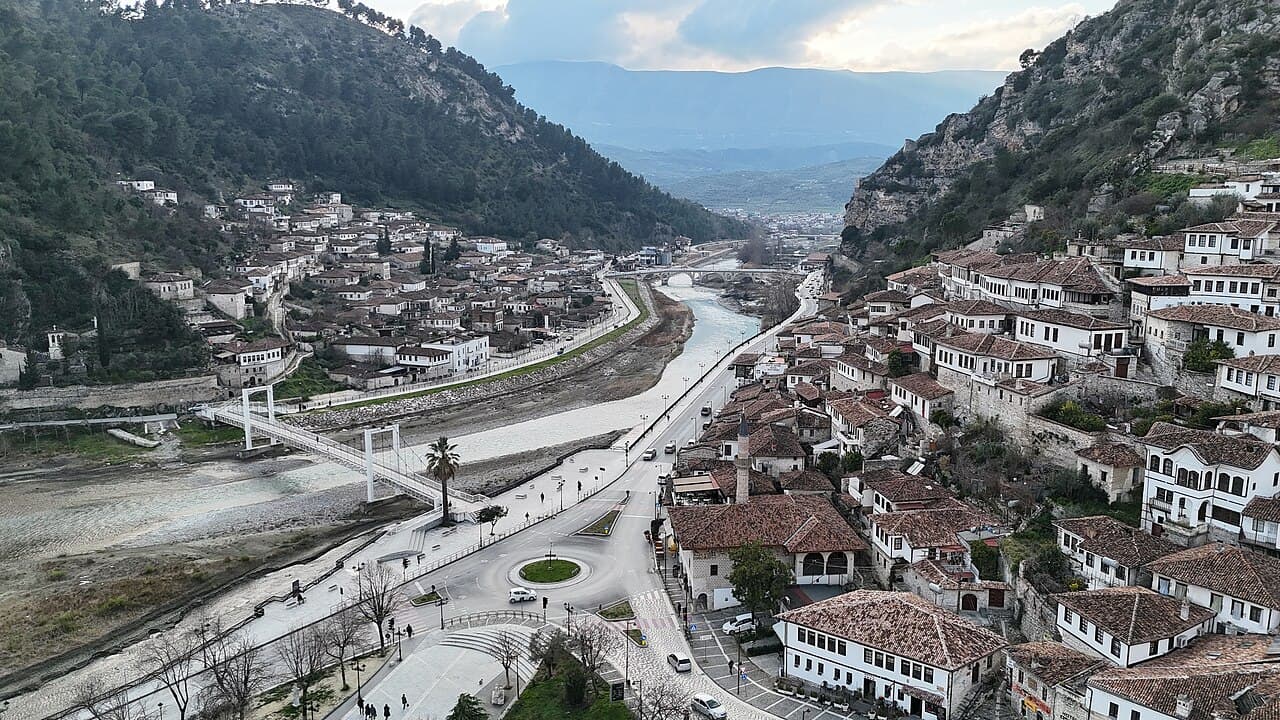
Berat
UNESCO-listed "City of a Thousand Windows" — an extraordinary Ottoman hilltop town with white houses cascading down to a river. One of Albania's most beautiful destinations.
Shkodër
Albania's cultural capital in the north, with Rozafa Castle overlooking Lake Shkodër, a vibrant cycling culture, and the gateway to the Albanian Alps.
Kotor, Montenegro
A stunning walled medieval city on a fjord-like bay — one of the most dramatic settings in the Adriatic. UNESCO-listed old town with Venetian architecture.
Ohrid, North Macedonia
A UNESCO-listed lakeside town with Byzantine churches, a medieval fortress, and the crystal-clear Lake Ohrid — one of Europe's oldest and deepest lakes.
Entry Requirements
Albania is not an EU member but is an EU candidate country. It has a very liberal visa policy and grants visa-free access to a wide range of nationalities. EU/Schengen citizens and most Western nationals can enter freely for up to 90 days.
Entry Requirements by Nationality
| Nationality | Visa Required | Max Stay | Notes |
|---|---|---|---|
| US / Canada / UK / Australia | Visa-free | 90 days | Valid passport required. Albania is not Schengen — time spent here does NOT count toward your Schengen 90-day allowance. |
| EU/EEA Citizens | Visa-free | 90 days (extendable) | National ID card accepted. Long-stay registration available for stays over 90 days. |
| China / India | Yes | Per visa | Visa required in advance from Albanian embassy. E-visa available for some nationalities — check official government portal. |
Visa-Free Entry
Visa on Arrival
Tips
- •Albania is NOT part of Schengen — time spent in Albania does not count toward your EU 90-day allowance, making it a great "reset" for long-term European travelers
- •Border crossings from Montenegro, North Macedonia, Kosovo, and Greece are straightforward for most Western passport holders
- •Keep entry stamps in your passport — border officials sometimes check when you exit
- •Travel insurance is strongly recommended; Albanian medical facilities in Tirana are adequate for minor issues but serious conditions may require evacuation
Shopping
Tirana offers excellent value shopping, particularly for local food products, handmade goods, and traditional crafts. The Pazari i Ri (New Bazaar) is the best single shopping destination. Avoid tourist-trap souvenir shops near Skanderbeg Square.
Pazari i Ri (New Bazaar)
Covered market / artisan food hallThe city's renovated bazaar is the best place for shopping in Tirana — fresh produce, local cheeses, olives, wine, raki, honey, and traditional byrek pastries. The upper level has craft stalls and independent shops.
Known for: Local food products, artisan goods, traditional pastries
Rruga Myslym Shyri
Boutique shopping streetA pedestrian-friendly street in the Blloku area lined with independent boutiques, international fashion brands, and local designer shops. Tirana's answer to a high street.
Known for: Albanian fashion designers, international brands, cafés
Toptani Shopping Center
Modern mallThe city's best-known shopping mall, right next to Skanderbeg Square. International and local brands on four floors, plus a food court. Useful for essentials.
Known for: International brands, electronics, clothing
Antique & Book Market (Rruga Luigj Gurakuqi)
Outdoor antique marketA small but interesting outdoor market near the university where vendors sell old books, communist-era memorabilia, antiques, coins, and curious objects. Best on weekend mornings.
Known for: Communist-era collectibles, old books, antiques
🎁 Unique Souvenirs to Look For
- •Albanian raki (grape or mulberry brandy) — buy from Pazari i Ri, not tourist shops
- •Qeleshe (the traditional white felt Albanian skullcap) — the national symbol of Albanian identity
- •Handwoven Albanian kilims (wool rugs) — sold at craft markets and traditional shops
- •Scanderbeg-themed items (the double-headed eagle emblem) — keyrings, prints, ceramics
- •Albanian olive oil — excellent quality from the Berat region, found at Pazari i Ri
- •Communist-era memorabilia — Hoxha-era postcards, badges, and coins (antique market)
Language & Phrases
Albanian uses the Latin alphabet with some additional letters (ë, ç). It is a unique language isolate in the Indo-European family — not related to Greek, Slavic, or Romance languages. Albanians are extremely touched when foreigners attempt their language. In Tirana, many people under 40 speak English or Italian (Albanian TV heavily broadcasts Italian channels). Young Albanians often speak Italian fluently without formal study.
| English | Translation | Pronunciation |
|---|---|---|
| Hello | Tungjatjeta | toon-jat-YEH-ta |
| Hi (casual) | Ç'kemi | ch-KEH-mee |
| Thank you | Faleminderit | fah-leh-min-DEH-reet |
| Please | Ju lutem | yoo LOO-tem |
| Yes | Po | poh (said with a head shake — opposite to Western nod) |
| No | Jo | yoh (said with a head nod — opposite to Western shake) |
| Excuse me / Sorry | Më falni | muh FAL-nee |
| Where is...? | Ku është...? | koo UHSH-tuh |
| How much is this? | Sa kushton? | sah KOOSH-ton |
| One coffee, please | Një kafe, ju lutem | nyuh kah-FEH yoo LOO-tem |
| Cheers! | Gëzuar! | guh-ZOO-ar |
| Goodbye | Mirupafshim | mee-roo-PAF-sheem |
If you like Tirana, you'll love…
4 cities with a similar vibe, outside of the same country.

Peru · OVR 72
workable for remote days · easy on the wallet

Georgia · OVR 76
stretches your budget · reliable wifi, decent English

North Macedonia · OVR 74
easy on the wallet · reliable wifi, decent English

Armenia · OVR 73
workable for remote days · genuinely affordable