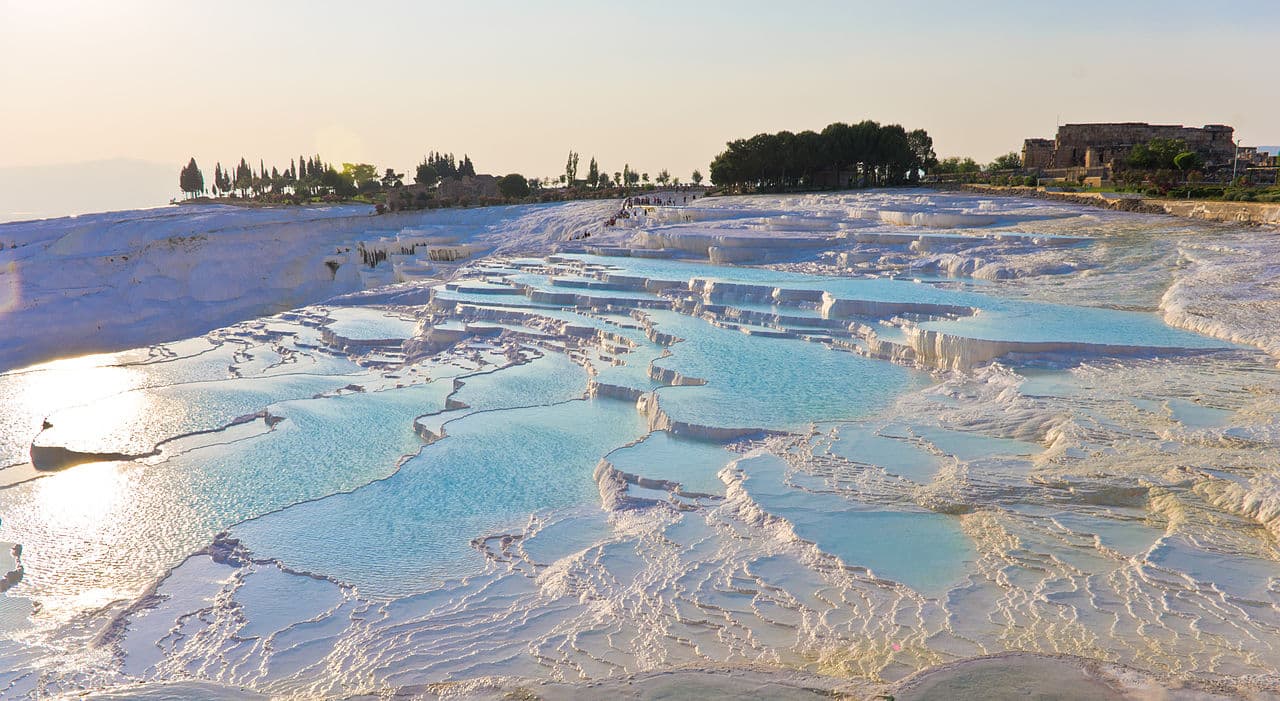
Pamukkale
THE QUICK VERDICT
By Anthony · Updated April 2026
Choose Pamukkale if you want the white travertine terraces and Hierapolis ruins as a 1-2 night detour, often paired with Cappadocia.
- Best for
- barefoot walks on the white travertines and a swim in Cleopatra's Pool among Hierapolis columns
- Two seasons
- Apr–Jun and Sep–Oct
- Budget anchor
- $70/day mid-range
- Real bargain
- Bottom 10% on daily spend ($70/day mid-range)
- Skip if
- you want nightlife or more than two days — it's a 1-night stop, often paired with Cappadocia
A surreal cascade of blinding-white travertine terraces — calcium carbonate platforms shaped over 14,000 years by hot mineral springs flowing down a 200m cliff in southwestern Turkey. Above the terraces sits Hierapolis, the Greco-Roman spa city Marcus Antonius gifted to Cleopatra, with a 12,000-seat theatre, the largest necropolis in Anatolia, and the still-bathable Cleopatra's Pool studded with toppled marble columns. UNESCO-listed since 1988; visited by 2.5 million per year, but most arrive on day buses from Antalya, Kuşadası, or Marmaris and clear out by 17:00.
The two links below are affiliate links — MapSorted earns a small commission if you book through them, at no extra cost to you. How this works.
Tours & Experiences
Bookable tours, activities, and day trips in Pamukkale
Where to Stay
Compare hotels and rentals in Pamukkale
📍 Points of Interest
Travertine Terraces
White calcium-carbonate pools tiered down a 200m cliff, fed by hot mineral springs — walked barefoot only
Hierapolis Ancient City
Greco-Roman spa city above the travertines — Roman theatre, colonnaded street, Necropolis with 1,200+ tombs
Cleopatra's Antique Pool
36°C carbonated mineral pool with submerged Roman columns from a 7th-century earthquake-toppled temple
Hierapolis Archaeology Museum
On-site museum in restored Roman bath complex — Sarcophagus Gallery and Hierapolis necropolis finds
Roman Theatre of Hierapolis
2nd-century AD theatre seating 12,000 with intact carved scaenae frons depicting Apollo, Dionysus, Artemis
Hierapolis Necropolis
2 km of 1,200+ tombs in three styles (tumulus, sarcophagi, mausolea) — pilgrims came here to die in the curative waters
Martyrium of St Philip
5th-century octagonal church on the hill above Hierapolis where the apostle was reportedly crucified upside-down in 80 AD
★ Local Picks
Karahayıt Red Springs
Iron-rich red and orange mineral springs 6 km north — the contrasting colour to Pamukkale's white, plus thermal hotels
At a Glance
- Pop.
- 3K (village)
- Timezone
- Istanbul
- Dial
- +90
- Emergency
- 112 / 155
Pamukkale means "cotton castle" in Turkish — the brilliant white travertine terraces are formed by calcium carbonate deposited over 14,000 years by hot mineral springs flowing down a 200-metre cliff face above the Menderes Valley
Pamukkale and the ruined city of Hierapolis directly above it form a single UNESCO World Heritage Site (1988) — the only mixed natural and cultural site in Turkey, which means a single ticket admits you to both
Hierapolis was a Greco-Roman spa city founded around 190 BCE by Eumenes II of Pergamon — the apostle Philip was reportedly martyred and buried here in 80 AD, and his tomb was discovered by Italian archaeologists in 2011 above the city
Cleopatra's Antique Pool — fed by the same mineral springs that built the travertines (water temperature 36°C, carbonated bubbles) — contains submerged Roman columns from a temple toppled in a 7th-century earthquake. You swim among the ruins
You must walk the travertines barefoot — shoes have been banned since 1997 to protect the calcium carbonate surface from erosion. The white deposits are surprisingly grippy underfoot once your feet adjust
The site has been a tourist destination for over 2,000 years — Roman emperors and senators came to take the waters, and the Antique Pool has hosted bathers continuously since at least the 2nd century AD
Top Sights
The Travertine Terraces
📌The reason you came — a cascade of brilliant-white calcium carbonate pools tiered down a 200-metre cliff, fed by hot mineral springs. The walking path runs from the Hierapolis upper gate down through the terraces to the village of Pamukkale, barefoot only. Most pools are dry or shallow due to water-flow management; the active filled sections are at the top and middle. Sunset turns the white pools pink and gold.
Hierapolis Ancient City
🗼The sprawling ruins of the Greco-Roman spa city sit directly above the travertines — the well-preserved Roman theatre (12,000 seats, restored 2013), the colonnaded Frontinus Street, the Necropolis (one of the largest in Anatolia with 1,200+ tombs), the Plutonium (a sacred cave releasing toxic CO₂ believed to be the entrance to the underworld), and the 4th-century Martyrium of St Philip on the hill above. Allow 3 hours minimum.
Cleopatra's Antique Pool
📌A natural mineral pool (water 36°C, carbonated bubbles, mildly radioactive — believed therapeutic) where Roman columns from a 7th-century earthquake-toppled temple lie submerged on the floor. You swim around them. Separate ticket from Hierapolis (~₺250) and worth every lira; you can spend hours in the warm carbonated water. Towel and locker rental on-site; modest swimwear required.
Hierapolis Archaeology Museum
🏛️The on-site museum housed in the restored Roman bath complex — the Sarcophagus Gallery has extraordinary pieces from the Hierapolis necropolis with carved relief decoration in remarkable preservation. The Small Finds gallery includes glassware, jewellery, and the inscribed bronze statues recovered from the Frontinus Gate area. Included in the Hierapolis ticket.
Roman Theatre of Hierapolis
🗼Built into the hillside in the 2nd century AD under Hadrian and restored to remarkable condition by an Italian archaeology team in the 2010s. The theatre seats 12,000 and the carved scaenae frons (stage backdrop) is among the best-preserved in Anatolia, with intact reliefs of Apollo, Dionysus, and Artemis. Climb to the top tier for the panoramic view.
Hierapolis Necropolis
🗼The northern necropolis of Hierapolis stretches over 2 km along the road out of the city — more than 1,200 tombs in three styles: tumulus (earth mounds), sarcophagi, and mausolea (small temple-tombs). Pilgrims and the dying came to Hierapolis from across the Roman world for the curative waters; many ended up buried here. The Tomb of Flavius Zeuxis is the headline piece.
Martyrium of St Philip
🗼A 5th-century octagonal church on the hill above Hierapolis, built on the site where the apostle Philip was reportedly crucified upside-down in 80 AD. His tomb was rediscovered by Italian archaeologists in 2011 in a separate adjacent structure. The 20-minute climb up the marked path from the main Hierapolis area is worth it for the views back over the travertines and Menderes Valley.
Karahayıt Red Springs
📌Six kilometres from Pamukkale village, the spring at Karahayıt deposits iron-rich red and orange minerals instead of white calcium carbonate — a small but striking colour contrast to the main travertines, and a destination for thermal hotels with private pools fed by the same waters. Many visitors stay overnight in Karahayıt rather than Pamukkale village for better facilities.
Costs & Currency
Where the money goes
USD per dayBackpacker = hostel dorm + street food + public transit. Mid-range = 3-star hotel + neighbourhood restaurants + transit cards. Luxury = 4/5-star + fine dining + taxis. How we calibrate these numbers →
Quick cost estimate
Customize per category →Estimates based on regional averages. Flight prices vary by season and airline.
budget
$25-45
Basic Pamukkale village pension dorm or budget room, lokanta meals, dolmuş transport, Hierapolis + Cleopatra's Pool admission
mid-range
$50-90
Karahayıt thermal hotel with private mineral pool, restaurant dinners with wine, organised day tour to Aphrodisias, Cleopatra's Pool soak
luxury
$150-280
Premium Karahayıt thermal resort with spa treatments, fine dining, hired car for Salda Lake + Aphrodisias day trips, private guide for Hierapolis
Typical Costs
| Item | Local | USD |
|---|---|---|
| AccommodationPamukkale village pension (basic) | ₺550–900/night | $16–26 |
| AccommodationMid-range Pamukkale or Karahayıt hotel | ₺1,800–3,200/night | $51–91 |
| AccommodationPremium Karahayıt thermal resort | ₺4,000–8,500/night | $114–243 |
| FoodLokanta lunch (Turkish home-cooking) | ₺200–350 | $6–10 |
| FoodTrout dinner at village restaurant | ₺300–500 | $9–14 |
| FoodTourist-strip kebab restaurant dinner | ₺500–900 | $14–26 |
| FoodGlass of Turkish wine | ₺180–280 | $5–8 |
| FoodTurkish coffee / çay | ₺40–100 | $1–3 |
| TransportDolmuş Pamukkale ↔ Denizli | ₺50–80 | $1.40–2.30 |
| TransportTaxi DNZ Airport → Pamukkale | ₺1,000–1,400 | $28–40 |
| TransportDay tour to Aphrodisias from Pamukkale | ₺1,200–1,800 | $34–51 |
| AttractionHierapolis + Travertines admission | ₺700 | $20 |
| AttractionCleopatra's Antique Pool (separate) | ₺250 | $7 |
| AttractionHierapolis Museum (included in main ticket) | ₺0 (included) | $0 |
💡 Money-Saving Tips
- •A single overnight stay in Pamukkale village or Karahayıt is far better value than a long day-tour from İzmir or Antalya — you avoid 8 hours of bus travel and get to see sunrise + sunset at the site
- •Cleopatra's Pool is a separate ticket from the main Hierapolis ticket — budget for both (~₺950 total)
- •Local trout (alabalık) restaurants in Pamukkale village are dramatically better value than the kebab tourist traps near the gate; ₺300 vs ₺800 for similar quality dinner
- •Karahayıt thermal hotels often sell day-passes for non-guests (₺400–600) which include access to private mineral pools, spa, and pool areas — useful if your accommodation doesn't have its own
- •Buy water, snacks, and sunscreen at Denizli or Pamukkale village shops before entering the site — gate-area prices are 3× higher
- •Day tours from Pamukkale to Aphrodisias are good value (₺1,200–1,800 incl. transport, English guide, lunch); independent trip by taxi is more expensive and Aphrodisias has limited public transport
- •The Pamukkale → Antalya bus (5 hours, ₺400) is comfortable and has free wifi — use it as travel rather than a costly transfer
Turkish Lira
Code: TRY
The Turkish Lira is highly volatile — at writing roughly 1 USD ≈ 35 TRY. Tourist-facing businesses in Pamukkale and Karahayıt often accept and quote prices in EUR; you can pay with hard currency at most hotels and the larger restaurants. Always have lira for dolmuş, small kiosks, and tipping. The single ATM in Pamukkale village (Garanti) is reliable but can run out of cash on busy weekends — withdraw at Denizli Otogar before arriving.
Payment Methods
Cards (Visa, Mastercard) accepted at the Hierapolis ticket gate, Cleopatra's Pool, hotels, and most sit-down restaurants. American Express has very limited acceptance. Cash for: dolmuş minibuses, water/snack kiosks, small restaurants, tips, and the public toilets at the Hierapolis gate (₺5). Withdraw cash at Denizli Otogar ATMs before arriving in Pamukkale.
Tipping Guide
10% at sit-down restaurants is standard. Some tourist-facing places now add a service charge automatically.
Bellboy: ₺20–50 per bag. Housekeeping: ₺50/night for thermal hotel stays. Spa massage attendant: 15–20% of treatment cost.
€5–€10 per person on a half-day shared tour, €10–€20 on a full day. The driver also gets a small tip (€5–€10) for full-day trips.
Round up to the nearest ₺10–20. For longer routes, agree the price upfront and tip ₺50–100 if the service was good.
Climate & Best Time to Go
Pamukkale sits in inland southwestern Turkey at 350m elevation in the Menderes Valley — Mediterranean continental climate with hot, dry summers (July–August often 35°C+) and cool, rainy winters (occasionally below freezing at night). The mineral waters maintain 36°C year-round, so swimming in Cleopatra's Pool is comfortable in any season; the travertines feel more atmospheric in cooler months without the haze.
Spring
April - May50 to 75°F
10 to 24°C
The optimal time — wildflowers in the Menderes Valley, pleasant temperatures for walking the Hierapolis ruins, and the travertines look brilliant under clear blue spring skies. April can have showers; May is reliably dry and warm.
Summer
June - August68 to 97°F
20 to 36°C
Hot and busy — peak tourist season with daily highs over 35°C. The white travertine surface reflects sun intensely; barefoot walking can be uncomfortable midday. Visit at sunrise or after 5pm. Cleopatra's Pool is a welcome relief.
Autumn
September - October54 to 86°F
12 to 30°C
Excellent — September still warm and golden, October brings reliable mild days (22–25°C) without the crowds. The Menderes Valley turns amber and the Hierapolis pine forest is at its most photogenic.
Winter
November - March28 to 57°F
-2 to 14°C
Cold and quiet — daytime in the low teens, nights occasionally below freezing, and the surrounding hills receive snow. The travertines under snow are spectacular and almost empty. The thermal pools (Cleopatra's, Karahayıt hotel pools) are at their best in cold air.
Best Time to Visit
April–May and September–October are the optimal windows: pleasant temperatures (15–28°C), the travertines look spectacular under blue spring/autumn skies, and crowds are manageable. June and late September are also good. Avoid mid-July to mid-August unless you visit at sunrise or after 5pm — the white travertine surface reflects sun aggressively and the barefoot walking becomes uncomfortable.
Spring (April–May)
Crowds: ModerateThe perfect window — wildflowers in the Menderes Valley, comfortable temperatures (18–24°C), and clear blue skies that make the white travertines pop. May is reliably dry; April can have brief showers.
Pros
- + Best photographic conditions
- + Wildflowers around Hierapolis
- + Pleasant for Hierapolis ruin walking
- + Reasonable prices
Cons
- − April rain occasionally
- − Cleopatra's Pool busier as weather warms
Summer (June–August)
Crowds: Very high (peak season)Peak season and the busiest time — every day-tour bus from İzmir, Antalya, and Selçuk arrives between 10am and 3pm. White surface reflection makes midday brutal; sunrise visits and after-5pm visits transform the experience.
Pros
- + Long daylight (sunset 20:30 in July)
- + Cleopatra's Pool feels excellent
- + All facilities running
Cons
- − 35°C+ midday heat
- − Maximum crowds
- − Most expensive accommodation
- − Barefoot travertine walking is uncomfortably hot
Autumn (September–October)
Crowds: Moderate (high in early September)Excellent — September still summery (sea ~27°C nearby), October brings reliable mild days (22–25°C) without the haze. Day-tour numbers drop significantly. The Menderes Valley turns amber and the Hierapolis pine forest is photogenic.
Pros
- + Best light for photography
- + Lower prices than peak summer
- + Pleasant Hierapolis exploration
- + Cleopatra's Pool less crowded
Cons
- − Late October can see first rains
- − Some Karahayıt resort facilities scaling down
Winter (November–March)
Crowds: LowCold and atmospheric — daytime in the low teens, occasional snow on surrounding hills. The travertines under snow are spectacular and almost empty. The thermal pools (Cleopatra's, Karahayıt hotels) are at their best in cold air. Hotel prices drop 40–60%.
Pros
- + Very cheap accommodation
- + Almost empty site
- + Thermal pools at their most therapeutic
- + Snow on travertines (rare and stunning)
Cons
- − Freezing nights possible
- − Some Karahayıt hotels closed
- − Limited dolmuş schedules
- − Cold for barefoot travertine walking
🎉 Festivals & Events
Pamukkale International Festival
JuneAnnual cultural festival with concerts staged in the restored Roman theatre at Hierapolis — Turkish folk music, classical performances, and traditional dance in the 12,000-seat ancient theatre. Ticketed events ₺250–600.
Karahayıt Wellness & Thermal Festival
OctoberKarahayıt resort hotels collectively host an annual wellness week — discounted spa treatments, group thermal pool events, traditional Turkish bath demonstrations. Coordinated through major hotels.
Aphrodisias Cultural Programme
July - AugustAphrodisias (90 km from Pamukkale) hosts occasional summer concerts in its 30,000-seat ancient stadium — typically 1–2 events per summer; check programme in advance.
Off the Beaten Path
Sunset on the Travertines
The travertines turn gold then pink in the hour before sunset, when the angled sun catches the white calcium carbonate from the side. This is when most of the day-tour buses have left and the site empties. Position yourself on the upper terraces (near the Hierapolis side) facing west into the Menderes Valley. The light show lasts about 40 minutes and is utterly silent and surreal.
The mid-morning to early-afternoon crowds make Pamukkale feel theme-parky. After 4pm in summer it transforms — the travertines feel mystical and you almost have them to yourself.
Karahayıt Thermal Hotels
Six kilometres from the Pamukkale village, Karahayıt is the spa-resort town where most international visitors actually stay — large thermal hotels with their own piped mineral pools (fed by the same Karahayıt red-mineral springs), buffet meals, and free shuttles to the Pamukkale gate. Rooms with private thermal jacuzzi balconies cost €60–€100/night and the experience of soaking in 40°C mineral water at 11pm is the entire point.
Pamukkale village is small and limited; Karahayıt has the proper thermal hotel experience that lets you actually use the mineral waters at your own pace, not just admire them as a UNESCO photo op.
The Plutonium Sacred Cave
A small cave at the centre of Hierapolis where toxic CO₂ vents from underground at concentrations lethal to small animals — Roman priests of Cybele used to demonstrate the temple's "divine power" by leading bulls inside; the bulls collapsed and died, the priests (who held their breath at the top of the steps) survived. Strabo wrote about it in 25 BC. The cave is barriered today; you can stand at the entrance and watch birds drop dead from the gas. Genuinely unsettling.
One of the few places in the ancient world where the actual mechanics of pagan religious "miracles" can still be witnessed — and the death of small animals from invisible gas is genuinely affecting if you stop to think about what you're seeing.
Local Trout Restaurants in Pamukkale Village
The springs that feed Pamukkale support extensive trout farms in the Menderes Valley below — village restaurants like Mehmet's Place (Pamukkale main road) serve grilled fresh trout (alabalık) with Turkish meze for ₺250–400, far better and cheaper than the tourist-trap kebab restaurants near the gate. Pair with raki and a salad; the trout is genuinely excellent.
Most visitors eat at the gate area where prices are 3× and the food is mediocre. The village restaurants 500m back from the gate are where the locals eat and the food is from the Menderes Valley itself.
Hierapolis at Sunrise
The Hierapolis upper gate opens at 06:30 in summer (08:30 in winter); arriving at opening means you have the Roman theatre, the Necropolis, and the Frontinus Street to yourself for two full hours. The light is beautiful, the temperature manageable, and the photographs are uncrowded. Plan to be at the gate 15 minutes before opening; combine with Cleopatra's Pool (which opens later) at midday.
By 10am Hierapolis is heaving with day-tour groups. The 06:30–08:30 window is when you experience it as the ruins of an actual ancient city, not as a tourist queue line.
Safety Breakdown
Very Safe
out of 100
Pamukkale is a very safe destination — small village, organised tourism site, professional spa/thermal hotels, and visible site staff. Safety concerns are largely physical (slippery travertine surface, sun exposure) rather than crime-related. The village is small enough that residents notice strangers and look out for visitors.
Things to Know
- •The travertine surface is slippery when wet — walk slowly, especially on the upper section where water flow is strongest. Falls are the most common visitor injury at the site
- •Barefoot walking is required and the white surface reflects sun aggressively — use sunscreen on the tops of your feet (a frequently forgotten spot) to avoid burns
- •Cleopatra's Pool is genuinely warm (36°C) and mildly radioactive — pleasant for short soaks but limit immersion to 20–30 minutes; people with cardiovascular issues should consult their doctor
- •The Plutonium cave's CO₂ vents are barriered for a reason — do not attempt to enter or lean over the railing; the gas is genuinely lethal
- •Hierapolis ruins involve uneven stone walking, exposed sun, and few shaded rest areas — bring water (1L per person minimum), sun hat, and appropriate footwear (the travertines you walk barefoot, but for the ancient city you need shoes)
- •Carpet shop and pottery shop touts in the village can be persistent — politely decline ("hayır, teşekkürler") if not interested; never feel obligated by a "free tea" offer
- •The Pamukkale–Karahayıt road is single-lane and busy with tour buses; if walking between the two villages, use the dedicated pedestrian path rather than the road
Emergency Numbers
Emergency (all services)
112
Police
155
Site security (Pamukkale)
+90 258 272 2077
Ambulance
112
How to Get There
✈️ Airports
Denizli Çardak Airport(DNZ)
60 km east of Pamukkale (90 km from airport)Denizli Çardak (DNZ) is the primary gateway — domestic Turkish Airlines / Pegasus / AnadoluJet flights from Istanbul and Ankara (1 hr 15 min). Airport shuttle (Havaş) to Denizli Otogar runs ~₺150 (45 min); from Denizli, the Pamukkale dolmuş departs every 30 minutes (₺50–80, 50 min). Total airport-to-Pamukkale: 2 hours, ~₺200. Taxi direct from DNZ to Pamukkale: ~₺1,200 (€32).
✈️ Search flights to DNZİzmir Adnan Menderes Airport (alternative)(ADB)
270 km westİzmir is a larger international airport with European charter flight links. From ADB, take the Havaş shuttle to İzmir Otogar, then a direct bus to Denizli (3.5 hr, ₺350). From Denizli, dolmuş to Pamukkale. Total ADB-to-Pamukkale: 5–6 hours. Better to fly into DNZ if direct flights are available; ADB makes sense if combining with Ephesus.
✈️ Search flights to ADB🚆 Rail Stations
Denizli Train Station
60 km east of PamukkaleConnected to İzmir by the Basmane–Denizli regional service (5–6 hours, ₺120). Slow but scenic via the Menderes Valley. Limited utility unless you specifically want a rail connection — the bus from İzmir is faster and more frequent.
🚌 Bus Terminals
Denizli Otogar (bus station)
60 km from Pamukkale and the main long-distance gateway. Buses to Antalya (5 hr, ~₺400), Selçuk/Ephesus (3.5 hr, ~₺300), Bodrum (5 hr, ~₺450), İzmir (3.5 hr, ~₺350), Istanbul (10 hr overnight, ~₺900). Operators: Pamukkale, Kâmil Koç, Metro Turizm. From Denizli, take the local Pamukkale dolmuş.
Travel Connections
Aphrodisias
A spectacular Roman-era city named for Aphrodite, with one of the best-preserved stadiums in the ancient world (seating 30,000) and a sculpture school whose marble works fill the on-site museum. Far less visited than Ephesus and arguably more impressive — UNESCO listed in 2017. A morning here paired with afternoon at Pamukkale is a perfect day.

Antalya
The Turkish Riviera capital — Hadrian's Gate, Kaleiçi old town, Düden Falls, and the Antalya Museum. The road from Pamukkale climbs over the Taurus Mountains and is scenic in itself. Most travellers combine Pamukkale and Antalya in a single trip.
Ephesus
The most famous classical ruin in Turkey — the marble-paved Curetes Way, the Library of Celsus façade, the Great Theatre, and the massive 25,000-seat amphitheatre. Combine with Şirince village and Selçuk's archaeology museum. The closest major airport to Pamukkale (İzmir, ADB) is also near Ephesus.
Salda Lake
A crater lake whose alkaline white-mineral shoreline is so geologically similar to the Jezero Crater on Mars that NASA used it for Perseverance rover testing. The "Maldives of Turkey" — turquoise water, white-sand beaches. Best as a self-drive day trip; bus connections are limited.
Entry Requirements
Turkey is NOT a member of the EU or the Schengen Area — it operates its own visa policy. Most Western passport holders enter visa-free for 90 days within any 180-day period. US, UK, Canadian, and Australian passport holders are now visa-free as of 2024 (previously e-Visa required). Entry typically processed at İzmir (ADB) or Istanbul (IST/SAW) before transferring to Denizli (DNZ).
Entry Requirements by Nationality
| Nationality | Visa Required | Max Stay | Notes |
|---|---|---|---|
| US Citizens | Visa-free | 90 days in any 180-day period | Visa-free as of 2024 (previously e-Visa). Passport must be valid for at least 6 months beyond entry date AND have one full blank page. No exit fee. |
| UK Citizens | Visa-free | 90 days in any 180-day period | Visa-free since March 2024. Passport must be valid 150 days beyond entry. No e-Visa required. |
| EU Citizens | Visa-free | 90 days in any 180-day period | All EU passports visa-free. ID cards accepted from Belgium, France, Germany, Greece, Italy, Liechtenstein, Luxembourg, Malta, Netherlands, Portugal, Spain, Switzerland. |
| Canadian Citizens | Visa-free | 90 days in any 180-day period | Visa-free as of 2024. Passport valid 6 months beyond entry; one blank page required. |
| Australian Citizens | Visa-free | 90 days in any 180-day period | Visa-free entry. Passport valid 150 days from arrival. |
Visa-Free Entry
Tips
- •Turkey's 90-day visa-free period is independent of Schengen — useful if you have used most of your Schengen allowance elsewhere in Europe
- •Always check the e-Visa portal even if you believe you are visa-exempt — rules change frequently
- •Passport validity must extend 150 days beyond intended departure for many nationalities (UK, AU, NZ); 6 months for US
- •Most Pamukkale visitors arrive via İzmir (ADB) or Istanbul; immigration at these airports is well-organised and typically processed in under 30 minutes
- •Bring printed proof of return flight and accommodation booking — entry officers occasionally ask, especially for solo travellers on one-way tickets
Getting Around
Pamukkale is small (~3,000 residents) and entirely walkable — the village, the lower travertine entrance, the upper Hierapolis gate, and Karahayıt 6 km away are connected by minibus (dolmuş) and easy walking paths. Most visitors arrive on day tours from İzmir, Selçuk (Ephesus), or Antalya, which include their own transport. Independent travellers use Denizli (DNZ airport, 60 km) as the gateway.
Walking
FreeThe site walks itself — Pamukkale village (lower gate) to the upper Hierapolis gate via the travertines is 1.5 km uphill (35 minutes barefoot). Karahayıt to Pamukkale village is 6 km on a flat dedicated path along the irrigation canal — pleasant 75-minute walk in cool weather.
Best for: Travertines, Hierapolis ruins, Pamukkale village, Karahayıt path
Dolmuş (Minibus)
₺20–80 per rideFrequent shared minibuses run Pamukkale ↔ Karahayıt ↔ Denizli (60 km, ₺50–80). The Denizli–Pamukkale dolmuş runs every 30 minutes from Denizli Otogar (bus station) and takes 50 minutes. Late returns from Pamukkale to Denizli stop around 21:00.
Best for: Denizli connection, Karahayıt commute
Taxi
Flagfall ₺25 + ~₺25/kmPamukkale taxi rank by the upper gate; expect ₺250–400 for Pamukkale–Karahayıt or Pamukkale–DNZ airport. Always insist on the meter; for longer routes (e.g. Salda Lake), agree the price upfront. BiTaksi works in Denizli but coverage in Pamukkale itself is limited.
Best for: Airport, Salda Lake, late nights, luggage
Hotel Shuttle
Free for hotel guestsMost Karahayıt thermal hotels run free hourly shuttles to the Hierapolis upper gate and back — book on arrival and use them rather than walking the 6 km in summer heat. Some hotels also offer airport pickups for an additional fee (~€15–25).
Best for: Hotel guests doing day visits to the site
Walkability
Pamukkale village and the entire UNESCO site (travertines + Hierapolis) are walkable in a single day on foot. The 1.5 km uphill walk through the travertines from the lower gate is itself one of the highlights — a unique sensory experience walking barefoot on warm white stone with mineral water flowing around your ankles.
Shopping
Pamukkale shopping is limited to small village shops and tourist stalls along the road to the Hierapolis gate — Turkish carpets, ceramics, leather, and the inevitable cotton T-shirts. Karahayıt has slightly more variety with its hotel-resort visitor base. For serious carpet/jewellery purchases, Antalya, Istanbul, and Cappadocia are far better hunting grounds; Pamukkale prices are inflated for the captive day-tour market.
Pamukkale Village Tourist Strip
craft marketThe single road from the village up to the Hierapolis lower gate is lined with carpet shops, ceramics displays, leather sellers, and souvenir stalls. Quality is mediocre and prices inflated — bargain hard or skip and buy elsewhere. The cotton products (after which the site is named) are the one local specialty: hammam towels (peştemal), bedlinen, and embroidered cotton fabrics from the surrounding Menderes Valley villages.
Known for: Cotton hammam towels, ceramics, T-shirts, low-end carpets
Karahayıt Resort Strip
modern resort areaThe thermal-hotel cluster at Karahayıt has higher-end carpet showrooms targeting the European thermal-spa clientele, plus jewellery shops with onyx, silver, and amber pieces. Prices are inflated but the quality is generally better than Pamukkale village. Negotiation expected.
Known for: Carpets, onyx and silver jewellery, hammam textiles
Denizli Bazaar
local marketIn nearby Denizli (60 km east), the Çamlık district hosts the Denizli Bazaar — a real Turkish urban market where locals shop. Far better prices on textiles, spices, and household goods than the tourist stalls at Pamukkale. Worth a stop if you have time on the inbound or outbound.
Known for: Textiles, spices, household goods, Denizli is a major textile manufacturing centre
🎁 Unique Souvenirs to Look For
- •Cotton hammam towel (peştemal) from Denizli — the region's textile speciality, traditional Turkish bath wrap that doubles as a beach towel; ~₺200–400
- •Travertine-mineral bath salt or scrub — small jars of "Pamukkale mineral salt" sold at hotel spas; mostly tourist branding but pleasant; ~₺100
- •Iznik-style ceramic plate or bowl with traditional cobalt and turquoise tulip motifs — small pieces ₺200, larger plates ₺500–1,000
- •Onyx items (chess set, pestle and mortar, bookends) — Denizli province produces excellent onyx; expect ~₺400–1,500
- •Bottle of local Menderes Valley wine — Çal and Buldan villages produce reasonable Turkish reds (Kalecik Karası, Boğazkere); from grocery shops ~₺200
- •Photo book of Pamukkale — the on-site museum shop has well-produced books with archaeological context the brochures miss; ₺150–300
Language & Phrases
Turkish uses the Latin alphabet (Atatürk's 1928 reform) with extra letters: ç, ğ, ı (dotless), ş, ü, ö. English is spoken at the Hierapolis ticket office, the larger Karahayıt thermal hotels, and many Pamukkale village pensions. Outside the tourism core, Turkish is essential — and any attempt is enthusiastically appreciated.
| English | Translation | Pronunciation |
|---|---|---|
| Hello | Merhaba | mer-ha-BA |
| Good morning | Günaydın | goon-ay-DIN |
| Good evening | İyi akşamlar | EE-yee ak-SHAM-lar |
| Please | Lütfen | LOOT-fen |
| Thank you | Teşekkür ederim | teh-shek-KUR ed-er-im |
| You're welcome | Rica ederim | ree-JA ed-er-im |
| Yes / No | Evet / Hayır | eh-VET / hi-YIR |
| How much? | Ne kadar? | neh ka-DAR? |
| The bill, please | Hesap, lütfen | heh-SAP LOOT-fen |
| A tea, please | Bir çay, lütfen | beer CHAI LOOT-fen |
| Where is...? | Nerede...? | NEH-reh-deh? |
| It's beautiful | Çok güzel | CHOK goo-ZEL |
If you like Pamukkale, you'll love…
4 cities with a similar vibe, outside of the same country.

Pakistan · OVR 80
stretches your budget · unforgettable natural beauty

India · OVR 80
jaw-dropping scenery · rich cultural layers

Peru · OVR 80
landscapes that steal the show · museum-dense old core

Myanmar · OVR 79
unforgettable natural beauty · stretches your budget