Paraty
THE QUICK VERDICT
By Anthony · Updated April 2026
Choose Paraty if You want a UNESCO colonial town that does double duty as a beach base — a perfectly walkable historic centre, a schooner-launching harbour, and Atlantic Forest hikes within 20 minutes of your guesthouse..
- Best for
- cobbled colonial centre, Saco do Mamanguá schooner trips, cachaça distillery tours, Trindade beach hikes
- Best window
- Apr–Sep
- Budget anchor
- $130/day mid-range
- Worth a look
- the FLIP literary festival (late July/early August) draws Brazil's top writers to a town of 40,000
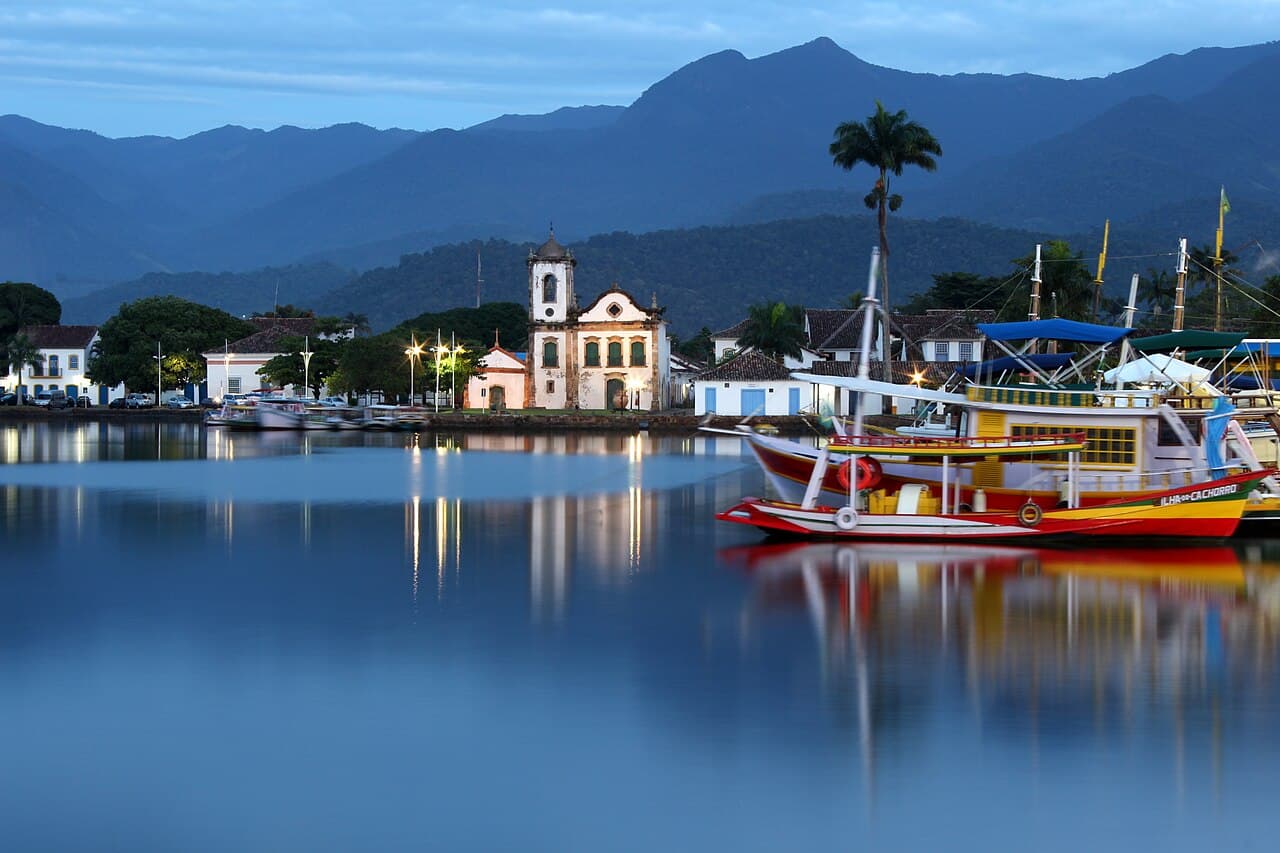
Paraty is the perfectly preserved 18th-century colonial port halfway between Rio and São Paulo — whitewashed houses with bright shutters, churches at every corner, and cobblestone streets so uneven you stop pretending shoes will help. UNESCO inscribed the historic centre in 2019 (alongside the surrounding Atlantic Forest reserves) for its colonial architecture and the cultural landscape that grew around the gold-mining caminho do ouro. Today the harbour fills with traditional schooners (saveiros) running day trips to dozens of green islands and turquoise coves; the back lanes hide some of Brazil's best cachaça stills, and the surrounding Serra da Bocaina forest hides 100m waterfalls reachable on foot.
The two links below are affiliate links — MapSorted earns a small commission if you book through them, at no extra cost to you. How this works.
Tours & Experiences
Bookable tours, activities, and day trips in Paraty
Where to Stay
Compare hotels and rentals in Paraty
📍 Points of Interest
Centro Histórico
17th-19th century walled colonial centre — six pedestrian-only blocks of whitewashed houses and four churches
Igreja Matriz N.S. dos Remédios
Largest of the four colonial churches — twin-tower facade dominating Praça Matriz
Schooner Bay Trip
Six-hour wooden saveiro cruise to 5-6 islands and beaches in the Bay of Paraty — swim and snorkel stops
Trindade Village
Fishing village 26 km southwest — five postcard beaches in walking distance plus the Cachadaço natural pool
Cachoeira do Tobogã
Natural rock waterslide on smooth granite — locals slide standing up; deep plunge pool at the base
Forte Defensor Perpétuo
1703 Portuguese fort on the headland — climb for the panoramic view back to the colonial centre
Caminho do Ouro (Gold Trail)
1.2 km section of the original 18th-century stone-paved gold trail — Atlantic Forest hike with howler monkeys
Engenho d'Ouro Alambique
Working cachaça distillery using 1780-era wooden press and copper alembic — free 30-min tours and tastings
Praia do Sono· 16 km SE
Hidden beach reached by 1-hr Atlantic Forest hike — no road, no electricity, fishermen-run pousadas
★ Local Picks
Quilombo do Campinho
Traditional escaped-slave-descendant community — guided village tour, cassava mill demo, community lunch
Banana da Terra Restaurant
Chef Ana Bueno's acclaimed modern Brazilian restaurant — caiçara cuisine, tasting menu
At a Glance
- Pop.
- 44K
- Timezone
- Sao Paulo
- Dial
- +55
- Emergency
- 190 / 192
Paraty's historic centre — founded in 1597 — is one of the best-preserved colonial port towns in the Americas, with whitewashed houses, brightly painted shutters, and uneven cobbled streets that flood deliberately at high tide to "wash" the town
UNESCO inscribed Paraty (and the surrounding Atlantic Forest) as a mixed cultural-and-natural World Heritage Site in 2019 — the first Brazilian site to win that dual category
The town was built in the 18th century as the Atlantic gateway for Minas Gerais gold — the Caminho do Ouro (Gold Trail) brought ingots overland to Paraty's harbour for shipment to Lisbon, making it briefly one of the richest small ports in the empire
Paraty is one of Brazil's major cachaça-producing areas — the surrounding Bocaina valleys hold 30+ small alembic distilleries (alambiques) producing artisan sugarcane spirit using techniques unchanged for two centuries
The town sits between the Serra da Bocaina mountains and the Atlantic — within 30 minutes you can be in colonial streets, on a hidden beach, on a schooner among 65 islands, or in a primary Atlantic Forest waterfall
The historic centre is closed to vehicles — the cobblestones are deliberately rough so horse-drawn carts kept their grip; the tide floods the main streets through engineered drainage gaps to clean them, an 18th-century sanitation system that still works
Top Sights
Centro Histórico (Historic Centre)
📌The walled colonial core — six narrow blocks of 17th-19th century houses, four colonial churches, and cobblestones so uneven that high heels are physically impossible (locals call them "pé de moleque" — "kid's feet"). Pedestrian-only. The town is best seen on foot in the late afternoon, when the light catches the white facades and brightly painted doors. Spend half a day wandering; lose the map deliberately.
Igreja Matriz de Nossa Senhora dos Remédios
📌The largest of Paraty's four colonial churches, built between 1646 and 1873 (renovations took two centuries). The whitewashed twin-tower facade dominates Praça Matriz; the interior is austere by Brazilian colonial standards but the harbour-facing position is iconic. R$5 entry; closed during services. The other three churches — Santa Rita (1722), Rosário (1725, originally for slaves), and Capela das Dores (1820, built by wealthier white women to avoid worshipping with the others) — are each tiny gems.
Schooner Trip Around the Bay
📌The classic Paraty experience — an old wooden saveiro (schooner) cruise around 5-6 islands and beaches in the Bay of Paraty, including swimming and snorkelling stops. Departs the central harbour 11:00, returns 17:00; lunch on board (extra). R$80-180 (~$16-36) per person depending on operator and meal inclusion. Operators line the harbour wall; quality varies — the Soberano da Costa and Sai Saí are reliable. Customised private boats from R$600/half-day for groups of 6.
Trindade
🏖️A small fishing village 26 km southwest of Paraty (R$15 bus, 45 min, hourly), beloved by Brazilians as the "village of perfect beaches." Five beaches in walking distance, including the natural pool at Cachadaço (a wave-protected swimming hole) and the long stretch of Praia do Cepilho with surfing. Day trip or overnight in one of the small pousadas; the village itself is rustic-bohemian. Combine with a longer trek into Bocaina park.
Cachoeira do Tobogã
🌿A natural rock waterslide 9 km inland from Paraty in the Penha valley — flat granite worn smooth by centuries of waterfall, with a deep plunge pool at the base. Locals slide down it standing up, holding hands; tourists usually sit. Free; access via the Penha road (taxi R$50, or rented bike). The adjacent Cachoeira do Pimenta is gentler if Tobogã looks intimidating. Combine with a visit to Engenho d'Ouro cachaça still nearby.
Forte Defensor Perpétuo
📌The 1703 Portuguese fort on the headland north of town — built to defend Paraty against pirates raiding the gold shipments. The fort itself is small and crumbling but the climb up the headland (15 min from the harbour) and the panoramic view over the bay back towards the colonial centre are the main draw. Free entry; walk via the Praia do Pontal beach.
Caminho do Ouro (Gold Trail Hike)
📌A 1.2 km section of the original 18th-century stone-paved trail that carried Minas Gerais gold over the Serra do Mar to Paraty's port — restored and now a popular guided forest hike. Starts at the Penha trailhead (12 km from town); R$15 entry plus optional R$50 guide. Dense Atlantic Forest, river crossings, spot howler monkeys at dawn. Allow 4-5 hours including return; combine with the Tobogã waterfall and a cachaça tasting.
Engenho d'Ouro Alambique
📌A working cachaça distillery 10 km from Paraty, still operating with the same wooden press and copper alembic stills used since 1780. Free 30-min tours daily 09:00-16:00, with tastings of espadín-pure white cachaça and oak-aged amber versions. Bottles for sale R$45-180 (~$9-36). The Maria Izabel and Coqueiro distilleries are also high quality and similarly tour-friendly. Combine with the Tobogã waterfall on the same Penha valley loop.
Praia do Sono
🏖️A protected beach reached by a 1-hour Atlantic Forest hike from the trailhead at Laranjeiras (40 min south of Paraty by car) — no road, no cars, no electricity at the beach itself. A handful of fishermen-run pousadas and a long crescent of fine sand. Can be done as a strenuous day trip (4 hours hiking + beach time) or as an overnight in a hammock at one of the pousadas (~R$80-150/night with breakfast). Guides recommended for the Praia do Sono → Antigos → Antiguinhos circuit.
Casa de Cultura de Paraty
🏛️The municipal cultural centre in a restored 18th-century mansion in the historic centre — rotating exhibitions on Paraty history, the gold trail, and local artists. The permanent exhibition includes a recreated colonial kitchen and the original gold-counting room of the Casa do Padre Carlos. Free entry (or R$8); 30-45 minutes. The associated bookshop has the best English-language books on Paraty's history.
Climate & Best Time to Go
Paraty has a humid tropical climate moderated by the Atlantic — warm, wet summers (Dec-Mar) with frequent thunderstorms; mild, drier winters (Jun-Aug) that are the optimal travel window. The Serra do Mar wrings rain out of the prevailing wind year-round, so Paraty is consistently one of the wettest places in southeast Brazil — annual rainfall ~2,300 mm. Boat trips and forest hikes both require dry-ish weather, so the dry season is double-counted as the best time to visit.
Summer (Wet Season)
December - March72 to 86°F
22 to 30°C
Hot, humid, and very rainy — daily afternoon thunderstorms and occasional 2-3 day downpours. Boat trips are frequently cancelled; forest trails turn to mud. Brazilian school holidays peak the crowds. Carnival week in Feb/Mar packs the town. Avoid unless you specifically want the festival.
Autumn
April - May64 to 82°F
18 to 28°C
The first sweet spot — temperatures drop, humidity drops, rain becomes occasional rather than constant. April still gets some lingering summer storms; May is reliably good.
Winter (Dry Season)
June - August57 to 75°F
14 to 24°C
The optimal months — warm sunny days, cool nights, low humidity, and the lowest rainfall of the year. Boat trips run reliably; forest hikes are at their best. Pack a fleece for the evenings (down to 14°C). Brazilian winter holidays in mid-July push prices and crowds back up.
Spring
September - November63 to 82°F
17 to 28°C
The second sweet spot — warming up but rain still moderate. September is excellent; October and November the heat and humidity start to climb. The Festa Literária Internacional de Paraty (FLIP) is in late September/early October and packs the town.
Best Time to Visit
May through September is the optimal window — the dry season gives you reliable boat trips, dry forest hikes, and lower humidity. June, July, and August are the driest. Avoid December-March (peak rainfall, frequent boat cancellations), and avoid Carnival week and FLIP literary festival week (mid-September to early October) for crowd-and-price reasons unless you specifically want either event.
Summer / Wet Season (December - March)
Crowds: Very high (Carnival peak)Hot, humid, and very rainy — daily afternoon thunderstorms, frequent boat cancellations, muddy trails. Brazilian summer holidays peak the crowds. Carnival is the highlight if you want it, brutally expensive otherwise.
Pros
- + Carnival energy and parades
- + Long daylight (sunset 19:00)
- + Lush green forest after rain
- + Atlantic Forest at maximum biodiversity
Cons
- − Daily afternoon storms cancel boats
- − Maximum humidity
- − Carnival prices double or triple
- − Muddy trails
- − Mosquitoes peak
Autumn (April - May)
Crowds: ModerateThe first sweet spot — humidity drops, rain becomes occasional. May is reliably good and prices have dropped after Easter.
Pros
- + Comfortable temperatures
- + Lower crowds
- + Lower prices
- + Boat trips reliable
- + Excellent forest hiking
Cons
- − April still has lingering summer rain
- − Days shortening
Winter / Dry Season (June - August)
Crowds: Moderate (high in mid-July)The optimal months — warm sunny days, cool nights, low humidity, lowest rainfall. Boat trips run reliably. July school holidays push crowds and prices back up briefly.
Pros
- + Driest months — boat trips reliable
- + Cool nights for sleeping (no AC needed)
- + Forest hikes at their best
- + Clear views from coastal hills
Cons
- − Cool nights down to 14°C — pack a fleece
- − Shorter daylight (sunset 17:30)
- − Ocean cool for swimming
- − July prices spike
Spring (September - November)
Crowds: Moderate (FLIP week is high)The second sweet spot — warming up but rain still moderate. September is excellent; the FLIP literary festival in late Sep / early Oct is a major event that packs the town.
Pros
- + Warming up — better swimming
- + Lower crowds outside FLIP week
- + Boat trips reliable
- + Spring blossoms
Cons
- − FLIP week crowds and prices
- − Humidity climbing by November
- − Some afternoon storms returning
🎉 Festivals & Events
Festa do Divino Espírito Santo
May or June (Pentecost weekend)A 200-year-old religious procession through the historic centre — a costumed parade led by an "emperor" carrying a dove emblem, with traditional music and a free communal feast in the church square. The most authentic Paraty event, attended mostly by locals.
Festival da Cachaça e do Camarão
August (third weekend)A weekend dedicated to local cachaça and shrimp — the historic centre fills with stalls from 30+ alembiques and the best local seafood restaurants. Free admission; food and drink at stall prices.
FLIP - Festa Literária Internacional de Paraty
Late September / early OctoberBrazil's most important literary festival — five days of author talks, panels, and parties across the historic centre. Major international authors regularly appear. Books up the town a year in advance and roughly doubles accommodation prices for the week.
Carnival
February or early MarchParaty's carnival is a smaller, neighborhood-driven version of Rio's — with the Bloco da Lama (the famous "mud bloc" parade where revellers cover themselves in tidal mud) as the signature event. Hotels triple in price.
Festival de Cinema de Paraty
OctoberA small but well-curated independent film festival — Brazilian and international features, with screenings in the historic centre theatres. R$15-30 per session.
Off the Beaten Path
Banana da Terra Restaurant
Chef Ana Bueno's acclaimed restaurant in a colonial townhouse on Rua Doutor Samuel Costa — modern Brazilian cuisine using Paraty produce (local fish, wild greens, banana-flour breads). Tasting menu R$220-280 (~$44-56) or à la carte mains R$80-130. One of the few genuinely fine-dining options in town; book ahead.
Most Paraty restaurants serve the same predictable seafood-and-rice tourist menu. Banana da Terra is the standout — Ana Bueno was one of the first Brazilian chefs to put the cuisine of caiçara fishing communities on the international map.
Quilombo do Campinho da Independência
A 25-minute drive south of Paraty — a traditional quilombo community (descendants of escaped enslaved Africans) opens its village to visitors with guided tours, cassava-flour mill demonstrations, and a community-run lunch (R$50-70). The story of the community's 19th-century founding and ongoing land struggles is part of the visit. Reservations through the community association recommended.
A genuine community-tourism initiative that puts your money directly into the quilombo. The cassava demonstration and the lunch are excellent; the historical context is powerful.
Sunset on Pontal Beach
The small Praia do Pontal at the mouth of the Perequê-Açu river, just north of the historic centre — a kiosk bar with plastic chairs in the sand serves caipirinhas at sunset, with the colonial church silhouettes across the river bar. Locals' sunset spot; touristy enough that someone is always there but local enough that it's mostly Brazilians.
The historic-centre-facing sunset view is the iconic Paraty photo, and the kiosk bar gives you front-row seats with a cheap caipirinha in your hand.
Casa Sítio Quintal Cachaça Tasting
A small artisan distillery on the Penha road run by a third-generation family — the patriarch personally walks visitors through the production (mash, ferment, distill, age) and pours flights of 6-8 cachaças including the rare oak-aged Carvalho version. R$30 per person for the tasting (no purchase required, but most leave with bottles at R$60-180). Call ahead.
Larger commercial alembiques have polished but generic tours. Sítio Quintal's tasting is genuinely intimate, the family's pride is contagious, and the oak-aged cachaça will change your view of the spirit.
Safety Breakdown
Moderate
out of 100
Paraty is one of the safest tourist towns in Brazil — small, low-population, heavily dependent on tourism, and the historic centre is essentially a pedestrian zone with constant foot traffic. Violent crime is rare; petty theft is occasional; the main physical risks are the slippery cobblestones (sprained ankles are common), heatstroke on the trail, and rip currents on certain beaches.
Things to Know
- •The cobblestones in the historic centre are deliberately uneven — wear shoes with grip and watch your step, especially after high tide when they're wet. Sprained ankles are the single most common Paraty injury
- •Schooner trips: confirm the operator has life jackets, a working radio, and shade — quality varies. Soberano da Costa and Sai Saí are reliable; the harbour-front aggressive ticket sellers can be hit-or-miss
- •Hiking the Caminho do Ouro and Praia do Sono trails: take a guide or go in a group, carry water, and start before 09:00 to avoid the heat. Don't hike in the rain — the granite slabs become lethally slippery
- •Petty theft on schooner trips: don't leave bags unattended on the boat's open deck — keep valuables in a dry bag with you
- •Beach safety: Trindade's Cachadaço pool is calm and safe; the open Praia do Cepilho has strong rip currents — swim near the lifeguard flag (red = danger)
- •Sun protection is essential year-round; Paraty's humidity makes sunburn deceptive
- •Drink only bottled or filtered water; tap water is treated but inconsistent. Most pousadas provide free bottled water
- •In Trindade and remote beach villages, ATM access is limited — bring enough cash for the day
Natural Hazards
Emergency Numbers
Police (Military Police)
190
Ambulance (SAMU)
192
Fire Department
193
Tourist Police (POLITUR)
+55 24 3371-1234
Coast Guard (Capitania dos Portos)
185
Costs & Currency
Where the money goes
USD per dayBackpacker = hostel dorm + street food + public transit. Mid-range = 3-star hotel + neighbourhood restaurants + transit cards. Luxury = 4/5-star + fine dining + taxis. How we calibrate these numbers →
Quick cost estimate
Customize per category →Estimates based on regional averages. Flight prices vary by season and airline.
budget
$40-70
Hostel dorm in the historic centre, market lunches, schooner day trip, public bus to Trindade and Penha waterfalls
mid-range
$100-180
Mid-range pousada in or near the historic centre, restaurant dinners with cachaça, schooner trip with lunch, cachaça tasting, gold trail hike with guide
luxury
$350-800
Boutique pousada (Casa Turquesa, Pousada Literária), Banana da Terra tasting menu, private schooner charter, private guide for the gold trail and waterfalls
Typical Costs
| Item | Local | USD |
|---|---|---|
| AccommodationHostel dorm (historic centre) | R$80-150/night | $16-30 |
| AccommodationMid-range pousada double | R$350-700/night | $70-140 |
| AccommodationBoutique pousada (Casa Turquesa, Literária) | R$1,200-2,800/night | $240-560 |
| FoodRestaurant dinner with caipirinha | R$80-160 per person | $16-32 |
| FoodPer-kilo buffet lunch | R$60-90/kg | $12-18/kg |
| FoodCaipirinha at a bar | R$18-30 | $3.60-6 |
| FoodBottle of beer (Brahma, Skol) | R$10-15 | $2-3 |
| ActivitySchooner day trip (with lunch) | R$120-180 | $24-36 |
| ActivitySchooner day trip (basic) | R$80-100 | $16-20 |
| ActivityCachaça tasting (3-bottle flight) | R$30-60 | $6-12 |
| ActivityCaminho do Ouro hike with guide | R$80-150 | $16-30 |
| TransportCosta Verde bus from Rio (Novo Rio) | R$90-140 | $18-28 |
| TransportLocal bus to Trindade | R$15 | $3 |
| TransportTaxi to Penha waterfalls | R$50-80 | $10-16 |
| AttractionIgreja Matriz entry | R$5 | $1 |
| AttractionCasa de Cultura entry | R$8 | $1.60 |
💡 Money-Saving Tips
- •Take the local bus to Trindade (R$15) instead of a taxi (R$80) — same one-hour journey
- •Buy cachaça at the Penha valley alembique cellar doors rather than in historic centre shops — about half the price for the same bottles
- •Per-kilo buffet lunch (por quilo) at restaurants like Sabor da Terra is excellent and R$60-90/kg — fills a plate for ~R$30-40
- •Schooner trips: book the basic-no-lunch option (R$80-100) and bring sandwiches — same boat, same itinerary
- •Stay in a hostel or guesthouse on the edge of the historic centre rather than inside it — same walking access, half the price
- •Public bus to the Penha waterfalls (R$8) drops you within walking distance of Tobogã and the alembiques
- •Skip the Caminho do Ouro guided hike if you're a confident hiker — the trail is well-marked and free entry is R$15
- •Avoid Carnival, FLIP (literary festival), and Brazilian school holidays for accommodation prices 50-70% lower
Brazilian Real
Code: BRL
1 USD is approximately 5.0 BRL (early 2026). ATMs in Paraty are limited and occasionally out of cash — use Banco do Brasil or Bradesco machines on Avenida Roberto Silveira (near the rodoviária) and withdraw enough for the day. PIX (instant Brazilian bank transfer) is widely accepted in restaurants and shops; foreign visitors generally pay by card or cash. Exchange rates at hotel reception are poor; use ATMs.
Payment Methods
Credit cards (Visa, Mastercard) accepted at most restaurants, pousadas, and shops in the historic centre. American Express limited. Cash is needed for: local buses, market stalls, schooner trip extras, the smaller alembiques in the Penha valley, and Trindade village (limited card acceptance).
Tipping Guide
Most restaurants add a 10% "serviço" charge to the bill — optional but customary to pay. If not included, 10% is standard.
Not expected at casual bars. At cocktail bars or for table service, R$2-5 is appreciated.
R$5-10 (~$1-2) per bag for porters. R$5-10/day for housekeeping at upscale pousadas.
R$10-20 per person at the end of the day-cruise is appreciated.
R$30-60 (~$6-12) per person for a half-day guide; R$50-100 for a full day.
Round up to the nearest R$5; not expected on Uber/99.
How to Get There
✈️ Airports
Santos Dumont Airport (Rio de Janeiro)(SDU)
250 km northeast (4-5 hr by direct bus)No direct flight to Paraty itself. Most visitors fly to Rio (Santos Dumont SDU for domestic, Galeão GIG for international) and then take a 4-5 hour bus on Costa Verde Transportes from the Rodoviária Novo Rio direct to Paraty (R$90-140). Rental car drive ~3.5 hours via the BR-101 Costa Verde road. Some private transfer services run as well (~R$600-800 per car).
✈️ Search flights to SDUGaleão International Airport (Rio de Janeiro)(GIG)
270 km northeast (5 hr by bus)Same as SDU but adds 30 minutes from the airport to the Rodoviária. Most international visitors arrive here.
✈️ Search flights to GIGGuarulhos International Airport (São Paulo)(GRU)
320 km west (6 hr by bus)Direct buses from São Paulo Tietê (Reunidas Paulista, R$110-180) take 5-6 hours. Many international visitors fly into GRU and overnight in São Paulo before the morning bus.
✈️ Search flights to GRU🚌 Bus Terminals
Rodoviária de Paraty
Paraty's small bus terminal, 5 minutes' walk from the historic centre. Direct buses to Rio (Costa Verde Transportes, ~10 daily, R$90-140), São Paulo (Reunidas Paulista, ~6 daily, R$110-180), Angra dos Reis (hourly, R$25), Ubatuba (hourly, R$30), and Trindade (hourly, R$15). For Ilha Grande, take any Angra-bound bus and transfer to the ferry/schooner.
Getting Around
Paraty is small and the historic centre is pedestrian-only — within town you walk everywhere. For day trips, the Costa Verde Transportes local bus runs to Trindade, the Penha valley waterfalls, and along the BR-101 to Angra dos Reis. Taxis and Uber (working but limited driver pool) cover the gaps. A rental car is convenient for the inland waterfalls and cachaça distilleries but unnecessary in town.
Walking
FreeThe historic centre is pedestrian-only and the entire town fits in a 1.5 km radius — you walk everywhere within Paraty proper. Cobblestones are punishing on shoes and ankles; comfortable trainers are essential.
Best for: All in-town movement
Local Bus (Costa Verde Transportes)
R$8-25 (~$1.60-5)The local bus company runs hourly services from the Paraty rodoviária (5 min walk from the historic centre) to Trindade (45 min, R$15), the Penha valley waterfalls (30 min, R$8), and along the BR-101 highway to Angra dos Reis (1 hr, R$25). Cash only; clean, air-conditioned. The cheapest way to do day trips.
Best for: Trindade, Penha waterfalls, Angra dos Reis day trips
Local Taxi
R$15-100 (~$3-20) most tripsA small fleet of conventional taxis at the rodoviária and harbour. Useful for late-night moves or for the Penha valley if you're skipping the bus. Centre to Trindade ~R$80; centre to the airport ~R$30. Negotiate the fare in advance.
Best for: Late-night moves, Penha valley waterfalls, airport
Uber / 99
R$10-60 (~$2-12) most tripsBoth apps work in Paraty but the driver pool is small — wait times can be 15-30 minutes, especially in the wet season when many drivers stay home. Cheaper than taxis when available. Fares roughly half the taxi rate.
Best for: Cheaper alternative to taxis, when available
Rental Car
R$140-260 (~$28-52) per day plus fuelUseful for the inland waterfalls, the cachaça distilleries, and the southern beaches (Praia do Sono trailhead at Laranjeiras). Available from Localiza in Angra dos Reis (1 hr away) — there's no car rental in Paraty itself, so most visitors hire a car at GIG Rio airport or GRU São Paulo before driving down. Within Paraty proper, parking is limited and the historic centre is car-free.
Best for: Inland waterfalls, cachaça distilleries, southern beach trailheads
Walkability
Paraty's historic centre is one of the most walkable in Brazil — entirely car-free, six blocks across, surrounded by the harbour and river. Walking from one end of the centre to the other takes 10 minutes. Cobblestones are challenging; comfortable shoes essential.
Travel Connections

Rio de Janeiro
The most common pairing — most Paraty visitors arrive from Rio (4-5 hr direct bus) or São Paulo. The Costa Verde road is windy but scenic, hugging the coast.

São Paulo
The other natural connection — direct buses from São Paulo Tietê terminal. Less scenic than the Rio road but a useful pairing if you're flying into GRU.

Ilha Grande
The car-free Atlantic Forest island — pristine beaches, hiking trails, the iconic Lopes Mendes beach. Easy combination with Paraty for a coastal slow-down: 2-3 days each.
Trindade Village
Five postcard beaches and a natural rock pool — the easiest Paraty day trip and a popular overnight escape for Brazilians.
Ubatuba
The next coastal town across the São Paulo state line — over 100 beaches scattered along the Litoral Norte, surf culture, and excellent seafood. Often combined with Paraty as a longer Costa Verde road trip.
Entry Requirements
Brazil offers visa-free entry to most Western nationalities for tourism stays up to 90 days within any 180-day period. The Brazilian e-visa for US, Canadian, and Australian citizens — initially scheduled to take effect in 2024 and then 2025 — has been postponed multiple times; as of early 2026 these nationalities still enter visa-free, but check the latest before travel. Paraty has no immigration post; you enter Brazil at your arrival airport (typically Rio GIG or São Paulo GRU) and travel onwards by bus.
Entry Requirements by Nationality
| Nationality | Visa Required | Max Stay | Notes |
|---|---|---|---|
| US Citizens | Visa-free | 90 days in any 180-day period | Visa-free for tourism (current as of early 2026; the much-postponed e-visa requirement may take effect — verify before travel). Passport must be valid 6+ months beyond entry. |
| UK Citizens | Visa-free | 90 days in any 180-day period | Visa-free for tourism. Passport valid 6+ months beyond entry. |
| EU Citizens | Visa-free | 90 days in any 180-day period | Visa-free for tourism. Passport valid 6+ months beyond entry. |
| Canadian Citizens | Visa-free | 90 days in any 180-day period | Visa-free for tourism (current; verify the e-visa status before travel). |
| Australian Citizens | Visa-free | 90 days in any 180-day period | Visa-free for tourism (current; verify the e-visa status before travel). |
Visa-Free Entry
Tips
- •Yellow fever vaccination is officially required if you're entering Brazil from a country with risk (most South American and African countries) — not normally checked for direct flights from Europe or North America, but advisable
- •The 90-day stay starts the day Brazilian Federal Police stamp you in at your arrival airport — overstays trigger a R$8-100/day fine at exit
- •Paraty itself has no airport — you fly into Rio (GIG or SDU) or São Paulo (GRU or CGH) and continue by bus. The Costa Verde Transportes bus is the main route from Rio
- •Most pousadas in Paraty will scan your passport at check-in and report your stay to Brazilian authorities — this is normal and required
- •The local City Tax (Taxa de Turismo) is R$5/person/day, charged by your accommodation and added to the bill
Shopping
Paraty's historic centre is dense with small shops, galleries, and craft stalls — most carry a similar mix of cachaça, embroidered textiles, painted ceramics, and Atlantic Forest-themed art. Quality varies; a few standout artisan studios make the difference. Best buys: artisan cachaça from a Penha valley alembique (better and cheaper than what's in town shops), local cangas (sarongs) from a textile boutique, and contemporary Brazilian art from one of the centre's small galleries.
Rua Dr. Samuel Costa
main shopping streetThe historic centre's main commercial axis — cachaça shops, art galleries, designer clothing boutiques, bookshops, and good restaurants. Most upmarket end of town. Open 10:00-22:00 most days; closed for siesta 14:00-16:00 in some shops.
Known for: Cachaça, art galleries, designer clothing, designer cangas
Rua da Lapa & Rua Tenente Francisco Antônio
craft districtThe narrower side streets — small artisan studios, ceramic workshops, jewellery makers, and craft boutiques. Less polished than Rua Samuel Costa but better hunting ground for one-of-a-kind pieces. Keep an eye out for the carved wooden saveiro (schooner) miniatures, a Paraty specialty.
Known for: Ceramics, jewellery, carved wooden boats, leather
Mercado Municipal
covered marketA small covered market 10 minutes' walk from the historic centre — produce, fish, and a small handful of food stalls. Not a tourist sight per se but a good place to see daily Paraty life and pick up fresh fruit. Mornings only, closed Sundays.
Known for: Local produce, fish, atmosphere
Penha Valley Alembiques
distillery cellar doorsThe 30+ artisan cachaça distilleries in the Penha valley each have a small cellar-door shop — direct purchase typically R$45-180 for serious bottles, half what you'll pay in the historic centre. Engenho d'Ouro, Maria Izabel, Coqueiro, and Sítio Quintal are the most accessible.
Known for: Artisan cachaça (espadín, oak-aged amber, infused versions)
🎁 Unique Souvenirs to Look For
- •Bottle of artisan cachaça from a Penha valley alembique — R$45-180 (~$9-36) for a serious bottle, miles better than the Pitú/Velho Barreiro supermarket brands
- •Hand-embroidered linens from a Rua da Lapa boutique — table runners, tea towels, R$60-200 (~$12-40)
- •Carved wooden saveiro miniature from a Rua Tenente Francisco Antônio workshop — R$50-300 depending on size
- •Brazilian-made canga (sarong) in tropical print — R$40-80 (~$8-16) at any beach boutique
- •Painted azulejo ceramic tile (the colonial Portuguese blue-and-white style) from a Penha workshop — R$25-100 each
- •Handmade necklace from a Centro Histórico jeweller using local sea glass and silver — R$80-300
Language & Phrases
Brazilian Portuguese is the language of Paraty. English proficiency is moderate at upmarket pousadas and tour operators, limited elsewhere. Locals appreciate Portuguese effort — especially the older artisans, schooner crews, and Penha valley distillery families. Spanish is broadly understood but Portuguese is preferred.
| English | Translation | Pronunciation |
|---|---|---|
| Hello | Olá / Oi | oh-LAH / OY |
| Good morning | Bom dia | bom JEE-ah |
| Good evening | Boa noite | BOH-ah NOY-chee |
| Please | Por favor | por fah-VOR |
| Thank you | Obrigado / Obrigada (m/f) | oh-bree-GAH-doo / oh-bree-GAH-dah |
| Yes / No | Sim / Não | seem / now |
| How much? | Quanto custa? | KWAN-too KOOS-tah? |
| The bill, please | A conta, por favor | ah KOHN-tah por fah-VOR |
| Where is...? | Onde fica...? | OHN-jee FEE-kah? |
| A caipirinha, please | Uma caipirinha, por favor | OO-mah ky-pee-REE-nyah por fah-VOR |
| I don't speak Portuguese | Não falo português | now FAH-loo por-too-GES |
| Cheers! | Saúde! | sah-OO-jee |
If you like Paraty, you'll love…
4 cities with a similar vibe, outside of the same country.
Chile · OVR 72
strong food culture · decent pedestrian spine

China · OVR 74
reliable eating scene · manageable on foot

North Macedonia · OVR 73
decent pedestrian spine · clean enough to relax
.jpg%3Fwidth%3D1280&w=1600&q=75)
China · OVR 75
reliable eating scene · manageable on foot