Quick Verdict
Pick Paraty for car-free colonial alleys, schooner harbor mornings, and Atlantic Forest waterfalls minutes inland. Pick Salvador if Pelourinho baroque churches, Tuesday Olodum drums, and acarajé street nights are the trip.
Can't pick? Visit both.
Build a trip that includes Paraty and Salvador, with complementary stops we'll suggest.
🤝 It's a tie — both rated 72 OVR
Keep exploring
Paraty
Brazil

Salvador
Brazil
Paraty
Salvador
How do Paraty and Salvador compare?
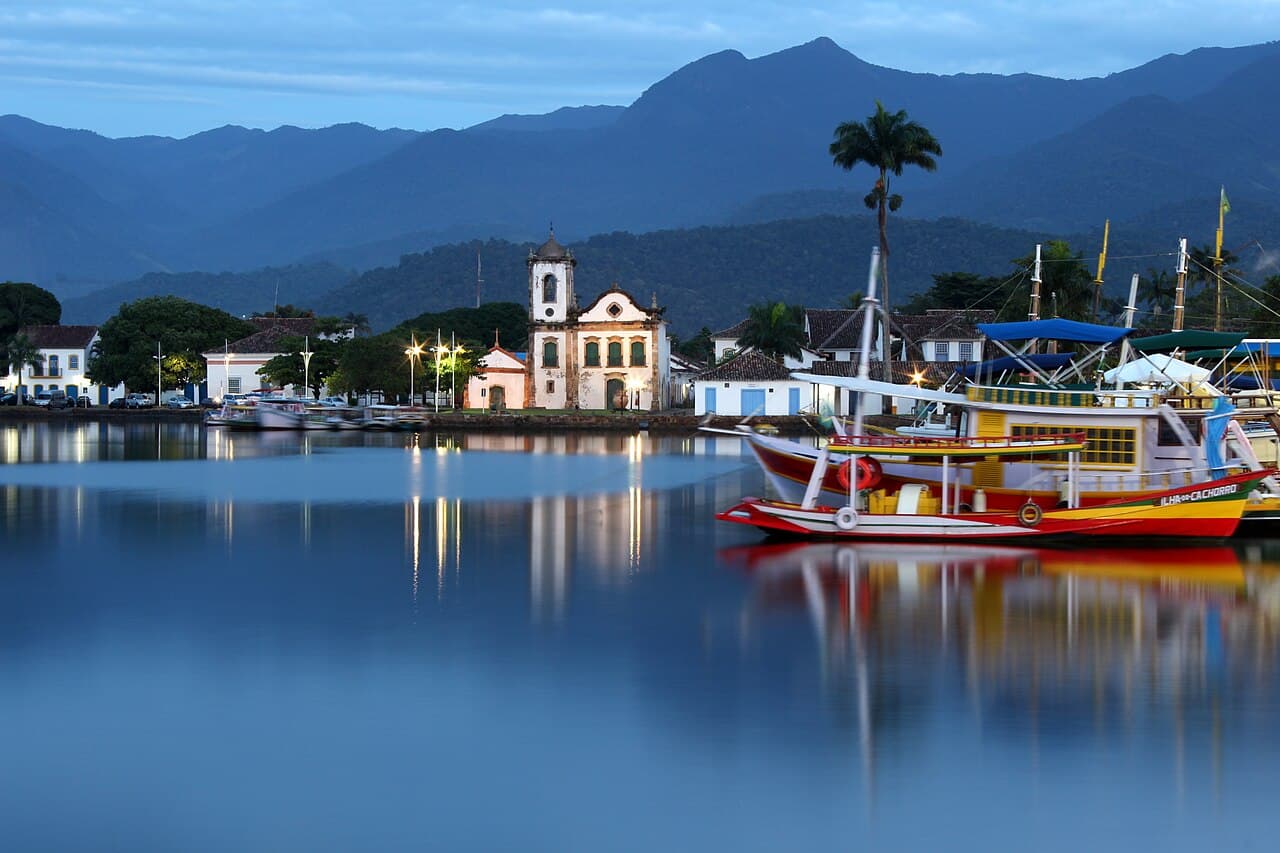
Paraty and Salvador are both colonial Brazil in UNESCO whitewash but the resemblance ends at the cobblestones. Paraty is a tiny preserved port on the Costa Verde — 36,000 people, schooners in the harbor running to Ilha do Pelado and Saco do Mamanguá, Atlantic Forest waterfalls (Cachoeira do Tobogã) behind the town, and a centro histórico that's been car-free since 1972. Salvador is the country's first capital (1549-1763) and the heart of Afro-Brazilian culture — Pelourinho's pastel-painted hill of baroque churches, the gold-leafed Igreja São Francisco interior, capoeira rodas in Largo do Pelourinho, and Olodum samba-reggae rehearsals every Tuesday night at 8 PM in the Rua Gregório de Matos.
There's no direct route — Paraty is a 4-hour Costa Verde Transportes bus from Rio (roughly 100 BRL), Salvador is 1,200 km farther up the coast and best reached by a 2-hour flight from GIG/SDU around 350-500 BRL on Azul or LATAM. Mid-range Paraty runs 130 USD/day; Salvador comes in at 115 USD with acarajé from Pelourinho street vendors (Cira and Dinha are the legendary baianas) at 10-12 BRL and moqueca at neighborhood spots like Maria Mata Mouro or Casa de Tereza for 80-110 BRL. Best months differ sharply — Paraty is April-September for dry colonial weather; Salvador's window is September-March for swimmable beaches at Porto da Barra and the Carnival season.
Pro tip: time Salvador for the second week of February if Carnival is the trip — it's the world's largest street party and rivals Rio's, with blocos like Filhos de Gandhy crowding Barra and Campo Grande for six days straight; book lodging four months out. Pick Paraty if a quiet cobblestoned schooner town with rainforest waterfalls 20 minutes inland sounds like the holiday. Pick Salvador if Pelourinho baroque mornings, Olodum drum nights, and an acarajé-and-moqueca food week are what you want from Brazil.
💰 Budget
🛡️ Safety
Paraty
Paraty is one of the safest tourist towns in Brazil — small, low-population, heavily dependent on tourism, and the historic centre is essentially a pedestrian zone with constant foot traffic. Violent crime is rare; petty theft is occasional; the main physical risks are the slippery cobblestones (sprained ankles are common), heatstroke on the trail, and rip currents on certain beaches.
Salvador
Salvador has real safety challenges and is among Brazil's cities where tourist caution is warranted. The Pelourinho is significantly safer than average during daylight hours due to police presence, but can be sketchy after dark. The Comércio (commercial port district) empties at night and becomes dangerous. Favela areas throughout the city should not be entered by visitors without a trusted local guide. That said, millions of tourists visit safely each year by following sensible precautions.
🌤️ Weather
Paraty
Paraty has a humid tropical climate moderated by the Atlantic — warm, wet summers (Dec-Mar) with frequent thunderstorms; mild, drier winters (Jun-Aug) that are the optimal travel window. The Serra do Mar wrings rain out of the prevailing wind year-round, so Paraty is consistently one of the wettest places in southeast Brazil — annual rainfall ~2,300 mm. Boat trips and forest hikes both require dry-ish weather, so the dry season is double-counted as the best time to visit.
Salvador
Salvador has a tropical climate and is warm year-round, with temperatures ranging from 24°C to 30°C (75-86°F) in most months. There is no true cold season. The main distinction is between the wet season (April to July) and the drier, sunnier season (September to March), which is when most tourists visit. The coast is moderated by trade winds and sea breezes year-round.
🚇 Getting Around
Paraty
Paraty is small and the historic centre is pedestrian-only — within town you walk everywhere. For day trips, the Costa Verde Transportes local bus runs to Trindade, the Penha valley waterfalls, and along the BR-101 to Angra dos Reis. Taxis and Uber (working but limited driver pool) cover the gaps. A rental car is convenient for the inland waterfalls and cachaça distilleries but unnecessary in town.
Walkability: Paraty's historic centre is one of the most walkable in Brazil — entirely car-free, six blocks across, surrounded by the harbour and river. Walking from one end of the centre to the other takes 10 minutes. Cobblestones are challenging; comfortable shoes essential.
Salvador
Salvador is a large, sprawling city built across a peninsula with an upper city and lower city connected by the famous Elevador Lacerda. Public transit exists but is complex — the metro has only 2 lines with limited coverage, and buses cover the city but can be confusing for visitors. Uber and 99 are widely available and are the recommended option for most tourist journeys.
Walkability: Walkability in Salvador is highly neighborhood-dependent. The Pelourinho historic center is excellent for walking and best explored on foot. Barra is also walkable along the waterfront. Beyond these areas, the city sprawls with heavy traffic, few pedestrian crossings, and hot sun making long walks impractical. Use Uber for journeys between neighborhoods.
📅 Best Time to Visit
Paraty
Apr–Sep
Peak travel window
Salvador
Jan–Mar, Sep–Dec
Peak travel window
The Verdict
Choose Paraty if...
You want a UNESCO colonial town that does double duty as a beach base — a perfectly walkable historic centre, a schooner-launching harbour, and Atlantic Forest hikes within 20 minutes of your guesthouse.
Choose Salvador if...
you want the cradle of Afro-Brazilian culture — Pelourinho, capoeira, Olodum drums, moqueca, and the world's biggest street Carnival
Salvador
Frequently asked
Is Paraty or Salvador cheaper?
Salvador is cheaper on average. A mid-range day in Paraty costs about $130 vs $115 in Salvador, so Salvador saves you roughly $15 per day compared to Paraty.
Is Paraty or Salvador safer?
Paraty scores higher on our safety index (75/100 vs 50/100). Paraty is one of the safest tourist towns in Brazil — small, low-population, heavily dependent on tourism, and the historic centre is essentially a pedestrian zone with constant foot traffic.
Is it easier to get by with English in Paraty or Salvador?
English is more widely spoken in Paraty (3/5 vs 2/5 on our scale). You'll find it easier to order food, ask for directions, and navigate transit in Paraty.
When is the best time to visit Paraty vs Salvador?
Paraty peaks in Apr–Sep. Salvador peaks in Jan–Mar, Sep–Dec. Both peak in Sep, so a single trip pairs them naturally.
How long is the flight from Paraty to Salvador?
Roughly 2h 8m on a direct flight (about 1,314 km / 816 mi). One-way fares typically run $120-350 depending on season and how far in advance you book.
How do daily costs in Paraty and Salvador compare?
In Paraty: budget ~$40-70/day, mid-range ~$100-180/day, luxury ~$350-800/day. In Salvador: budget ~$30-50/day, mid-range ~$80-150/day, luxury ~$200+/day.
You might also compare
ParatyvsSalvador
Try another