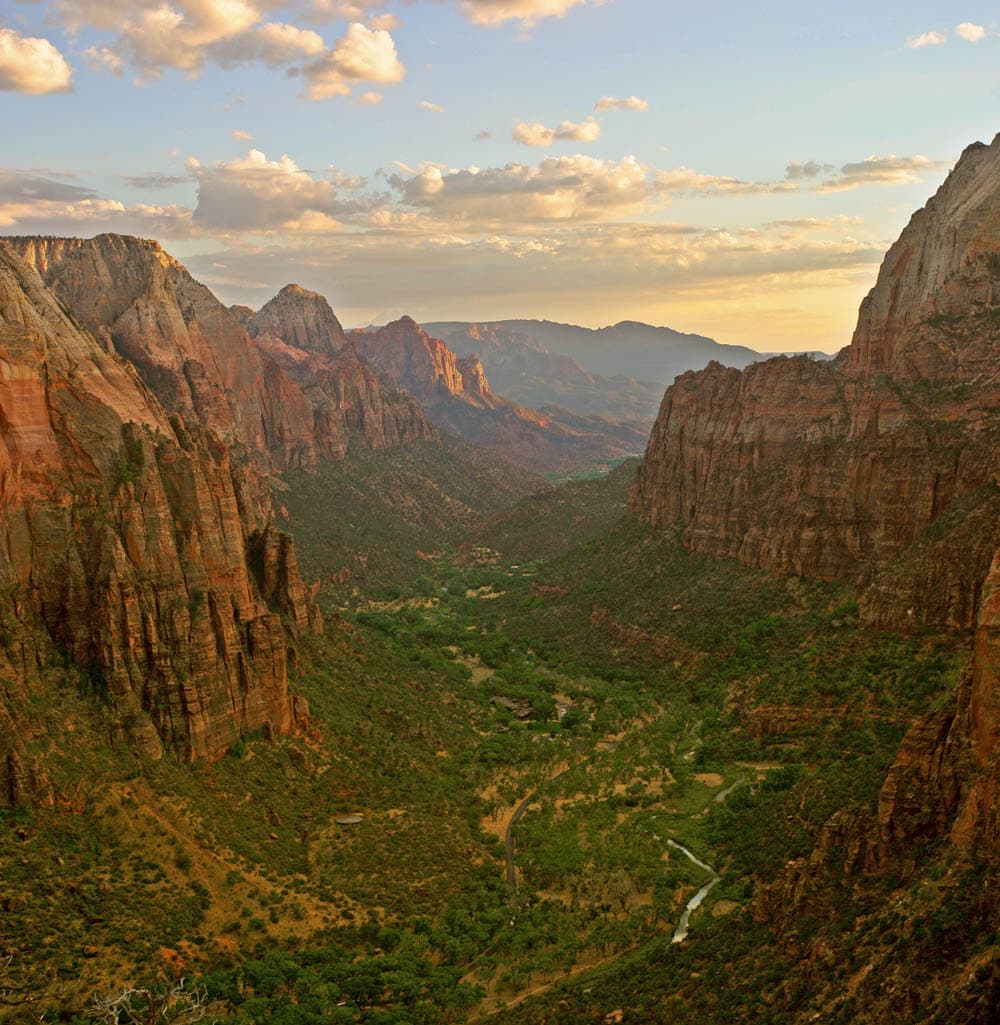
Zion National Park
THE QUICK VERDICT
By Anthony · Updated April 2026
Choose Zion National Park if you want red-rock slot canyons, Angels Landing's permit-lottery ridge, and the Narrows waded up the Virgin River.
- Best for
- Angels Landing chained ridge (lottery permit), Narrows wade up the Virgin River, Observation Point, mandatory canyon shuttle
- Two seasons
- Mar–May and Sep–Nov
- Budget anchor
- $310/day mid-range
- Costs bite
- Top 10% of destinations on daily spend ($310/day mid-range)
- Skip if
- flash-flood season July through September concerns you — slot canyons close on hours' notice and rescues happen
Zion is a slot canyon national park — the Virgin River carved red-and-white Navajo Sandstone walls up to 2,000 feet above the valley floor. It's the third most-visited U.S. park (4.5 million a year), which is why the Zion Canyon shuttle is mandatory April–November. Angels Landing's chained ridge requires a permit lottery and has killed hikers; the Narrows is a wade-up-river slot that closes on flash-flood days.
The two links below are affiliate links — MapSorted earns a small commission if you book through them, at no extra cost to you. How this works.
Tours & Experiences
Bookable tours, activities, and day trips in Zion National Park
Where to Stay
Compare hotels and rentals in Zion National Park
📍 Points of Interest
Angels Landing
The infamous chain-clutching ridge climb — permit required, 1,488 ft of elevation, sheer 1,000+ ft drops
The Narrows / Temple of Sinawava
The wade-up-the-river slot canyon — start from the Temple of Sinawava Riverside Walk
Emerald Pools Trailhead
Three tiers of pools and seasonal waterfalls from the Zion Lodge shuttle stop
Kolob Canyons Visitor Center· 25 km NW
The separate NW park entrance off I-15 exit 40 — 5-mile scenic drive and finger canyons
Court of the Patriarchs
A short paved overlook of three sandstone peaks named Abraham, Isaac, and Jacob — dawn light is magic
The Subway
Semi-circular water-carved tunnel of polished sandstone — permit required, technical canyoneering top-down
Riverside Walk
Paved 2.2-mile round-trip along the Virgin River to the mouth of the Narrows — accessible and beautiful
★ Local Picks
Observation Point
A 2,100 ft overlook looking DOWN on Angels Landing — best reached via East Mesa Trail
Canyon Overlook Trail
A 1-mile round trip on the east side of the tunnel with one of the park's best view-to-effort ratios
Watchman Trail
A 3.3-mile round trip straight from the visitor center to a sunset-lit Watchman overlook
At a Glance
- Pop.
- No permanent residents; ~4.5M visitors/year
- Timezone
- Denver
- Dial
- +1
- Emergency
- 911
Zion covers 146,000 acres in southwest Utah — Navajo Sandstone cliffs rise up to 2,000 feet in red-and-white bands, carved over millions of years by the North Fork of the Virgin River
Established in 1909 as Mukuntuweap National Monument, renamed Zion in 1918, and elevated to national park status in 1919 — it is Utah's oldest national park
Zion is the third most-visited national park in the United States with roughly 4.5 million visitors a year — and almost all of them funnel into a single 8-mile canyon
The park shuttle is MANDATORY on the Zion Canyon Scenic Drive from April through late November — no private vehicles allowed past Canyon Junction during shuttle season
The eastern entrance uses the 1930 Zion–Mt. Carmel Tunnel — vehicles over 7'10" wide or 11'4" tall need a $15 escort permit to pass through
Entry is $35 per vehicle for 7 days or $80 for the America the Beautiful annual pass — Zion is also one of the "Mighty 5" Utah national parks and commonly paired with Grand Canyon
Top Sights
Angels Landing
📌The most infamous day hike in America — 5.4 miles round trip with a 1,488-foot climb ending at a narrow sandstone fin with chains bolted into the rock and 1,000+ foot sheer drops on both sides. Multiple deaths over the years. As of 2022 the final half-mile (past Scout Lookout) requires a PERMIT via NPS lottery — apply in advance or day-before. Skip it if you have any fear of heights.
The Narrows
📌Wading up the Virgin River through a slot canyon where walls rise 1,000 feet and narrow to 20-30 feet across. The classic bottom-up route starts at the Riverside Walk and requires no permit — turn around whenever. Top-down is a 16-mile thru-hike requiring a permit and a shuttle. NEVER enter under a flash flood warning — a storm 10 miles away can kill you. Water stays 10-15°C even in summer; a drysuit and canyoneering boots are standard Nov-April.
Observation Point
📌A towering sandstone overlook 2,100 feet above the canyon floor with views looking down on Angels Landing itself. The traditional Weeping Rock trailhead has been closed by rockfall for years — the better approach now is the East Mesa Trail (7 miles round trip, mostly flat) from the east side of the park. Arguably a superior alternative to Angels Landing for the big view without the white-knuckle chains.
Emerald Pools
📌A three-tier network of pools and waterfalls — the Lower Pool is a short paved 1.2-mile round trip, the Middle Pool adds a scramble, and the Upper Pool sits against a massive hanging wall with seeping seasonal waterfalls. Crowded but legitimately beautiful, especially after spring snowmelt when the falls actually run.
Canyon Overlook Trail
📌A 1-mile round trip on the east side of the Zion-Mt. Carmel Tunnel that delivers one of the park's best big views for astonishingly little effort. Ledges, slickrock, and a dramatic overlook of Pine Creek Canyon and the lower Zion Canyon. No shuttle needed — park at the small lot immediately after the tunnel. The most underrated hike in the park.
Kolob Canyons
📌A completely separate entrance 30 miles northwest of the main park off I-15 exit 40 — finger canyons of vivid red Navajo Sandstone with a 5-mile scenic drive, short overlook hikes, and the Middle Fork Taylor Creek trail to the Double Arch Alcove. Gets a tiny fraction of main-canyon visitation despite being stunning.
The Subway
📌A semi-circular water-carved tunnel of polished sandstone — one of the most photogenic canyons in the Southwest. Requires a permit via NPS lottery (apply 3 months ahead). Bottom-up is a 9-mile scramble-and-wade out-and-back; top-down is full technical canyoneering with rappels, wetsuits, and route-finding. Not a casual hike — prepare seriously or go with a guide.
Riverside Walk
📌A paved 2.2-mile round-trip path along the Virgin River from the Temple of Sinawava shuttle stop — the gateway to the Narrows and an easy option for anyone not hiking into the water. Hanging gardens, cottonwoods, and sheer canyon walls rising straight from the river. Accessible to strollers and wheelchairs.
Costs & Currency
Where the money goes
USD per dayBackpacker = hostel dorm + street food + public transit. Mid-range = 3-star hotel + neighbourhood restaurants + transit cards. Luxury = 4/5-star + fine dining + taxis. How we calibrate these numbers →
Quick cost estimate
Customize per category →Estimates based on regional averages. Flight prices vary by season and airline.
budget
$75-130
Watchman Campground or dispersed BLM camping, groceries from St. George, shuttle-only transit, free trails, shared park entrance
mid-range
$220-400
Mid-tier Springdale motel, one guided outfitter half-day or Narrows rental, table-service dinners, car rental
luxury
$500-1,000+
Zion Lodge or Desert Pearl Inn peak rate, fine dining, private guide, helicopter tour, full canyoneering package
Typical Costs
| Item | Local | USD |
|---|---|---|
| EntryZion entry (per vehicle, 7 days) | $35 | $35 |
| EntryAmerica the Beautiful annual pass (all NPS) | $80 | $80 |
| EntryZion-Mt. Carmel Tunnel oversized vehicle escort | $15 | $15 |
| AccommodationWatchman Campground (tent site) | $20-30 | $20-30 |
| AccommodationSouth Campground (tent site) | $20 | $20 |
| AccommodationZion Lodge (in-park, book 12+ months ahead) | $250-450 | $250-450 |
| AccommodationSpringdale motel (peak season) | $150-300 | $150-300 |
| AccommodationSpringdale premium hotel (Desert Pearl, Cliffrose) | $300-500 | $300-500 |
| AccommodationSt. George chain hotel (45 mi west) | $100-180 | $100-180 |
| GearNarrows drysuit + boots + staff rental | $55-65/day | $55-65/day |
| GearNarrows neoprene socks + boots only (summer) | $25-35/day | $25-35/day |
| FoodCoffee and pastry in Springdale | $6-10 | $6-10 |
| FoodCasual lunch (Oscar's, Zion Pizza & Noodle) | $15-25 | $15-25 |
| FoodNice Springdale dinner (Bit & Spur, King's Landing) | $35-70 | $35-70 |
| TransportPark and town shuttles | Free | Free |
| TransportPaid Springdale day parking | $15-30/day | $15-30/day |
| ActivitiesGuided Narrows top-down day trip | $200-275 | $200-275 |
| ActivitiesGuided Subway canyoneering day | $220-320 | $220-320 |
| ActivitiesAngels Landing permit lottery fee | $6 application + $3/person | $6 + $3/person |
💡 Money-Saving Tips
- •Buy the America the Beautiful annual pass ($80) if you're hitting 3+ national parks in 12 months — it pays for itself immediately
- •Do the Narrows bottom-up from the Riverside Walk (free, no permit) instead of top-down (requires permit and a $40+ paid shuttle)
- •Camp at Watchman or South Campground ($20-30) instead of paying $250+ for Zion Lodge — book on recreation.gov 6 months ahead
- •Stay in St. George or Hurricane for 40-60% cheaper rooms than Springdale and a 45-minute drive in
- •Ride the free shuttles — paid Springdale parking runs $15-30/day and park village parking is impossible most of summer
- •Buy groceries at a Costco or Smith's in St. George before heading to Springdale — everything in town costs 30-50% more
- •Skip the drysuit if hiking the Narrows in July-August — just neoprene socks and boots ($25-35) are enough when the water is warmer
- •Use Kanab as a base for a Zion + Bryce + Grand Canyon North Rim trifecta — cheaper than Springdale and central to all three
- •Visit in shoulder season (March, early April, late October, November) for better rates and smaller crowds
- •Check the Angels Landing seasonal lottery months ahead OR the day-before lottery the evening before — the day-before is less competitive midweek
US Dollar
Code: USD
Standard US Dollars. ATMs are available at the Zion Lodge (in-park) and at banks and gas stations along Highway 9 in Springdale. Credit and contactless payments work essentially everywhere — the shuttle is free, the park accepts cards at entrance stations, and every outfitter, restaurant, and lodge takes Visa and Mastercard. Carry a small amount of cash for tips.
Payment Methods
Credit and debit cards accepted everywhere inside the park and throughout Springdale — entrance stations, visitor centers, lodge, restaurants, gas stations, outfitters, gift shops. Visa and Mastercard are universal; American Express widely accepted. Tap-to-pay and mobile wallets (Apple Pay, Google Pay) work at most terminals. Cash useful only for tips, small gift-shop items, and Springdale farmers market.
Tipping Guide
18-20% of the pre-tax bill is standard for table service. 20%+ for good service. Counter service and quick-serve does not require tipping (optional $1-2).
$2-5 per bag for bellhops. $3-5 per night for housekeeping, left in the room with a note. Zion Lodge, Desert Pearl, and Cliffrose staff expect this.
15-20% of the tour cost for guided canyoneering or Narrows day trips. $5-10 per person for shorter activities or shuttle drivers.
No tipping expected on rental counters (drysuits, boots, staff). A tip is appreciated for in-depth orientation talks or gear fitting.
$1-2 per drink or 15-20% of the total tab at Zion Lodge, Oscar's, and other Springdale bars.
Climate & Best Time to Go
Zion's desert climate is defined by vertical relief — the canyon floor sits at 4,000 feet while the rims reach 6,500+ feet, meaning conditions can differ by 5-10°C between stops on the same hike. Summer is brutally hot on exposed trails (35-40°C) with dangerous afternoon monsoon thunderstorms and flash flood potential in slot canyons. Winter brings ice on Angels Landing and snow on the rims, with the canyon floor hovering between 0-15°C. Spring and fall are the ideal windows. The Virgin River stays a bracing 10-15°C year-round — plan Narrows gear accordingly.
Spring
March - MayCanyon: 41-77°F / Rims: 32-68°F
Canyon: 5-25°C / Rims: 0-20°C
The best window alongside fall. Wildflowers bloom in April-May, waterfalls at Emerald Pools actually run after snowmelt, and temperatures are comfortable for long hikes. The Virgin River runs high and cold through May — the Narrows often closes briefly during peak runoff. Crowds build by spring break and stay high through May.
Summer
June - AugustCanyon: 68-104°F / Rims: 59-90°F
Canyon: 20-40°C / Rims: 15-32°C
Peak season and peak danger. Canyon floor hits 35-40°C with relentless sun and little shade on most trails. The monsoon kicks in mid-July through September with violent afternoon thunderstorms — flash floods kill people here (Keyhole Canyon 2015 killed 7). NEVER enter the Narrows or any slot canyon under a flash flood watch. Start hikes at dawn and be off exposed trails by noon.
Autumn
September - NovemberCanyon: 41-82°F / Rims: 32-72°F
Canyon: 5-28°C / Rims: 0-22°C
The other ideal window. Monsoon ends mid-September, crowds thin after Labor Day, and cottonwoods along the Virgin River turn brilliant yellow in late October. Temperatures drop into the most pleasant range of the year by October. Shuttle typically runs through late November before switching to private-vehicle winter mode.
Winter
December - FebruaryCanyon: 32-59°F / Rims: 23-46°F
Canyon: 0-15°C / Rims: -5-8°C
A quiet, magical season with private vehicles allowed on the Scenic Drive (shuttle typically doesn't run December-February except weekends around Christmas). Ice and snow on Angels Landing means the top section is often officially closed. Narrows requires a drysuit — water is frigid. Photographers love it: red rock dusted with snow is unforgettable.
Best Time to Visit
March through May and September through October offer the best combination of moderate temperatures, manageable crowds, and full trail access. Summer brings brutal heat, massive crowds, monsoon thunderstorms, and permit-lottery pressure. Winter is quiet and magical but the shuttle often doesn't run, the Narrows requires a drysuit, and Angels Landing's top section is typically iced out and unsafe.
Spring (March - May)
Crowds: Moderate (low in March, high by late May)One of the best windows. Wildflowers bloom, Emerald Pools waterfalls actually run after snowmelt, temperatures are comfortable on all trails. The Virgin River runs high and cold through May — the Narrows sometimes closes during peak runoff. Spring break weeks are intensely crowded.
Pros
- + Ideal hiking temperatures
- + Wildflower blooms
- + Waterfalls at peak flow
- + Shuttle fully running by April
Cons
- − Spring break extremely crowded
- − Narrows may close at peak runoff
- − Late snow on rims possible in March
Summer (June - August)
Crowds: Very high — peak seasonPeak crowds and peak danger. Canyon floor hits 35-40°C with relentless sun. Monsoon thunderstorms July-September bring flash flood risk in every slot canyon. Permit lottery for Angels Landing and Subway is at maximum competition. Narrows is the one silver lining — water is warmer and you can hike in shorts.
Pros
- + Narrows water warmest of the year
- + Long daylight hours
- + Full shuttle service and all programs running
- + Monsoon skies are dramatic photography
Cons
- − Extreme heat on exposed trails (dangerous)
- − Flash flood risk in slot canyons
- − Permit lottery crush
- − Accommodation prices peak
Autumn (September - October)
Crowds: Moderate in September, low-moderate in OctoberThe other ideal window. Monsoon ends mid-September, cottonwoods along the Virgin River turn brilliant yellow in late October, crowds thin noticeably after Labor Day, and temperatures drop into the most pleasant range of the year. The connoisseur season.
Pros
- + Best hiking temperatures of the year
- + Golden cottonwoods in late October
- + Post-monsoon clear skies
- + Thinner crowds
Cons
- − Narrows water cooling rapidly by mid-October
- − Drysuit required by November
- − Days shortening quickly
Winter (November - February)
Crowds: Very lowA quiet, magical season with minimal crowds and private vehicles allowed on the Scenic Drive (shuttle typically doesn't run December-February except weekends around Christmas). Ice on Angels Landing closes the top section officially or practically. Narrows requires a full drysuit. Photographers love it — red rock dusted with snow.
Pros
- + Minimal crowds
- + Private vehicles in the canyon
- + Red-rock-plus-snow photography
- + Lowest lodging rates
Cons
- − Angels Landing top section iced/closed
- − Narrows requires drysuit
- − Some trails closed for ice
- − Short daylight hours
🎉 Festivals & Events
Zion Half Marathon
NovemberA point-to-point half marathon held in Virgin/Springdale every November with the Zion cliffs as a backdrop. Draws a thousand-plus runners from around the country.
Springdale Farmers Market
May - September (Saturdays)Weekly farmers market in Springdale's Town Park with local produce, baked goods, live music, and crafts. Small but beloved local ritual through the warm months.
Dark Sky Star Parties
Year-round (weather-dependent)Zion is an International Dark Sky Park — the NPS hosts astronomy ranger programs periodically and several Springdale tour operators run dark-sky stargazing nights with telescopes.
Off the Beaten Path
Canyon Overlook Trail at Golden Hour
A 1-mile round trip just past the east side of the Zion-Mt. Carmel Tunnel — dramatic ledges, slickrock sections, and one of the best big-view overlooks in the park for astonishingly little effort. No shuttle needed, park at the small pullout immediately after the tunnel exit.
Skips the permit lottery and the shuttle chaos of the main canyon. At golden hour the light fills Pine Creek Canyon and lights up the lower Zion walls. Almost nobody talks about this trail — it is objectively one of the best view-to-effort ratios in any national park.
Kolob Canyons Separate Entrance
A 30-mile drive northwest of the main park off I-15 exit 40 — a 5-mile scenic drive through finger canyons of intense red sandstone plus hikes like Middle Fork Taylor Creek (5 miles RT to the Double Arch Alcove) and Timber Creek Overlook. Own visitor center and entrance station.
Kolob gets a tiny fraction of the visitation the main canyon gets, despite being the same park and arguably the most vivid red rock in it. Completely shuttle-free, family-friendly, and a welcome reset if you did three days in the Zion Canyon chaos.
Observation Point via East Mesa Trail
The traditional Observation Point trailhead near Weeping Rock has been closed by rockfall. The East Mesa Trail from the east side of the park is a 7-mile round trip that is mostly flat, reaches the same overlook, and has roughly 10% of the traffic.
You get a view that looks DOWN on Angels Landing — the same perspective everyone brags about on Angels Landing, minus the permit, the chains, and the white-knuckle fear. Requires a 4WD or high-clearance vehicle on the dirt access road to the trailhead.
Court of the Patriarchs at Dawn
The second shuttle stop in the canyon, with a short paved viewpoint of three massive sandstone peaks named Abraham, Isaac, and Jacob. Most visitors blow past it on the way to the Narrows — arrive on the first shuttle at dawn for golden light hitting the three peaks in sequence.
It's a 2-minute walk from the shuttle stop, so it's usually dismissed — but at dawn with no one there, the way the rising sun paints each peak separately is one of the best quiet photo moments in the park.
Watchman Trail at Sunset
A 3.3-mile round trip that starts directly from the visitor center and climbs to an overlook with the Watchman formation framed against the lower canyon. No shuttle required, moderate grade, and the return descent at dusk with the sandstone glowing red is a classic Zion moment.
Starting at the visitor center means you can walk straight from Springdale to this trailhead — no shuttle queue, no car, no parking hunt. Everyone rushes for Angels Landing sunset; Watchman gives you the same golden canyon light with a fraction of the crowd.
Safety Breakdown
Moderate
out of 100
Crime at Zion is a non-issue — the real hazards are natural and they kill people every year. Flash floods, falls from Angels Landing, heat illness, hypothermia in the Narrows, and dehydration are the big five. The single most important pre-hike habit: check the NPS flash flood forecast at the visitor center or nps.gov/zion before ANY slot canyon or Narrows trip. "Probable" or "Expected" risk means do not enter — a storm 10 miles upstream can kill you even in bright sunshine at the trailhead.
Things to Know
- •ALWAYS check the NPS flash flood forecast before the Narrows, Subway, or any slot canyon — "Probable" or "Expected" = do not enter. A storm miles away can still flood your canyon.
- •Apply for the Angels Landing permit via NPS lottery well before your trip (seasonal lottery months ahead + a day-before lottery). No permit = turn around at Scout Lookout.
- •If you have any meaningful fear of heights or exposure, skip Angels Landing — the chains section has killed people and the drops are vertical 1,000+ feet on both sides.
- •Drink electrolytes alongside water in summer — hyponatremia (low sodium from over-hydrating without salt) is as dangerous as dehydration and puts hikers in the ER every year.
- •Start hikes at sunrise in summer — be off Angels Landing, Observation Point, and any exposed trail before 11am when canyon temps spike.
- •The Virgin River is 10-15°C even in summer — if you are doing the Narrows in October-April, rent a drysuit and canyoneering boots from Springdale outfitters.
- •Watch for rockfall in the canyon — the Weeping Rock area closed permanently after a 2019 rockfall. Heed closure signs and listen for rumbles.
- •Rattlesnakes and scorpions are active spring through fall — watch where you place hands on ledges and don't sleep in the open without a tent.
- •Cell service is almost nonexistent in the canyon — tell someone your plan and return time before you set out.
Natural Hazards
Emergency Numbers
General Emergency
911
Zion NPS Emergency Dispatch
435-772-3256
Zion Canyon Medical Clinic (Springdale)
435-772-3226
Dixie Regional Medical Center (St. George)
435-251-1000
How to Get There
✈️ Airports
Harry Reid International (Las Vegas)(LAS)
160 miles southwest (2.5 hrs by car)The main fly-in hub for Zion — cheap flights globally, huge rental car fleet, and a 2.5-hour drive via I-15 north then Highway 9 east from Hurricane. The most common Zion itinerary is fly into LAS, drive, park in Springdale, shuttle in.
✈️ Search flights to LASSt. George Regional Airport(SGU)
45 miles west of Springdale (1 hr by car)A much smaller airport with primarily Delta, American, and United regional routes from SLC, DEN, DFW, PHX, and LAX. Rental cars available. A useful option if flights align — much shorter drive than Vegas.
✈️ Search flights to SGUSalt Lake City International(SLC)
310 miles north (4 hr 30 min by car)The closest full-service hub if you are doing a Mighty 5 loop. Long drive but scenic if you route via Bryce Canyon or Capitol Reef. Popular for visitors flying in one way and out another (SLC in / LAS out or vice versa).
✈️ Search flights to SLC🚆 Rail Stations
No passenger rail near Zion
There is no Amtrak service to Zion or southwest Utah. The nearest Amtrak stations are in Provo, Salt Lake City, or Grand Junction CO — none of them close enough to be practical. Car or shuttle from LAS, SGU, or SLC is the only realistic way in.
🚌 Bus Terminals
Zion South Entrance Station (Springdale)
The main and busiest entry, at the north end of Springdale on Highway 9. Entry is $35 per vehicle for 7 days, or $20 per person on foot or bicycle. Expect 15-45 minute queues in summer — arrive before 8am or after 4pm to minimize waits.
Zion East Entrance Station
On the east side of the park at the end of the Zion-Mt. Carmel Highway (Highway 9). Connects Zion to Bryce Canyon and Kanab. The highway passes through the 1930 Zion-Mt. Carmel Tunnel — vehicles over 7'10" wide or 11'4" tall must pay a $15 escort fee for one-way traffic control through the tunnel.
Kolob Canyons Entrance Station
A completely separate entrance 30 miles northwest of Springdale off I-15 exit 40. Own visitor center, own 5-mile scenic drive, own trailheads. Same $35 vehicle pass covers both entrances — hold onto your receipt.
Travel Connections

American Southwest
The parent region connecting Zion to Grand Canyon, Bryce, Arches, Monument Valley, and the Colorado Plateau. Start here for routing ideas if you are building a multi-park Southwest loop.

Grand Canyon National Park
The prime pairing with Zion — dramatically different scale (Grand Canyon goes down, Zion goes up) but geologically related and on every Southwest road-trip itinerary. A reasonable one-way drive or a natural loop via Page and Horseshoe Bend.

Bryce Canyon National Park
A completely different landscape — forests of orange hoodoos (spire-shaped rock columns) at 8,000-9,000 feet elevation, much cooler and drier than Zion. An easy add-on, often done as a day trip or one-night overnight from Zion. The Mighty 5 pairing of choice.

Las Vegas
The nearest major airport hub — LAS has cheap flights globally and a huge rental car fleet. Most Zion road trips fly into Las Vegas, drive 2.5 hours to the park, and loop back. The drive east on I-15 into the Virgin River Gorge is scenic in its own right.

Yosemite National Park
California's granite icon — Half Dome, El Capitan, giant sequoias, alpine meadows. Typically done as a separate trip rather than back-to-back, but sometimes paired on a west-coast parks grand tour.
Entry Requirements
Zion is in the United States. International visitors need either a US visa or an approved ESTA (Electronic System for Travel Authorization) if traveling under the Visa Waiver Program. US citizens and permanent residents need only a driver's license or passport for domestic flights. The park itself has no entry requirements beyond the $35 per-vehicle park pass (or $80 annual America the Beautiful pass).
Entry Requirements by Nationality
| Nationality | Visa Required | Max Stay | Notes |
|---|---|---|---|
| US Citizens | Visa-free | Unlimited | Domestic travel — only a REAL ID-compliant driver's license or passport required for flights. |
| UK Citizens | Visa-free | 90 days | ESTA required ($21, apply online 72+ hours before travel). Valid 2 years or until passport expires. Biometric e-passport required. |
| EU Citizens | Visa-free | 90 days | ESTA required for most EU nationalities ($21). A few EU nationalities still require a full B-1/B-2 visa — verify at your local US embassy. |
| Australian Citizens | Visa-free | 90 days | ESTA required ($21). Processing usually within minutes but can take up to 72 hours — apply at least 3 days before departure. |
| Canadian Citizens | Visa-free | 6 months | Valid passport required. No visa or ESTA needed. NEXUS pass holders can use expedited processing lanes. |
| Indian Citizens | Yes | As per visa | B-1/B-2 visitor visa required. Apply at US embassy/consulate. Interview and biometrics required. Processing can take 2-12 months depending on location. |
| Chinese Citizens | Yes | As per visa | B-1/B-2 visa required. 10-year multiple-entry visas are common. Interview and biometrics at US embassy/consulate. |
Visa-Free Entry
Tips
- •Apply for ESTA only on the official esta.cbp.dhs.gov site — avoid third-party sites that charge inflated fees
- •Apply for the Angels Landing permit well before your trip via the seasonal lottery, or the day-before lottery at 12:01am MT the night before
- •Your $35 vehicle park pass covers both the main entrance and the Kolob Canyons entrance — keep the receipt
- •Buy the America the Beautiful annual pass ($80) if you're visiting 3+ national parks in 12 months — it pays back immediately
- •Carry ID at all times — the park is federal property and rangers may request identification
- •Passport must be valid for the duration of your US stay (most Western nationalities are not subject to the 6-month rule, but verify)
Getting Around
Zion's transportation story is simple: the free park shuttle is MANDATORY on the Zion Canyon Scenic Drive April through late November — no private vehicles past Canyon Junction. The shuttle runs a 9-stop loop roughly every 10-15 minutes, takes about 45 minutes end-to-end, and stops at every major trailhead and viewpoint. Springdale (the gateway town) has its own free town shuttle connecting lodges, restaurants, and the park entrance. A private car is only useful on the main drive December through early March, for reaching Kolob Canyons (30 miles northwest, separate entrance), or for the Zion-Mt. Carmel Highway. There is no rideshare service inside the park.
Zion Canyon Shuttle (free)
Free with park entranceThe mandatory in-park shuttle on the Zion Canyon Scenic Drive — 9 stops from the visitor center to Temple of Sinawava, buses every 10-15 minutes from early morning (typically 6-7am) to late evening. A full loop takes about 45 minutes. No reservations required. Runs April through late November.
Best for: All in-canyon trailheads during shuttle season — use this, not your car
Springdale Town Shuttle (free)
FreeA separate free shuttle running through Springdale with 9 stops from the Majestic View area to the pedestrian bridge at the south park entrance. Connects hotels, restaurants, and outfitters to the park entry. Runs March through late October.
Best for: Guests at Springdale hotels walking to the park entrance
Private Vehicle
Fuel $30-60 per tank; Springdale paid lots $15-30/dayRequired for Kolob Canyons (separate entrance 30 miles NW off I-15), the Zion-Mt. Carmel Highway over the east side, and Canyon Overlook trailhead parking. Also the only option on the main Scenic Drive December through early March when the shuttle is parked for winter. Springdale parking fills fast in peak season — arrive early.
Best for: Kolob Canyons, east-side drives, winter canyon access
Pa'rus Trail (Walking)
FreeA paved 1.7-mile pedestrian and bike trail from the visitor center to Canyon Junction — follows the Virgin River, accessible to strollers and wheelchairs, and the only in-canyon trail that allows bicycles. A great first-morning stretch or a way to skip the busiest shuttle leg.
Best for: Skipping the first shuttle leg, biking into the canyon, early-morning walks
Guided Canyoneering & Hiking Tours
$150-400 per person per dayZion Adventure Company, Zion Guru, and Zion Mountain School run guided Narrows top-down trips, Subway canyoneering days, and Angels Landing alternatives. Required for technical canyons if you don't have your own skills and gear.
Best for: Permit-required canyons (Subway), winter Narrows, canyoneering beginners
Walkability
Springdale itself is extremely walkable — a linear town strung along Highway 9 with restaurants, outfitters, and lodges all within a mile of each other. Inside the park the shuttle handles the vertical distances; hiking trails are a mix of paved strolls (Riverside Walk, Pa'rus) and serious climbs (Angels Landing, Observation Point). Kolob Canyons has its own scenic drive and short trailheads but is not pedestrian-connected to the main canyon.
Shopping
Shopping in Zion centers on Springdale — essentially a one-street gateway town where outfitters, galleries, and souvenir shops line Highway 9 between the park entrance and the town's south end. Inside the park, the Zion Human History Museum and the Zion Canyon Visitor Center each have small NPS bookstores. If you are doing the Narrows, drysuit and canyoneering boot rental from Springdale outfitters is essentially mandatory November through April — reserve in advance during peak season.
Zion Outfitter
outdoor outfitterImmediately outside the park entrance — the most convenient Narrows gear rental in Springdale. Drysuits, neoprene socks, canyoneering boots, wooden hiking staffs, and dry bags. Reserve online during peak season.
Known for: Narrows drysuit rental ($55-65/day), canyoneering boots, hiking staffs
Zion Adventure Company
outfitter & guide serviceThe oldest guide operation in town — rental gear for the Narrows plus full guided canyoneering trips (Subway, technical slot canyons). Their Narrows orientation talk is worth the $5 even if you rent elsewhere.
Known for: Narrows rentals, guided Subway and Keyhole canyoneering, Angels Landing alternatives
Zion Canyon Visitor Center Bookstore
park bookstoreThe main NPS bookstore operated by Zion Forever Project (park non-profit partner) — geology books, field guides, Zion-specific hiking guidebooks, NPS passport stamps, and kid-friendly ranger gear. Proceeds support park programs.
Known for: NPS passport stamps, geology books, official Zion guidebooks
Zion Human History Museum Shop
museum shopAt the second shuttle stop — a small, carefully curated shop inside the Human History Museum focused on Southwest Native American history, Ansel Adams prints, and park-specific souvenirs. Worth the walk-through whether or not you buy.
Known for: Ansel Adams prints, Native American history books, Zion souvenirs
Worthington Gallery
art galleryOne of several Springdale galleries along Highway 9 — pottery, Southwest-themed paintings, turquoise jewelry, and regional photography. A cut above the usual gift-shop souvenirs if you want to take home something real.
Known for: Southwest pottery, turquoise jewelry, regional fine art
Sol Foods Market (Springdale)
groceryA small Springdale grocery with surprisingly good organic produce, sandwich counter, and trail snacks — convenient but pricey. For a serious grocery run do it in St. George (45 miles away) where a Costco and full supermarkets cut prices in half.
Known for: Trail snacks, sandwich counter, last-chance groceries
🎁 Unique Souvenirs to Look For
- •NPS passport stamp from Zion (stamp stations at the main visitor center and Kolob Canyons visitor center — collect both)
- •A Zion-specific hiking guidebook (Falcon Guides and Zion Forever publish the serious trail references)
- •Ansel Adams Zion prints — the Human History Museum shop has the curated selection
- •Southwest turquoise-and-silver jewelry from Springdale galleries (not the cheap highway roadside stands)
- •Zion Forever Project membership or annual pass sticker for your backpack or bumper
- •America the Beautiful annual pass ($80) if you're doing multiple national parks this year
- •A wooden hiking staff from Zion Outfitter — many hikers buy one after renting it for the Narrows
Language & Phrases
English is universal. Park signs are in English with some Spanish translation. The specialized terms below are the canyoneering/desert jargon you'll hear from rangers, outfitters, and experienced hikers. Knowing them makes the Narrows orientation and permit briefings make sense immediately.
| English | Translation | Pronunciation |
|---|---|---|
| Slot canyon | A narrow water-carved canyon with walls often closer than they are tall | The Narrows and the Subway are both slots — deadly in flash floods |
| Flash flood watch / warning | NPS daily forecast for slot canyon flood risk — "Probable" or "Expected" = do not enter | Check the visitor center or nps.gov/zion before any slot canyon day |
| CFS (cubic feet per second) | Measure of Virgin River flow rate | SEE-eff-ess — Narrows closes around 150 CFS; sweet spot is 30-80 CFS |
| The Narrows | The 16-mile slot canyon stretch of the Virgin River above Temple of Sinawava | Bottom-up needs no permit; top-down requires a permit and a shuttle |
| Angels Landing chains | The bolted chain section on the final half-mile of Angels Landing | Permit required since 2022 — past Scout Lookout is permit-only |
| Permit lottery | NPS-run random drawing for Angels Landing, the Subway, and backcountry permits | Seasonal lottery months ahead + a day-before lottery the night before |
| The Subway | A semi-circular water-carved slot on the Left Fork of North Creek | SUB-way — technical canyoneering top-down, or 9-mile scramble bottom-up |
| Scramble | Climbing using hands and feet on non-technical rock — between hiking and climbing | SKRAM-bul — no rope needed, but sure footing required |
| Drysuit | Fully sealed wetsuit-style garment for cold-water Narrows hiking | DRY-soot — rent in Springdale Nov-April; water stays 10-15°C |
| Wet canyon | A canyoneering route involving wading, swimming, or rappelling into water | As opposed to a dry canyon — gear and timing differ significantly |
| Leave No Trace | The ethical backcountry code: pack out everything | LNT for short — includes food waste, toilet paper, and all trash |
| Mighty 5 | Utah's five national parks: Zion, Bryce, Capitol Reef, Arches, Canyonlands | Common Utah road-trip branding — Zion is usually first or last on the loop |
If you like Zion National Park, you'll love…
4 cities with a similar vibe, outside of the same country.

Sweden · OVR 79
landscapes that steal the show · reliable wifi, decent English

Faroe Islands · OVR 78
landscapes that steal the show · workable for remote days

Norway · OVR 79
unforgettable natural beauty · reliable wifi, decent English

New Zealand · OVR 76
jaw-dropping scenery · reliable wifi, decent English