
Sarandë
THE QUICK VERDICT
By Anthony · Updated April 2026
Choose Sarandë if You want the cheapest swim-and-ruins combination in Europe — Ionian beaches, the UNESCO Butrint site, ferry-distance to Corfu, and a €65/day all-in cost roughly half of Greece across the water..
- Best for
- Butrint UNESCO ruins, Ksamil island swims, Lëkurësi Castle sunset, ferry across to Corfu in 30 minutes
- Two seasons
- May–Jun and Sep–Oct
- Budget anchor
- $65/day mid-range
- Real bargain
- Bottom 10% on daily spend ($65/day mid-range)
- Worth a look
- Albanian Riviera prices run roughly half of Greece across the strait for the same Ionian water
Sarandë is the southern anchor of the Albanian Riviera — a horseshoe bay of pebble beach and pastel apartment blocks staring across 18 km of Ionian Sea at the Greek island of Corfu. From the hilltop Lëkurësi Castle (a 30-minute climb or a €5 taxi) you get the photogenic two-bay sunset; from the harbour ferries cross to Corfu in 30 minutes (€19, multiple daily); and from the bus station the Ksamil islets (turquoise coves, swim-out distance) and the UNESCO Butrint ruins (Greek-Roman-Byzantine-Venetian, 2,500 years of city stacked on an island) are 15 and 25 minutes south. The town itself is honest about being a beach resort first — most architecture is post-1991 — but the location is hard to beat in Europe at €60/day all-in.
The two links below are affiliate links — MapSorted earns a small commission if you book through them, at no extra cost to you. How this works.
Tours & Experiences
Bookable tours, activities, and day trips in Sarandë
Where to Stay
Compare hotels and rentals in Sarandë
📍 Points of Interest
Butrint National Park (UNESCO)· 15 km S
Greek-Roman-Byzantine-Venetian-Ottoman archaeological palimpsest on a small island — 2,500 years of layered ruins
Ksamil Islets
Three uninhabited turquoise-water islets a swim-out from the Ksamil village beach
Lëkurësi Castle
1537 Ottoman-era hilltop castle with panoramic two-bay sunset view over Sarandë
Blue Eye Spring (Syri i Kaltër)· 17 km E
Natural spring with deep-blue water bubbling from a 50m+ underwater cave — depth never measured
Sarandë Waterfront Promenade
2 km pedestrian promenade — cafés, bars, ice-cream stands, evening xhiro stroll culture
Synagogue & Basilica Mosaic
Layered Roman-era synagogue mosaic and later Christian basilica — discovered 2003, free entry
Corfu Day Ferry
30-min daily passenger ferry to Corfu Town — €19 each way, perfect day trip
Mirror Beach (Plazhi i Pasqyrave)
Quiet white-pebble cove 7 km north of Sarandë — clearer water and far fewer crowds than Ksamil
Sarandë Archaeological Museum
Modest museum with finds from Butrint, Phoinike, and ancient Onchesmos — useful Butrint primer
Phoinike (Phoenice) Ruins
Greek-Roman archaeological site 28 km northwest — ancient Chaonian capital, 3rd-century BC theatre
★ Local Picks
Llogara Pass Coastal Drive· 51 km NW
SH8 mountain coastal road climbing to 1,043m — one of Europe's great underrated coastal drives
Taverna Kuzhina e Liqenit· 14 km S
Small lakeside taverna near Butrint — Lake Butrint mussels with view across to the ruins
At a Glance
- Pop.
- 23K
- Timezone
- Tirane
Sarandë sits on a horseshoe bay of the Ionian coast staring across 18 km of sea at the Greek island of Corfu — a daily passenger ferry connects the two in 30 minutes (~€19), making Sarandë the most easily accessible Albanian destination from Greece
The Albanian Riviera (the coastal strip from Sarandë north to Vlorë) is broadly considered one of the last affordable Mediterranean coasts in Europe — typical all-in costs run €50-80/day, roughly half what neighbouring Greece costs across the water
The UNESCO Butrint archaeological site — Greek, Roman, Byzantine, Venetian, and Ottoman ruins stacked on a small island 25 km south of Sarandë — is one of the great archaeological palimpsests in the Mediterranean and was inscribed in 1992
The Ksamil islets — three small uninhabited islets a few hundred metres off the coast 18 km south of Sarandë — have water clarity and turquoise colour comparable to the Cyclades or the Maldives at a fraction of the price
Sarandë's name comes from the 6th-century Byzantine monastery of Agioi Saranta (Forty Saints) — modern Sarandë is largely a post-1991 town built after the fall of communism, with Greek-Orthodox-Albanian-Muslim culture mixed in unique proportions
The Lëkurësi Castle ruins on the hill above town give you the iconic two-bay panoramic photo of Sarandë at sunset — the climb takes 30 minutes on foot or €5-7 by taxi
Top Sights
Butrint National Park (UNESCO)
📌The single most important archaeological site in Albania — Butrint is a small island in the Vivari Channel where a Greek city was founded in the 7th century BC, then layered over by Romans, Byzantines, Venetians, and Ottomans over the next 2,500 years. The 3rd-century BC Greek theatre, Roman baths, Byzantine basilica with original mosaic floor, Venetian triangular fortress, and Ottoman triangular castle are all walkable on a 2-hour loop. Entry 1,000 lek (~$10); allow half a day. 25 km south of Sarandë; reach by hourly local minibus (200 lek), taxi (€20-25 round trip), or organised tour. The single-best Albanian site for non-specialist visitors.
Ksamil Islets
🏖️Three small uninhabited islets a few hundred metres off the Ksamil village coast (18 km south of Sarandë) — postcard-turquoise water, fine sand, and a swim-out distance from the village beach (or pedalo rental for ~€10/hour). The water clarity is genuinely remarkable for European standards. Beach restaurants on the village side serve grilled fish for €10-18; bars on the islet side run honesty-box service. Crowded in July-August; far more pleasant May-June and September-October.
Lëkurësi Castle
📌The ruined Ottoman-era hilltop castle (built 1537) directly above Sarandë — the climb (30 min on foot, or €5-7 taxi up the back road) gives you the iconic two-bay panoramic photo of the town below. The castle interior is now a restaurant; sunset on the terrace with a beer (~€2-4) is the obligatory Sarandë moment. Free to access the viewing platform; restaurant prices are touristy but the location justifies them.
Blue Eye (Syri i Kaltër)
🌿A natural spring 22 km east of Sarandë — clear, cold, deep-blue water bubbling up from a 50m+ deep underwater cave, with the colour shading from light blue at the edges to the impossibly deep blue at the centre. The depth has never been fully measured. Surrounded by a small forest reserve with viewing platforms; swimming officially banned (but locals jump in anyway). Entry 50 lek (~$0.50); reach by minibus, organised tour, or rented car. Combine with the Mesopotam monastery on the same drive.
Sarandë Promenade
📌The 2 km waterfront promenade running the length of Sarandë's horseshoe bay — pedestrian-only, lined with cafés, bars, ice-cream stands, and bench seating facing the Ionian. Locals pass the evening here in the traditional Mediterranean xhiro (evening stroll). Most of Sarandë's social life happens on the promenade between 18:00 and 23:00, especially in summer. Free; the heart of the town.
Synagogue & Basilica Mosaic Floor
📌The remains of a 5th-6th-century Roman-era synagogue beneath modern Sarandë — discovered in 2003 — with a remarkable mosaic floor depicting menorahs, citrons (etrog), and ram's horns. The synagogue was later converted to a Christian basilica with a different mosaic layered over it. The two layers are exhibited together. Free entry (donations); closed Mondays. 30 minutes; one of Sarandë's most underrated sights.
Day Ferry to Corfu
📌The 30-minute morning ferry from Sarandë harbour to Corfu Town — daily departure typically 09:30, return 18:30 (€19 each way; book at the harbour ticket booth). Corfu Old Town (a UNESCO site itself) is walkable from the ferry pier; the EU's Greece is a striking price contrast (cappuccino €4 in Corfu, €1.20 in Sarandë). Bring your passport — Albania is non-Schengen so this counts as an international border crossing.
Mirror Beach (Plazhi i Pasqyrave)
🏖️A small protected cove 7 km north of Sarandë — clear water, white pebbles, and far less crowded than Ksamil. Reached by city bus #2 (50 lek), 15 min taxi (€8-12), or rented car. Two beach bars serving food and drinks. The most pleasant beach in walking distance of Sarandë proper; combine with the Manastiri 40 Saints monastery ruins on the same hill.
Sarandë Archaeological Museum
🏛️A modest but genuinely interesting museum showcasing finds from Butrint, Phoinike (a major nearby Greek archaeological site), and Sarandë's ancient origins as Onchesmos (Hellenistic and Roman port). Entry 200 lek (~$2); 45 minutes. Most foreign visitors skip it for Butrint itself but the context here makes Butrint richer.
Phoinike (Phoenice) Ruins
📌A second major Greek-Roman archaeological site 28 km northwest of Sarandë — the ancient capital of the Chaonian Greeks, with a still-functional 3rd-century BC theatre, Hellenistic walls, and a Roman-era basilica complex. Far quieter than Butrint and free or 200 lek entry. Best with a rented car or taxi (€30 round trip from Sarandë). 1.5-2 hours on site; combine with a stop at Konispol or the Ali Pasha tekke.
Costs & Currency
Where the money goes
USD per dayBackpacker = hostel dorm + street food + public transit. Mid-range = 3-star hotel + neighbourhood restaurants + transit cards. Luxury = 4/5-star + fine dining + taxis. How we calibrate these numbers →
Quick cost estimate
Customize per category →Estimates based on regional averages. Flight prices vary by season and airline.
budget
$25-45
Hostel dorm or budget guesthouse, market lunches and bakery breakfasts, furgon to Butrint and Ksamil, free promenade evenings
mid-range
$55-100
Mid-range guesthouse or 3-star hotel, restaurant dinners with wine, taxi day trips, museum entries, Lëkurësi sunset drink
luxury
$150-350
Boutique seafront hotel (Hotel Brilant Antik, Mango Beach Hotel), private guide for Butrint and Phoinike, fine dining, day-trip to Corfu, rental car
Typical Costs
| Item | Local | USD |
|---|---|---|
| AccommodationHostel dorm | 1,500-2,500 lek/night | $15-26 |
| AccommodationMid-range guesthouse double | 4,500-8,500 lek/night | $47-90 |
| AccommodationBoutique seafront hotel | 12,000-22,000 lek/night | $126-230 |
| FoodBakery breakfast (byrek + coffee) | 300-500 lek | $3-5 |
| FoodRestaurant dinner with wine | 1,200-2,500 lek | $13-26 |
| FoodGrilled fish at a beach taverna | 1,500-2,800 lek | $16-29 |
| FoodKorça beer at a bar | 200-300 lek | $2-3 |
| FoodCoffee at a centro café | 100-180 lek | $1-2 |
| TransportFurgon to Ksamil | 200 lek | $2 |
| TransportFurgon to Butrint | 200 lek | $2 |
| TransportFurgon to Tirana | 2,200 lek | $23 |
| TransportTaxi to Lëkurësi | 500-700 lek | $5-7 |
| TransportTaxi to Ksamil | 1,400-2,000 lek | $15-20 |
| TransportCorfu ferry one-way | ~1,800 lek (€19) | $19 |
| TransportRental car / day | 2,400-3,800 lek | $25-40 |
| AttractionsButrint UNESCO entry | 1,000 lek | $10 |
| AttractionsLëkurësi Castle viewpoint | Free | Free |
| AttractionsBlue Eye spring entry | 50 lek | $0.50 |
| AttractionsSarandë Archaeological Museum | 200 lek | $2 |
💡 Money-Saving Tips
- •Take furgons (200-300 lek) instead of taxis (€15-30) for day trips to Ksamil, Butrint, and the Blue Eye — same destination, fraction of the price
- •Eat at konobas (small family-run tavernas) rather than promenade restaurants — typical full meal 1,200-1,800 lek vs 2,500+ on the promenade
- •Bakery breakfasts (byrek + coffee for 300-500 lek) are excellent and a fraction of hotel breakfast costs
- •The Lëkurësi sunset is free if you walk up the staircase (30 min) instead of taxi up; bring a beer from a kiosk and skip the restaurant markup
- •Travel in May-June or September-October — accommodation prices are 30-50% below July-August peak
- •Day-trip to Corfu by ferry rather than overnighting on Corfu — ferry €19 each way vs Corfu hotels €100-300+/night
- •Rent a car for one day to do Llogara → Himarë → Phoinike — €25-40 for the day is cheaper than three separate taxis and far more flexible
- •Carry small-denomination Euros for tourist transactions — sometimes accepted at better effective rates than ATM-based lek
Albanian Lek
Code: ALL
1 USD is approximately 95 ALL; 1 EUR is approximately 100 ALL (early 2026). ATMs are widespread in Sarandë — Raiffeisen Bank, Credins Bank, and Intesa Sanpaolo machines are reliable for foreign cards. Many tourist-facing businesses (hotels, restaurants, ferries, taxis) accept Euros directly, sometimes giving better value than the official ATM exchange rate. Avoid changing money at hotels (poor rates); use the airport on arrival or downtown ATMs.
Payment Methods
Cash is preferred at small restaurants, market stalls, furgons, taxis, and most attractions. Credit cards (Visa, Mastercard) accepted at hotels, larger restaurants, and supermarkets. American Express less widely accepted. Contactless payments are growing in Tirana and partly in Sarandë but cash remains essential. Carry both lek and small Euros (€5, €10, €20) — Euros are widely accepted in tourist transactions.
Tipping Guide
10% is standard at sit-down restaurants — tipping is appreciated but not always expected. Some tourist-oriented restaurants add a service charge; check the bill.
Not expected for casual coffee or beer. At cocktail bars or for table service, leaving small change (50-100 lek / €0.50-1) is appreciated.
Not expected; round up to the nearest 100 lek for convenience.
€5-10 per person for a half-day group tour, €15-25 per person for a full-day private guide. Tip in Euros if you have them; lek equally fine.
100-200 lek (~$1-2) per bag for porters. 100-200 lek/day for housekeeping at upscale hotels.
No tipping expected on the Corfu ferry.
Climate & Best Time to Go
Sarandë has a Mediterranean climate — hot, dry summers (June-September) with reliably blue skies and warm sea; mild, wet winters (November-March) when most of the year's rainfall arrives in heavy short bursts. Spring (April-May) and autumn (September-October) are the optimal travel windows: warm enough for swimming, cool enough for archaeology, with very few crowds. The summer sea temperature peaks around 26°C; the winter sea drops to 14°C and most coastal businesses close for a few months.
Spring
April - May54 to 75°F
12 to 24°C
Warming up — wildflowers across the hills around Butrint, sea temperature climbing into swimmable range by mid-May, and crowds still very low. May is the single best month: warm, dry, uncrowded. April still has occasional rain.
Summer
June - August68 to 90°F
20 to 32°C
Hot, dry, and at peak crowds — Albanian and Italian families converge on the Riviera in July and especially August. Sea temperature 23-26°C. Daytime can hit 35°C inland; the coastal breeze keeps it comfortable on the beach. Hotel prices in July-August are 50-100% above shoulder season.
Autumn
September - October54 to 82°F
12 to 28°C
The other sweet spot — September is warm and the sea stays swimmable into early October. Crowds drop dramatically after the first week of September. October cools to spring-like temperatures. The first significant rains usually arrive late October.
Winter
November - March43 to 61°F
6 to 16°C
Mild but wet — most of the year's rainfall arrives in heavy short bursts, with sunny days mixed in. Many coastal restaurants and hotels close from late October to March. Ferries to Corfu run a reduced winter schedule. Butrint is at its most atmospheric (foggy mornings, no crowds) but the swimming is finished.
Best Time to Visit
May-June and September-October are the optimal windows — warm enough for swimming, cool enough for archaeology, lower crowds, and 30-50% cheaper than peak summer. Avoid mid-July to mid-August (peak Albanian and Italian holiday season, very crowded, prices double). November-March is too cool for swimming and many coastal businesses close.
Spring (April - May)
Crowds: LowWarming up — wildflowers in the Butrint hills, sea climbing into swimmable range by mid-May, very low crowds. May is the single best month: 24°C days, lowest prices, all sights open. April still has occasional rain.
Pros
- + Warm, dry, low crowds
- + Wildflowers and lush green hills
- + Sea swimmable from mid-May
- + Lowest accommodation prices
- + All sights and ferries operating
Cons
- − April still has some rain
- − Sea cool until mid-May
- − Some seasonal restaurants not yet open
Summer (June - August)
Crowds: Very high (peak in August)Hot, dry, and at peak crowds. June is excellent (warm, sunny, sea 22°C, crowds still moderate). July-August is the Albanian and Italian holiday peak — Ksamil and the promenade are very crowded; hotel prices double. August is the most crowded month.
Pros
- + Reliable hot and sunny weather
- + Sea at 24-26°C
- + Long daylight (sunset 20:30)
- + All festivals and beach scenes running
Cons
- − Maximum crowds in July-August
- − Hotel prices double
- − Restaurants packed
- − Very hot inland (35°C+)
- − Beaches crowded
Autumn (September - October)
Crowds: Moderate to lowThe other sweet spot — September is warm, the sea stays swimmable into early October, and crowds drop dramatically after the first week of September. October cools to spring-like temperatures.
Pros
- + Excellent September weather
- + Sea swimmable through early October
- + Crowds drop dramatically after first week of September
- + Lower prices
- + Best month for archaeology with cool walking weather
Cons
- − First rains arrive late October
- − Sea cooling after mid-October
- − Some seasonal restaurants closing in October
Winter (November - March)
Crowds: Very lowMild but wet — most of the year's rainfall arrives. Many coastal restaurants and hotels close. Ferries to Corfu run reduced winter schedules. Butrint at its most atmospheric (foggy, no crowds) but the swimming is finished.
Pros
- + Atmospheric, foggy Butrint
- + No crowds anywhere
- + Lowest prices of the year
- + Inland Albania accessible without summer heat
Cons
- − Heavy rain
- − Many coastal businesses closed
- − No swimming
- − Reduced ferry schedule
- − Short daylight
🎉 Festivals & Events
Sarandë Beach Festival
July (varies by year)A 2-3 day electronic music and beach culture festival on the Sarandë beachfront — international DJs, light shows, and beach parties. Tickets typically €25-60. Hotels book up months ahead for the festival weekend.
Independence Day
November 28The 1912 Albanian independence anniversary — flag-waving, fireworks, and concerts in Skanderbeg-named squares across the country. Sarandë's celebration is modest but heartfelt; restaurants stay open later.
New Year's Eve
December 31A surprisingly big celebration in Albania — fireworks over the bay, restaurants open, and a strong Albanian-diaspora returning-home tradition. The shoulder-season hotel price spike for one week.
Easter (Orthodox calendar)
Late April / early MayBoth Orthodox and Catholic Easter are celebrated; Orthodox Easter is more important in southern Albania. Local processions, family meals, and Easter-bread traditions. Restaurants busy on Easter Sunday.
Day of the Sea (Dita e Detit)
June (variable)A modest beach-culture day with concerts and water sports along the Albanian Riviera, including Sarandë. Local rather than international.
Off the Beaten Path
Taverna Kuzhina e Liqenit (near Butrint)
A small lakeside taverna at the edge of the Butrint National Park lagoon — fresh Lake Butrint mussels (~€8 for a generous plate), grilled local fish (€10-14), and a panoramic view back across the water to the Butrint ruins. Combine the meal with your Butrint visit — drive or taxi 5 minutes from the archaeological park entrance.
Most Butrint visitors eat at the touristy options near the parking lot. Kuzhina e Liqenit is genuinely local, the mussels are farmed in the lagoon you can see from your table, and the view across to the ruins beats any restaurant in Sarandë proper.
Sunset Beer at the Lëkurësi Castle Wall
Most visitors take photos at the Lëkurësi viewpoint and leave; a smaller number stay for a beer (~€2) at the castle restaurant terrace. The genuinely best move is to grab a beer from a kiosk in town, walk up the staircase 30 min before sunset, and sit on the castle wall outside the restaurant for free with the same view. Bring a snack and a layer (the wind picks up at sunset).
The Lëkurësi sunset is the iconic Sarandë moment — but you don't need the restaurant's €5-8 markup to enjoy it. The castle wall is free and the view is identical.
Manastir Mirror Beach Cafe
A small beach café on Mirror Beach (Plazhi i Pasqyrave, 7 km north) — Greek-style coffee, fresh-fish sandwiches (€4-6), local Korça beer (€2). The white-pebble beach is far quieter than Ksamil and the swim-out coves around the headland are some of the clearest water in the bay. A €2.50 city bus or €8-12 taxi gets you there.
The summertime crowd in Sarandë and Ksamil is significant. Mirror Beach is a 15-minute escape that gives you the same Riviera water at half the crowd.
Llogara Pass Drive (en route to Himarë)
The SH8 coastal road from Sarandë north to Himarë and Vlorë climbs through the Llogara Pass (1,043m) — the views from the pass back down over the Albanian Riviera are some of the best in the Mediterranean. Rent a car for a day (~€25-40) and drive Sarandë → Himarë → return; pause at the Llogara National Park lookouts on the way. The road is paved but winding; allow 4-5 hours round-trip with stops.
The SH8 coastal drive is one of Europe's great underrated coastal roads. Most international visitors fly into Tirana and never see this stretch — and that's their loss.
Safety Breakdown
Very Safe
out of 100
Albania is genuinely one of the safer countries in Europe for tourists — violent crime against foreigners is very rare and the country's tourism economy is built on hospitality. Sarandë has zero of the over-tourism harshness sometimes found in adjacent Greek and Italian coasts; locals are warm and helpful. The main concerns are minor traffic risks (drivers are aggressive, sidewalks are uneven), rare petty theft in crowded summer beach scenes, and occasional rip currents on exposed beaches.
Things to Know
- •Sarandë is very safe day and night — solo female travellers report it as comfortable. Walk freely along the promenade and centro at any hour
- •Drivers are aggressive and pedestrian rules are vague — use marked crosswalks, make eye contact with drivers, and don't assume cars will stop. Most road accidents are tourists hit at intersections
- •Sidewalks and stairs around the historic centre and Lëkurësi Castle are uneven — wear shoes with grip, especially at night
- •Pickpockets are rare but possible at peak summer in Ksamil and on the Sarandë promenade — keep wallets in front pockets
- •Taxi drivers occasionally inflate fares for tourists — agree the fare before getting in (Sarandë centro to airport-equivalent: there's no airport; centro to Lëkurësi €5-7; centro to Ksamil €15-20)
- •For longer trips (Tirana, Berat), use established furgon (minibus) operators from the Sarandë bus terminal — clean, regular, and safe
- •Tap water in Sarandë is generally safe but inconsistent; most visitors stick to bottled water (€0.50-1 per litre at any kiosk)
- •Mobile data works well throughout the area — Vodafone and One Albania (formerly Telekom) have good coverage. Tourist SIMs available at the bus terminal for €5-15 with 10-30GB
Natural Hazards
Emergency Numbers
Emergency (all services)
112
Police
129
Ambulance
127
Fire
128
Tourist Information
+355 85 222 282
How to Get There
✈️ Airports
Tirana International Airport (Mother Teresa)(TIA)
290 km north (5-6 hr by furgon)Albania's primary international airport. Take a furgon directly from Tirana's Regional Bus Terminal (Terminali i Autobusëve të Jugut, near the Air Albania stadium) to Sarandë — 4-5 daily, 5-6 hr, €18-22. Several private shuttle operators run daily Tirana-Sarandë services for €25-30 with hotel pickup. Tirana itself is worth 1-2 days en route. Tirana flight network: London, Rome, Milan, Athens, Istanbul, Frankfurt, Vienna direct on Wizz Air, Ryanair, Pegasus, Air Albania, and major flag carriers.
✈️ Search flights to TIACorfu International Airport (Greece - alternative)(CFU)
~50 km west via ferryOften faster than Tirana for Sarandë, especially in summer. Corfu has direct EasyJet, Ryanair, and Wizz Air flights from across Europe. From Corfu Airport, taxi or bus to Corfu Old Port (~€15 taxi, 20 min), then 30-min passenger ferry to Sarandë (€19). Total: 2-3 hours airport-to-Sarandë depending on ferry timing. Bring your passport and check Albania visa requirements.
✈️ Search flights to CFU🚌 Bus Terminals
Sarandë Bus Terminal (Stacioni i Autobusave)
Sarandë's small bus station, 800m north of the harbour. Furgons (white minibuses) and full-size coaches to Tirana (4-5 daily, 5-6 hr, €18-22), Berat (2-3 daily, 4 hr, €15-20), Gjirokastër (3-4 daily, 1.5 hr, €5-8), Vlorë (3-4 daily, 3 hr, €10-15), Athens (international overnight bus, 12-14 hr, €40-55), and local services to Ksamil, Butrint, the Blue Eye, and surrounding villages. Cash only. Schedules can shift seasonally; check with hotel reception or the station.
Getting Around
Sarandë is small and the centre is walkable in 20 minutes end to end. For day trips (Butrint, Ksamil, Lëkurësi, Mirror Beach, Blue Eye), local minibuses (furgons) and city buses run regular cheap routes; taxis fill the gaps. There's no Uber yet in Albania (as of 2026); the Tirana-based startup Speedex offers ride-hail in some cities but coverage in Sarandë is limited. Long-distance travel (Tirana, Berat) is by furgon from the Sarandë bus terminal.
Walking
FreeThe Sarandë centro and 2 km waterfront promenade are entirely walkable — the city is small enough that you walk everywhere within town. The climb to Lëkurësi Castle takes 30 minutes; most other in-town moves are under 15 minutes.
Best for: All in-town movement
Furgon (Local Minibus)
200-2,200 lek (~$2-22)White minibuses are the backbone of Albanian regional transport — Sarandë's bus terminal (Stacioni i Autobusave) sends regular furgons to Ksamil (every 30 min, 200 lek / ~$2), Butrint (hourly, 200 lek), the Blue Eye (every 1-2 hr, 250 lek), Gjirokastër (3-4 daily, 700 lek), Tirana (4-5 daily, 2,200 lek / ~€22). Cash only; pay the driver.
Best for: Day trips and intercity travel
Local Taxi
€5-120 (~$5-130) most tripsTaxis at the bus terminal, harbour, and most hotels. Fares: centro to Lëkurësi €5-7; centro to Ksamil €15-20; centro to Butrint €25-30; centro to Blue Eye €35-45. Always agree the fare in advance; meters are rare. For longer day trips, hire a taxi for the day at €70-120.
Best for: When you want flexibility, late evenings, or for a private day-trip itinerary
Corfu Ferry
€19 one-wayTwo operators (Finikas Lines and Ionian Sea Way) run daily passenger ferries from the Sarandë harbour to Corfu Town, 30 minutes each way. €19 one-way / €38 return; book at the harbour ticket booth or online. Customs and passport control at both ends. Reduced winter schedule (Nov-Mar).
Best for: Day trip to Corfu, onward Greek travel
Rental Car
€25-40 (~$27-43) per day plus fuelUseful for the Llogara coastal drive, Phoinike ruins, and inland exploration toward Berat. Several local agencies in Sarandë (Toni Rental, Albania Rent a Car) and international branches (Sixt, Avis) at Tirana and Corfu airports. €25-40/day for a small car; fuel ~€1.40/litre. Driving is left-hand drive; roads are mostly paved but winding.
Best for: Llogara coastal drive, multiple inland archaeological sites, full Albania exploration
Walkability
Sarandë's centro and waterfront promenade are very walkable — the bay arcs around in a 2 km horseshoe and you can walk the full length in 30 minutes. Side streets back into the town centre are uneven and steep in places; comfortable shoes are essential.
Travel Connections
Corfu Town (Greece)
The Greek island capital — UNESCO Old Town, Venetian fortresses, the Liston arcade, and Corfu prices that make Sarandë look like an even better deal. Easy day trip; bring your passport.
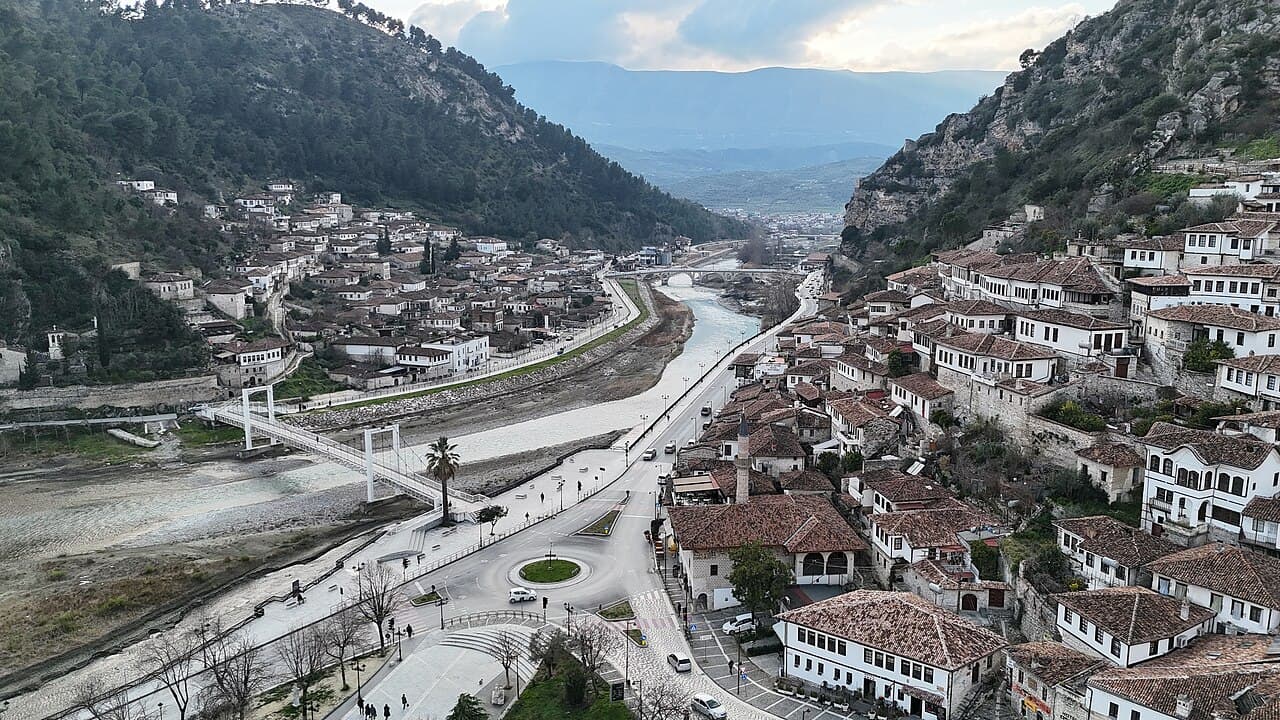
Berat
The "City of a Thousand Windows" — UNESCO Ottoman-era Berat is the most photogenic town in inland Albania. The natural inland pairing with Sarandë for a 7-10 day Albania trip.
Gjirokastër
The other UNESCO Ottoman city of Albania (inscribed alongside Berat in 2008) — a slate-roofed mountain town with a vast hilltop castle and the birthplace of Enver Hoxha and writer Ismail Kadare. Easy day trip or overnight on the way to Berat or Tirana.
Himarë
A quieter Albanian Riviera fishing town halfway up the coast to Vlorë — the SH8 coastal road from Sarandë to Himarë is genuinely spectacular, climbing the Llogara Pass and hugging the cliffs above the Ionian. Beach culture without Sarandë's tourist density.

Tirana
Albania's rapidly modernising capital — colourful Skanderbeg Square, the Bunk'Art Cold War museums, Blloku café district, and the natural air-hub for international flights out of Albania. Most travellers either start or end an Albania trip here.
Entry Requirements
Albania offers visa-free entry to most Western nationalities for tourism stays up to 90 days within any 180-day period. The country is not in the Schengen Area; days in Albania do NOT count against your Schengen 90/180 quota — making it useful as a "Schengen reset" stopover for travellers who've maxed out their Schengen days. The Sarandë harbour border is a working international crossing for the Corfu ferry; have your passport accessible.
Entry Requirements by Nationality
| Nationality | Visa Required | Max Stay | Notes |
|---|---|---|---|
| US Citizens | Visa-free | 90 days in any 180-day period | Visa-free for tourism. Passport must be valid for the duration of stay. No exit fee. |
| UK Citizens | Visa-free | 90 days in any 180-day period | Post-Brexit, visa-free for 90 days within 180. Passport valid for duration of stay. |
| EU Citizens | Visa-free | 90 days in any 180-day period | Visa-free for tourism. National ID card sufficient for entry; passport not required. |
| Canadian Citizens | Visa-free | 90 days in any 180-day period | Visa-free for tourism. Passport valid for duration of stay. |
| Australian Citizens | Visa-free | 90 days in any 180-day period | Visa-free entry. Passport valid for duration of stay. |
Visa-Free Entry
Tips
- •Albania is non-Schengen — days in Albania do not count against your Schengen 90/180 quota. Useful as a "Schengen reset" stopover for long-trip travellers
- •For the Corfu day-ferry, you complete Albanian exit and re-entry stamps at the Sarandë harbour customs hall — allow 30-45 min each way for the line
- •No exit fee or tourist tax is charged at land or air borders; some hotels charge a per-night municipal tourism tax (around 100-200 lek/night)
- •EU citizens can enter on a national ID card; non-EU visitors need a passport. Passport must be valid for duration of stay (no 6-month rule)
- •Customs allow up to 200 cigarettes, 1L spirits, 4L wine per adult into the EU on return — Albanian raki at €5-15/bottle is a popular and legal souvenir
- •No yellow fever or other vaccination certificate required for entry from any country
- •Drug laws are strict; even small amounts of cannabis are illegal and prosecuted
Shopping
Sarandë's shopping is small-scale and modest — a few souvenir shops on the promenade, a covered municipal market for produce, and the genuinely interesting craft work coming from Gjirokastër, Berat, and the Korça highlands rather than Sarandë itself. Best buys: local olive oil, raki (Albanian fruit brandy), wool textiles from the inland villages, and natural cosmetics from the Albanian beauty industry that's grown rapidly since 2015.
Sarandë Promenade Souvenir Shops
tourist shopping stripThe 2 km waterfront promenade has a string of small souvenir shops selling magnets, ceramics, t-shirts, and basic crafts. Quality is mixed; prices are modest by European standards (€2-15 for most items). Convenient for last-minute gifts but not where you find the best Albanian crafts.
Known for: Magnets, ceramics, beach gear, basic souvenirs
Tregu i Sarandës (Municipal Market)
covered marketSarandë's small municipal market, 5 minutes' walk from the harbour — fresh produce, olives, local olive oil, raki distilled at home, fresh fish in the morning. Mornings only (06:00-13:00); closed Sundays. Best for food souvenirs and seeing daily Sarandë life.
Known for: Olive oil, olives, raki, fresh produce, fish
Lëkurësi Castle Boutiques
curated craft shopsA small handful of higher-quality craft shops near the Lëkurësi Castle entrance — embroidered linens, hand-loomed wool blankets, silver jewellery, and ceramics from inland Albania. Prices €10-100; quality genuinely good.
Known for: Embroidered linens, wool blankets, silver, inland-Albania crafts
Gjirokastër Bazaar (90 min day trip)
Ottoman-era craft marketThe restored Old Bazaar in Gjirokastër is the most authentic craft shopping in southern Albania — stone houses converted to small workshops, with embroidery, copperware, wool slippers (qeleshe), and the distinctive Albanian woven čilim rugs. Prices about half of what you'd pay in Tirana for the same quality. Combine with the Gjirokastër Castle visit.
Known for: Embroidered textiles, copperware, qeleshe slippers, čilim rugs
🎁 Unique Souvenirs to Look For
- •Bottle of artisan raki (Albanian fruit brandy) from the Sarandë market or a Lëkurësi shop — €5-15 (~$5-16) for a homemade bottle, the iconic Albanian spirit
- •Bottle of cold-pressed Albanian olive oil from the Sarandë market — €8-20, often outstanding quality from family-owned olive groves around Sarandë and Gjirokastër
- •Hand-embroidered linen tablecloth or napkin set from a Lëkurësi shop or Gjirokastër Bazaar — €15-60
- •Pair of qeleshe (traditional Albanian wool slippers) from Gjirokastër — €8-25
- •Silver filigree pendant or earrings from a craft shop — €20-100; Albanian filigree is a genuine traditional craft with distinctive geometric patterns
- •Jar of mountain honey from the Korça or Pogradec highlands (sold in Sarandë markets and shops) — €5-12
Language & Phrases
Albanian is the language; Sarandë uses the southern Tosk dialect (the standardised written form of Albanian is based on Tosk). Greek is widely understood in Sarandë and the surrounding southern region (a long-standing Greek minority lives in nearby villages). Italian is broadly understood by middle-aged and older locals from Italian TV and 1990s migration. English proficiency is good among under-40s and excellent in tourism (hotels, ferry crew, tour operators); limited at small village shops and older taxi drivers. Albanian effort is warmly received.
| English | Translation | Pronunciation |
|---|---|---|
| Hello | Përshëndetje | pur-shen-DAY-tya |
| Hi (informal) | Tungjatjeta / Tung | toon-gya-TYE-ta / toong |
| Good morning | Mirëmëngjes | mir-uh-MAYN-jes |
| Good evening | Mirëmbrëma | mir-uhm-BRUH-ma |
| Please | Të lutem | tuh LOO-tem |
| Thank you | Faleminderit | fa-le-min-DAY-rit |
| Yes / No | Po / Jo | po / yo |
| How much? | Sa kushton? | sah KOOSH-ton |
| The bill, please | Llogarinë, ju lutem | llo-ga-REE-nuh yoo LOO-tem |
| Where is...? | Ku është...? | koo UH-shtuh |
| I don't speak Albanian | Nuk flas shqip | nook flahs shkip |
| Cheers! | Gëzuar! | guh-ZOO-ar |
If you like Sarandë, you'll love…
4 cities with a similar vibe, outside of the same country.

Philippines · OVR 72
museum-dense old core · easy on the wallet

Vietnam · OVR 75
stretches your budget · rich cultural layers

Peru · OVR 72
easy on the wallet · reliable eating scene

Armenia · OVR 73
stretches your budget · reliable eating scene