Compare 576 Travel Destinations
576 guides — page 5 of 24

Cancún
Mexico
The Caribbean's most visited resort destination — Cancún's Hotel Zone is a 23km barrier island of turquoise water so specific in shade it barely looks real. But Cancún is also the gateway to Mexico's greatest Maya site: Chichén Itzá (a New Seven Wonder, 200km inland), Isla Mujeres (30min ferry), and Tulum's cliff-top ruins above the sea. The cenotes of the Yucatán Peninsula — crystal-clear sinkholes sacred to the Maya — are the most extraordinary swimming experiences in the Americas.

Cannes
France
The French Riviera's film-festival capital was a 3,000-person fishing village until British Lord Brougham was quarantined here in 1834 and, smitten, told his aristocratic friends — within a generation Cannes was wintering European royalty. The 2 km palm-lined Boulevard de la Croisette runs from the red-carpeted Palais des Festivals (home of the May film festival since 1946) past the Belle Époque grand hotels (Carlton, Martinez, Majestic) to Pointe Croisette. Le Suquet, the medieval old town climbing the western hill, holds the 11th-century Tour du Suquet, the Église Notre-Dame de l'Espérance, and most of the city's actual character. Daily ferries from the Vieux Port reach the Lérins Islands — Sainte-Marguerite's Fort Royal (where the Man in the Iron Mask was imprisoned 1687–1698) and Saint-Honorat's working Cistercian monastery making Lérins wine. The Marché Forville, behind the old port since 1934, runs every morning except Mondays.

Cape Cod
United States
Cape Cod is the 65-mile hooked arm of Massachusetts that defines the New England summer for most of the East Coast. The Cape Cod National Seashore protects 44,000 acres of dune, marsh, and Atlantic beach from Eastham to Provincetown at the tip; the 22-mile Cape Cod Rail Trail runs the spine of the Lower Cape on a converted rail bed; and Hyannis is the ferry hub for day trips to Martha's Vineyard and Nantucket. Six loose regions (Upper, Mid, Lower, Outer, plus Falmouth and Sandwich) each have their own character. The catch: Friday and Sunday traffic over the Sagamore and Bourne bridges can add two hours to a trip.

Cape Town
South Africa
Cape Town is stunningly beautiful — Table Mountain looming over a city nestled between ocean and vineyards. The food and wine scene is world-class and incredibly affordable. From penguin colonies to the Cape of Good Hope, from vibrant Bo-Kaap to the V&A Waterfront, it's one of the most photogenic cities on earth.

Cappadocia
Turkey
Cappadocia is an otherworldly landscape of fairy chimneys, cave churches, and underground cities carved into volcanic rock. The sunrise hot air balloon flights over the valleys are bucket-list worthy, the cave hotels are unique, and the hiking through Rose Valley and Love Valley is spectacular. One of Turkey's most unforgettable destinations.

Capri
Italy
A 4-square-mile limestone island in the Bay of Naples — the Faraglioni sea stacks rising 100m straight from the Mediterranean, the eerie blue glow of the Blue Grotto where Tiberius bathed, the open chairlift to Mt Solaro’s 589m summit, the Piazzetta’s aperitivo theatre, and Villa San Michele’s cliff-edge Roman columns. Where Tiberius ruled the Roman Empire from AD 27–37, where Capri Pants were invented, and where 10,000 day-trippers pour off Naples ferries by 11 AM — overnight to see the island after they leave.

Cartagena
Colombia
Cartagena's UNESCO-listed walled city is one of the most beautiful colonial centers in the Americas — bougainvillea-draped balconies, pastel-colored buildings, and cobblestone streets alive with music and street food. The Caribbean warmth extends to the people, the nearby Rosario Islands, and the ceviche.

Casablanca
Morocco
Morocco's largest city (~4 million) and economic capital — the Hassan II Mosque rising from the Atlantic with its 210-metre minaret (one of only two mosques in Morocco open to non-Muslims), the Art Deco legacy of the French Protectorate along Boulevard Mohammed V, the 1930s Quartier Habous new medina, the Corniche oceanfront bar scene, and a nightlife reputation that rivals Marrakech. The city that the Bogart film was entirely NOT shot in.

Cebu
Philippines
The oldest city in the Philippines — founded by Spanish conquistador Miguel Lopez de Legazpi in 1565 and the colonial capital before Manila. Magellan's wooden cross from 1521 still stands beside the Basilica del Santo Niño, the country's oldest Catholic church. Cebu's lechon (whole roasted suckling pig with lemongrass and garlic stuffing) is what Anthony Bourdain called "the best pig ever". The Mactan Island shrine marks where chieftain Lapu-Lapu killed Magellan, ending the first European circumnavigation. Easy day trips reach Kawasan Falls, the Moalboal sardine run, the Oslob whale sharks, and the Bohol Chocolate Hills (2-hour ferry). The mid-January Sinulog Festival brings a million people to the city.

Český Krumlov
Czech Republic
Český Krumlov is what tourists imagine when they think 'medieval Bohemian fairytale' — a 13,000-person town of red-tile roofs and pastel-coloured facades wrapped tightly inside an oxbow loop of the Vltava River, with a 7-hectare castle complex (the second-largest in the Czech Republic after Prague Castle) climbing the opposite bank. The historic centre joined UNESCO in 1992; the castle moat famously holds bears instead of water, a quirk inherited from the Renaissance-era lords of Rožmberk. Two-and-a-half hours from Prague by direct bus, Český Krumlov is the country's most-visited town outside the capital — and it earns the visit.

Charleston
United States
Charleston has perfected the southern coastal city — pastel Rainbow Row on East Bay, Battery mansions staring down the harbor where Fort Sumter sits, and a restaurant scene (Husk, FIG, The Ordinary) that has defined modern low-country cooking. Gullah-Geechee heritage, King Street shopping, and plantation day trips round out longer visits.

Charlotte
United States
Charlotte is North Carolina's biggest city and the second-largest US banking centre after New York — Bank of America and Truist (formerly BB&T) are headquartered here, and the Uptown skyline along Tryon Street is a wall of corporate towers. Beyond banking, the NASCAR Hall of Fame anchors stock-car culture an hour from the Charlotte Motor Speedway, the US National Whitewater Center (a man-made Olympic-grade rapids course) sits west of town, and the Discovery Place science museum draws families. Charlotte is also the entry point to the western North Carolina mountains (Asheville is 2 hours northwest).

Chefchaouen
Morocco
Morocco's famous Blue City nestled in the Rif Mountains — every wall, stairway, and doorway painted in shades of blue. A photogenic haven with mountain hikes, artisan crafts, and a peaceful medina.

Chengdu
China
Capital of Sichuan Province and the panda capital of the world — the Giant Panda Breeding Research Base houses over 200 pandas and is best visited at 7:30am during feeding. Sichuan cuisine (málà numbing-spice from Sichuan peppercorn) is China's most internationally influential regional cooking. Sichuan Opera's biàn liǎn face-changing tradition is a UNESCO intangible heritage art. The Leshan Giant Buddha at 71 meters tall is the world's largest stone Buddha.
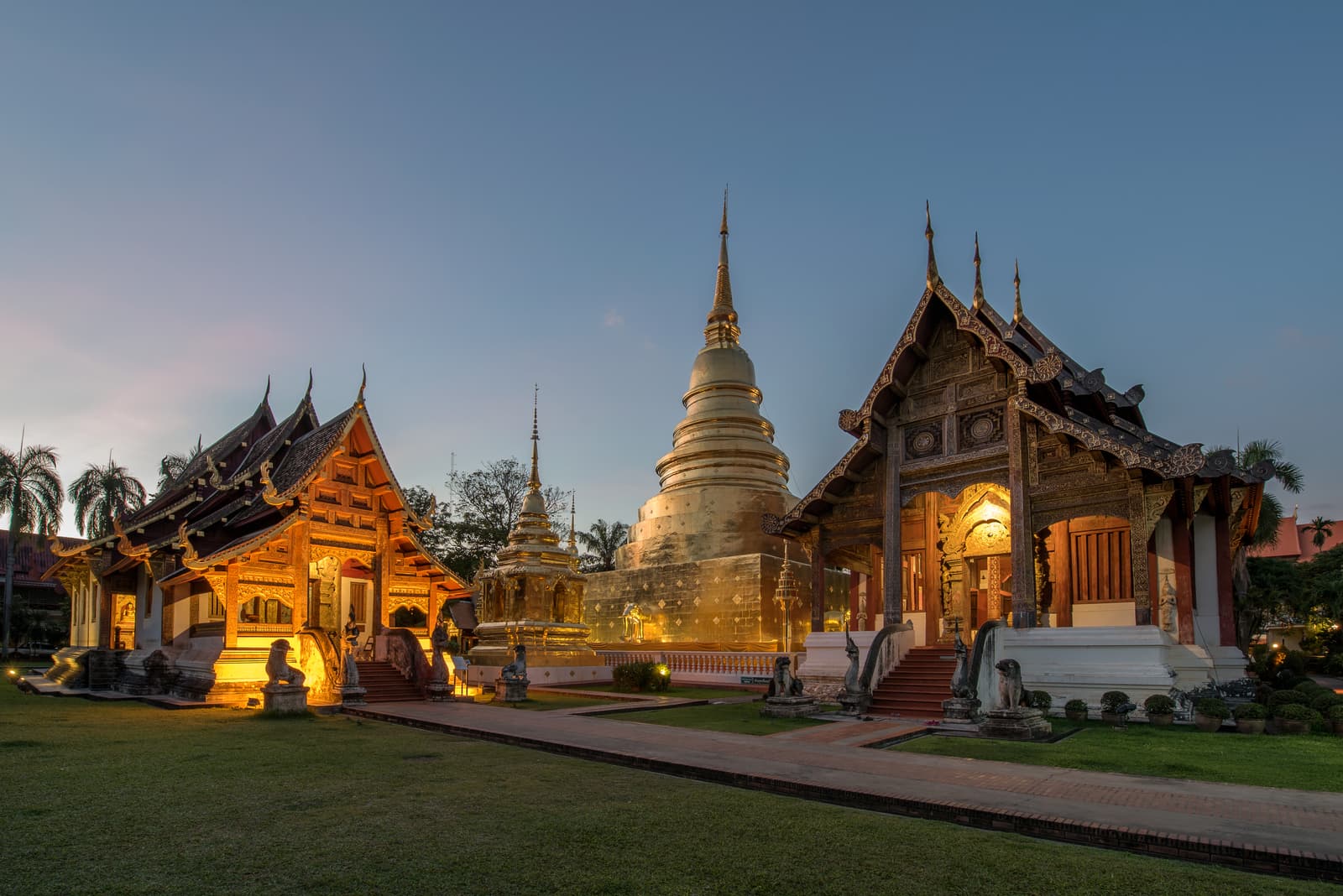
Chiang Mai
Thailand
Chiang Mai is northern Thailand's cultural capital — a laid-back city ringed by mountains and packed with over 300 Buddhist temples. The Old City's moat-enclosed streets, legendary night markets, and world-class cooking schools make it a favorite for long-stay travelers. The gateway to hill tribe treks and elephant sanctuaries.

Chiang Rai
Thailand
Thailand's northernmost city is defined by its temples — the White Temple (Wat Rong Khun), an all-white private temple covered in mirror glass and under continuous construction since 1997, is unlike anything else in the Buddhist world; the Black House (Baandam Museum) is its dark counterpart. The Golden Triangle — where Thailand, Myanmar, and Laos meet at the Mekong and Ruak confluence — is 65 km north. Doi Mae Salong, a misty tea-growing mountain village founded by KMT Chinese Nationalist soldiers after 1949, is one of the most surprising detours in all of Southeast Asia.

Chicago
United States
Chicago is America's architectural capital — a skyline of art deco towers and modern masterpieces rising from the shores of Lake Michigan. Deep-dish pizza is iconic, the jazz and blues scene is legendary, and the Art Institute is world-class. The Riverwalk, Millennium Park's Bean, and the city's diverse neighborhoods make the Windy City a must-visit.

Christchurch
New Zealand
New Zealand's South Island gateway — rebuilt after the 2010–11 earthquakes into a living showcase of urban innovation. Shigeru Ban's Cardboard Cathedral is a global architectural icon. The International Antarctic Centre is the world's best gateway to the southern continent (without going). The TranzAlpine train crossing the Southern Alps is one of the world's great rail journeys.

Cincinnati
United States
Cincinnati hits above its weight — the Over-the-Rhine neighborhood is one of the largest collections of 19th-century Italianate architecture in the United States, the John A. Roebling Suspension Bridge (1866) was the prototype for the Brooklyn Bridge, and the city's two contributions to American food (Cincinnati chili and the goetta breakfast sausage) are unlike anything else. The Reds play at riverfront Great American Ball Park, the Bengals next door at Paycor Stadium, and Findlay Market (1855) still anchors the OTR food scene every Saturday morning.

Cinque Terre
Italy
Five Ligurian fishing villages clinging to a 15km stretch of cliffs — Monterosso, Vernazza, Corniglia, Manarola, Riomaggiore. Connected by boat, by train every 15 minutes, and (sometimes) by the Sentiero Azzurro hiking trail. Pesto is from here, sciacchetrà dessert wine is from these cliffs, and no cars enter the villages.

Cleveland
United States
Cleveland sits at the mouth of the Cuyahoga River where it meets Lake Erie, and the city's two great institutions — the Rock & Roll Hall of Fame and the Cleveland Orchestra (one of the world's top five) — sum up its split personality: blue-collar rock town and high-culture European-flavored powerhouse. The West Side Market has been operating since 1912, the lakefront Edgewater beach gives you a real sand swim 10 minutes from downtown, and the city is now arguably the best sports town per-capita in America (Browns, Cavs, Guardians all play within walking distance of each other downtown).

Cliffs of Moher
Ireland
Ireland's most-visited natural attraction — 14 km of vertical sandstone sea cliffs on the County Clare coast, rising to 214 m at Knockardakin and dropping straight into the Atlantic. O'Brien's Tower (1835) marks the highest viewpoint; the Cliffs of Moher Visitor Experience charges €10 admission for the central platform and exhibition. The 20 km Cliff Walk runs from Hag's Head south of the visitor centre north to Doolin, with no fences along most of its length. Galway is 1 hr 30 by bus (€15 return); Doolin village is the closest base, 6 km north.
.jpg%3Fwidth%3D1280&w=1600&q=75)
Cluj-Napoca
Romania
Romania's second city and the unofficial capital of Transylvania — a 14th-century Saxon merchant town now reborn as the Silicon Valley of Eastern Europe. Four universities pump 100,000 students through Piata Unirii every year, the Gothic St. Michael's Church spire dominates the skyline, and Untold Festival fills August with 400,000 electronic music fans. Budget airlines from across Europe land at CLJ in 90 minutes from London or Berlin, the cafe scene rivals Berlin at a quarter the price, and you are six hours by train from Bucharest with the Apuseni Mountains an hour away.

Coimbra
Portugal
Coimbra was Portugal's first capital (until 1255) and has been a university city for over 700 years — the University of Coimbra (founded 1290, UNESCO 2013) sits on a hilltop above the river Mondego with the 18th-century Joanina Library still home to the colony of bats released every night to eat manuscript-damaging insects. Coimbra Fado is the male-sung university version of Portugal's national music — sadder, more academic, performed in black student capes — and entirely different from Lisbon Fado. Conímbriga, Portugal's largest Roman ruin, sits 16 km south.