Compare 576 Travel Destinations
173 of 576 guides match

Aarhus
Denmark
Denmark's second city and the country's youngest, with one in five residents enrolled at Aarhus University. The cultural centrepiece is ARoS, the art museum crowned by Olafur Eliasson's Your Rainbow Panorama, a 150 m glass walkway through every colour of the spectrum. Den Gamle By is an open-air history museum reconstructing Danish urban life across four centuries, and Moesgaard Museum south of town displays the 2,000-year-old Grauballe Man bog body in a grass-roofed sloping building you can walk over. Reach it from Copenhagen in 3 hours by direct DSB train (~DKK 350-450 / EUR 47-60) or 30 minutes by SAS flight.

Abisko
Sweden
A 200-person village 250 km north of the Arctic Circle that has become Europe's most reliable Northern Lights base — a microclimate produced by the Lapporten U-shaped valley keeps a hole in the cloud cover even when the rest of Swedish Lapland is socked in, giving Abisko roughly 200 clear nights a year. The Aurora Sky Station gondola climbs 900 m up Mount Nuolja for cloud-free aurora viewing from November through March. In summer the village is the southern trailhead of the Kungsleden, Sweden's classic 440 km long-distance hike, with the midnight sun above the horizon from late May to mid-July.

Akureyri
Iceland
Iceland's de facto northern capital — a town of 19,000 at the head of the 60 km Eyjafjörður, ringed by 1,500m mountains that hold their snow until June. The botanical garden is the world's northernmost; the bars on Strandgata are unexpectedly lively for a sub-Arctic latitude. Akureyri is the launch pad for the Diamond Circle (Goðafoss, Mývatn, Dettifoss, Húsavík whale watching) and a far quieter alternative to Reykjavík for serious north-Iceland exploration. 388 km / 5 hours from Reykjavík by Ring Road, or a 45-minute domestic flight.

Algarve
Portugal
Portugal's golden coast is Europe's most photogenic Atlantic shoreline — limestone sea stacks and grottos at Ponta da Piedade (Lagos), the sheltered cove of Praia da Marinha, and 300 days of sunshine per year (the highest in continental Europe). Cabo de São Vicente — the most southwesterly point of mainland Europe — is where Henry the Navigator founded his navigation school in 1419 and launched the Age of Discovery. The Ria Formosa lagoon system stretches 90km, home to flamingos, rare chameleons, and barrier island beaches.

Amalfi Coast
Italy
The Amalfi Coast is a UNESCO-listed stretch of dramatic clifftop villages cascading down to turquoise Mediterranean waters. Positano, Amalfi, and Ravello are the headliners, but the quieter towns of Atrani and Praiano offer a more authentic experience. The coastal roads are spectacular (if hair-raising), and the food is incredible.

Amsterdam
Netherlands
Amsterdam's iconic canal rings, world-class museums, and cycling culture make it one of Europe's most charming capitals. The city punches well above its weight in art (Rijksmuseum, Van Gogh Museum), food, and nightlife. Compact enough to explore on foot or by bike, with a tolerant, cosmopolitan vibe that's uniquely Dutch.

Annecy
France
Annecy is the alpine resort French people send each other to — a 14th-century old town wrapped around the Thiou canal where the Palais de l'Île sits midstream like a stone ship, and behind it the Lac d'Annecy: 27 km² of glacier-fed water so clear that EU water-quality reports rank it the cleanest large lake in Europe. The 42 km lakeside cycle path (Voie Verte) is one of France's flagship rides, the swimming is genuine swimming (not posing), and 30 minutes' drive south-east puts you on the Col de la Colombière or Glières plateau, both Tour de France climbs. Pastel facades, geraniums in window boxes, and a quality of summer evening light that makes the lake look almost tropical.

Antalya
Turkey
Turkey's Mediterranean capital of 1.7 million sprawls along a 30-km stretch of cliffs and coves backed by the snow-capped Beydağları range — Hadrian's Gate framing the entrance to Kaleiçi (the walled Roman-Ottoman old town), the Yivli Minaret silhouetted against the Gulf of Antalya, the Düden Falls cascading directly into the Mediterranean, and the Antalya Archaeological Museum's Pamphylian sculpture hall. The launchpad for the Lycian and Pamphylian ruins of Aspendos, Perge, Side, and Termessos, with year-round mild winters and summer beaches stretching to Olympos.

Athens
Greece
Athens is the cradle of Western civilization — the Acropolis still dominates the skyline 2,500 years on. Beyond the ancient ruins, a modern city of street art, rooftop bars, and a vibrant food scene has emerged. Plaka's winding streets, the Monastiraki flea market, and sunset views from Lycabettus Hill make it far more than a history lesson.

Azores
Portugal
Portugal's mid-Atlantic volcanic archipelago offers crater lakes, whale watching, hot springs, hydrangea-lined roads, and Europe's best-kept secret for nature lovers.

Barcelona
Spain
Barcelona is where Gothic architecture meets Gaudí's surreal masterpieces, where tapas bars spill onto sunny plazas, and where the beach is just a metro ride from the mountains. The Catalan capital has a creative energy all its own — distinct from the rest of Spain and fiercely proud of it.

Bath
United Kingdom
Britain's most perfectly preserved Georgian city, and the only British city designated entirely as a UNESCO World Heritage Site. The Roman Baths — a 2,000-year-old complex fed by Britain's only natural hot spring at 46°C — rank among the finest Roman remains in Northern Europe. The Royal Crescent (1767–1775), The Circus, and Pulteney Bridge (shops on both sides, one of only four in the world) form the Georgian masterwork that inspired Jane Austen, who lived here from 1801 to 1806.

Belfast
United Kingdom
Northern Ireland's capital has transformed from the epicenter of the Troubles into one of the UK's most vibrant cities. Titanic Belfast is the world's largest Titanic exhibition. The political murals of Falls and Shankill Roads are among the most powerful pieces of public art in Europe. The Cathedral Quarter's Victorian pubs and the covered St. George's Market are the social heart of modern Belfast.

Belgrade
Serbia
Serbia's capital at the confluence of the Danube and Sava rivers is famous for its legendary nightlife, Kalemegdan Fortress, hearty Balkan cuisine, and irrepressible spirit.
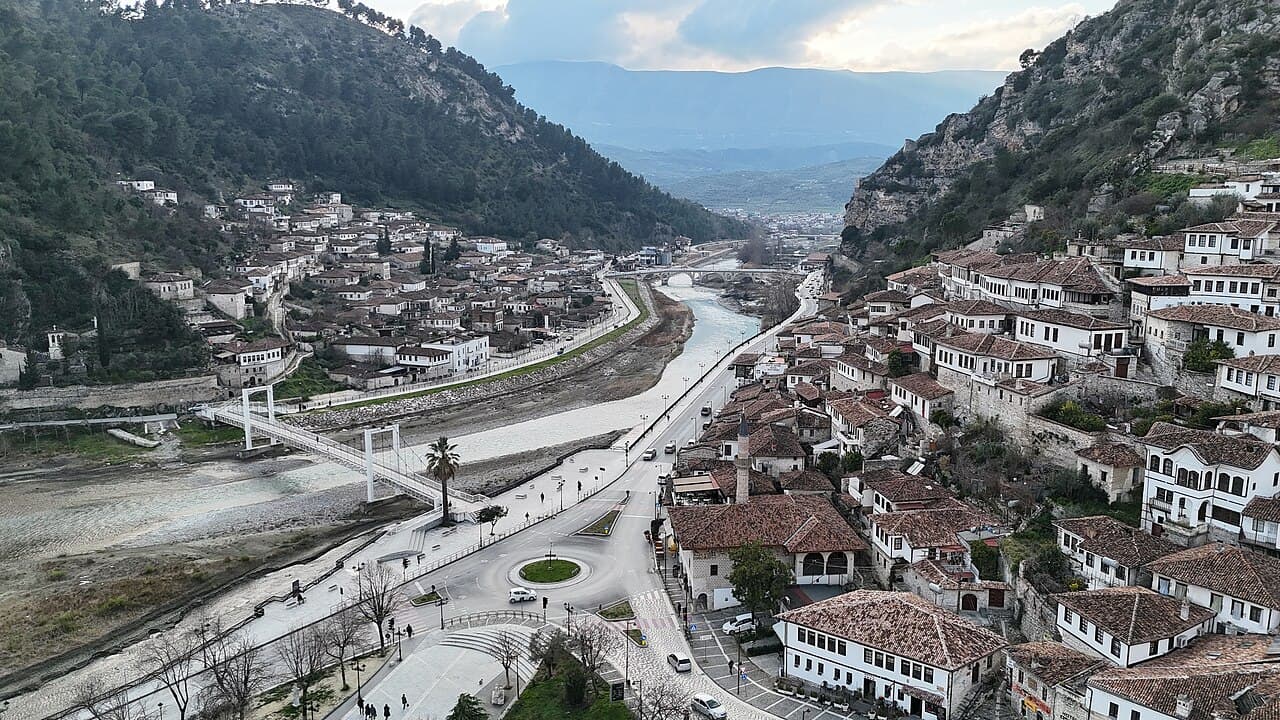
Berat
Albania
The "City of a Thousand Windows" — tiered white Ottoman houses stacked up the slopes above the Osum River. UNESCO 2008 and one of Europe's oldest continuously-inhabited cities (2,400+ years). Berat Castle (Kalaja) is a still-inhabited medieval citadel — people live inside the walls. Facing Mangalem (Muslim) and Gorica (Christian) quarters across the 18th-century stone bridge. Onufri icon museum inside the castle; Çobo and Kokomani wineries in Albania's wine capital; Tomor Mountain NP 20 km east. Access: 2.5 hr bus from Tirana. ALL currency (EUR widely accepted); 90-day visa-free for most Western.

Bergen
Norway
Norway's second city and the gateway to the western fjords — a UNESCO Hanseatic port wrapped around a harbour hemmed in by seven mountains. Bryggen's coloured wooden wharf buildings are Bergen in a single postcard. The Fløibanen funicular hauls you up Mount Fløyen for fjord-and-city views; the Bergen Railway to Oslo is one of the world's most scenic train rides; and Nærøyfjord (UNESCO) is an easy day trip by Norway in a Nutshell. It rains 270 days a year. Bring a waterproof.

Berlin
Germany
Berlin is Europe's capital of reinvention — a city shaped by its turbulent history and defined by its creative present. The Wall may be gone but its legacy is everywhere, from the East Side Gallery to the vibrant neighborhoods that grew up in its shadow. Cheap by Western European standards, with legendary nightlife and a thriving art scene.

Bern
Switzerland
Switzerland's federal capital — not Zurich, despite the common assumption — wrapped in a horseshoe bend of the turquoise Aare river. The medieval old town gained UNESCO status in 1983 for its 6 km of continuous sandstone arcades, the 1530 Zytglogge astronomical clock that still chimes on the hour, and the Bundeshaus where the Federal Council meets. Albert Einstein wrote his 1905 papers here while working at the patent office. In summer, locals float the Aare straight through the old town with a waterproof bag for their clothes.

Bilbao
Spain
The Basque Country's industrial-turned-cultural capital — still rough and confident around the edges where polished San Sebastián is precious. Frank Gehry's 1997 titanium-cloud Guggenheim Museum kicked off the most successful urban regeneration in modern Europe (the global "Bilbao Effect"); the Nervión riverbank that was biologically dead in the 1980s now runs from Calatrava bridges through the Old Town's Casco Viejo, where Calle del Perro's pintxo bars deliver dinner-quality bites for €3–€5 each. Add the Mercado de la Ribera (Europe's largest covered food market), Norman Foster's gleaming metro, and the Athletic Club Bilbao stadium where every player is Basque — and you get a bigger, edgier, dramatically cheaper alternative to San Sebastián.

Black Forest
Germany
A 160 km north-south range of densely-forested hills along Germany's southwest border with France — cuckoo-clock workshops in Triberg, the 163m Triberger Wasserfälle (Germany's highest waterfall), the deep-blue Titisee, the 60 km Schwarzwaldhochstrasse scenic drive, and the half-timbered villages of the Gutach Valley. The original Schwarzwälder Kirschtorte (Black Forest cake) was created here in 1915. Freiburg makes the obvious base — a sunny university town at the southwestern edge with the Münster spire and a tram running into the forest in 20 minutes.

Bologna
Italy
Italy's culinary capital — birthplace of tortellini, ragù, and mortadella. Medieval towers, 40 km of porticoed streets (UNESCO-listed), and the oldest university in the Western world.

Bordeaux
France
The world's wine capital and a UNESCO World Heritage city — Place de la Bourse and its Miroir d'Eau (the world's largest reflecting pool) anchor a centre of 18th-century limestone Hausmannian elegance that earned the nickname Little Paris. La Cité du Vin is the most ambitious wine museum on earth. Saint-Émilion's Romanesque monolithic church and chateaux are 40 minutes east; Médoc's first-growth grand crus 45 minutes north; the Atlantic and Dune du Pilat (Europe's tallest dune) an hour west. The TGV puts Paris just 2h05 away.

Bornholm
Denmark
Denmark's outlier — a 588 km granite island in the middle of the Baltic, closer to Sweden and Poland than to Copenhagen. Locals call it Solskinsoen (sunshine island) for clocking the country's highest annual sunshine totals, and it shows in the smoked herring smokehouses of Svaneke, the wooden cottage colonies of Gudhjem, and the white-sand beaches at Dueodde and Sandvig. Four medieval round churches built as Knights-Templar fortresses ring the interior, with Osterlars the largest and oldest. The Hammershus castle ruin on the northern cliffs is the largest medieval fortress complex in northern Europe. Reach it from Copenhagen by 3-hour combined train and ferry through Ystad in Sweden, or 35-minute direct flight.

Brașov
Romania
Transylvania's most beautifully preserved Saxon city sits in a Carpathian amphitheatre 625m above sea level — Mount Tâmpa rises directly above the old town with the famous Hollywood-style 'BRAȘOV' sign. The 14th-century Black Church (largest Gothic church in southeastern Europe), Council Square ringed by pastel Saxon merchant houses, and Strada Sforii (one of Europe's narrowest streets at 1.11m wide) anchor the UNESCO-quality old town. Bran Castle (Dracula marketing notwithstanding) is 30km away; the Poiana Brașov ski resort 12km. Founded in 1211 by the Teutonic Knights as one of the seven Saxon walled cities of Transylvania.