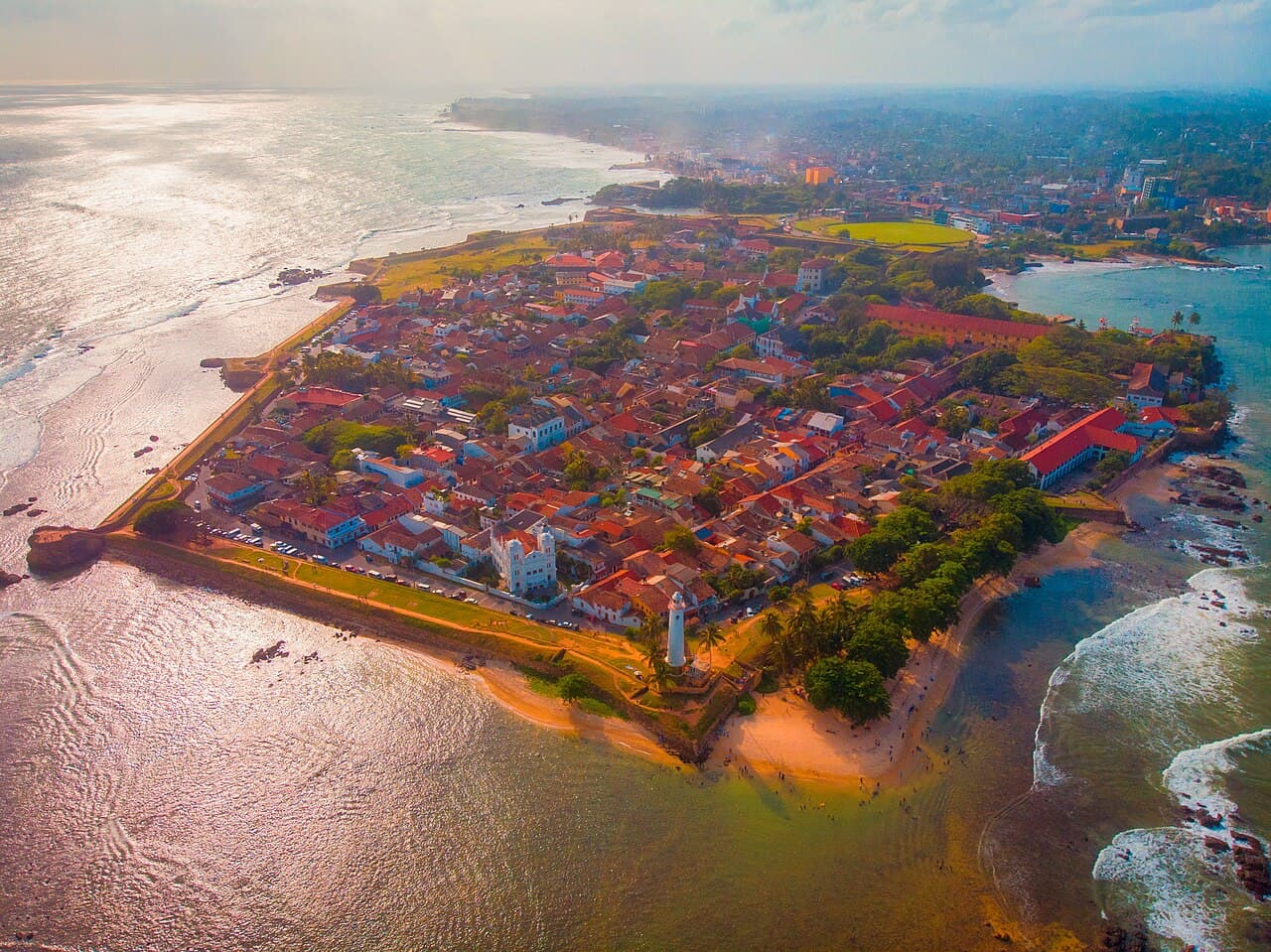
How many days in Galle?
Plan 1-3 days for Galle. 1 days hits the must-sees; 3 lets you eat well, walk neighbourhoods you've never heard of, and take one day trip.
The minimum
1 day
1 days fits the top sights, one good food walk, and one neighbourhood deep-dive — no day trips.
The sweet spot
3 days
3 days adds one day trip, two more neighbourhoods, and three more sit-down meals you'll actually remember.
Slow travel
5 days
5 days is when you leave the to-do list at home and actually live in the city for a week.
The headline things to do in Galle
From the Galle guide — these are the items that anchor a 1-day visit. For the full breakdown, read the Galle travel guide.
- Walk the Fort Ramparts — Galle Fort circuit
The 3-km circuit of granite-and-coral walls is the single defining Galle experience — easily walked in 60–90 minutes, ideally at sunset. Start at the Old Gate near the harbour, walk anticlockwise around to the Sun Bastion, the Triton Bastion (best sunset spot), the Flag Rock (where local boys cliff-jump from the bastion into the surf), past the lighthouse, and back. Free entry; the walls are wide enough to walk in pairs but watch your step on the seaward edge — there are no railings.
- Galle Lighthouse & Lighthouse Beach — Galle Fort, south-east corner
The 1939 white-painted brick lighthouse at the south-east corner of the fort is the most iconic Galle photograph — particularly with a coconut palm or two foregrounded. The small Lighthouse Beach below is suitable for a quick paddle but not real swimming. Best photos at golden hour, looking back from Flag Rock or down from the Triton Bastion.
- Old Gate & Maritime Museum — Galle Fort, north entrance
The Old Gate (built 1668) was the original landward entrance to the fort, now flanked by the Dutch coat of arms outside and the British coat of arms inside. The Maritime Archaeological Museum, housed in a 1671 Dutch warehouse just inside the gate, has displays on Dutch East India Company shipwrecks recovered from the harbour, ship models, and traditional Sri Lankan fishing techniques. Entry 600 LKR ($2); skip the air-conditioning blast at peak heat.
- Dutch Reformed Church (Groote Kerk) — Church Street, Galle Fort
The 1755 Dutch Reformed Church on Church Street is the oldest Protestant church in Sri Lanka still in use — a small, white-painted plastered building with a stone floor entirely paved with 17th and 18th-century gravestones (lifted from the surrounding graveyard during a 19th-century renovation). Stained-glass windows commemorate Dutch governors. Free entry; donations welcome.
- Pedlar's Street & Café Strip — Pedlar's Street / Lighthouse Street
The fort's commercial spine — narrow Pedlar's Street and the parallel Lighthouse Street are lined with 18th-century single-storey colonial townhouses converted into cafés (Pedlar's Inn, Poonie's Kitchen, Café Royal Dutch), boutique shops (Barefoot, Stick No Bills posters, Mimimango ceramics), and small art galleries. The strip runs from the Old Gate to the lighthouse and is the place to spend a slow morning over coffee and people-watching.
- Unawatuna Beach — Unawatuna, 6 km east of fort
The classic Galle area beach — a 1-km crescent of golden sand 6 km east of the fort, calm protected swimming, and a strip of casual restaurants, beach bars, and boutique guesthouses. Tuk-tuk from the fort: 600–1,000 LKR ($2–3.30). Get there before 11:00 to claim a sun lounger, or come for sunset with a fish curry at one of the beach restaurants. Also has reliable snorkelling at the eastern end of the bay.
- Mirissa Whale Watching — Mirissa, 30 km east
Mirissa, 30 km east of Galle, is one of the world's most reliable spots for blue whale sightings — the deepwater shelf comes close to shore and blue whales pass within 15–20 km of the coast on their migration. Boats depart 06:30–07:00 from Mirissa Harbour, return by 12:00; cost $40–60 per person. Sightings rate 80–90% November–April, when blues, sperms, fins, Bryde's, and pilot whales pass. May–October, the fleet shifts to Trincomalee on the east coast.
- Stilt Fishermen of Koggala — Koggala/Ahangama, 15 km east
15 km east of Galle, between Ahangama and Koggala, the traditional stilt fishermen perched on slender wooden poles in the surf became a National Geographic icon decades ago. The genuine practice is largely gone (replaced by tourist-oriented poses for photographs, $5 per shoot per fisherman); but the visual is still striking and the underlying tradition was real until the 2004 tsunami devastated the local fishing community. Negotiate the fee in advance.
Frequently asked
Is 1 day enough in Galle?
1 day is the minimum for a satisfying visit — you'll see the headline sights but won't have flex time. If you can stretch to 3, you unlock a day trip and the food walks that make the trip memorable.
Is 6 days too long in Galle?
6 days is for travellers who want to slow down — eat at neighbourhood spots tourists don't reach, take repeat day trips, and live in the city. If you're a tick-the-list traveller, 3 is enough.
What's the ideal trip length for first-time visitors to Galle?
3 days is the sweet spot for a first visit — long enough to cover the must-sees, eat at three good spots, take one day trip, and not feel like you're racing a checklist. Less than 1 usually feels rushed; more than 6 is into slow-travel territory.
Should I add Galle to a longer regional trip?
Yes — Galle works well as a 1-3-day stop on a longer regional itinerary. Pair it with a nearby destination via the trip planner so the transit days don't compress your time on the ground.