Galle
THE QUICK VERDICT
By Anthony · Updated April 2026
Choose Galle if You want a walkable colonial fort town with great cafés and beaches a short tuk-tuk ride away..
- Best for
- sunset on the fort ramparts, lighthouse and Dutch Reformed Church, Unawatuna beach tuk-tuk, hopper breakfasts
- Best window
- Nov–Apr
- Budget anchor
- $145/day mid-range
- No real seasons
- Within 1°C year-round — timing is about rain, not temperature
- Worth a look
- the only place in Sri Lanka where Sinhalese, Dutch, Portuguese, British, and Moorish heritage all stack
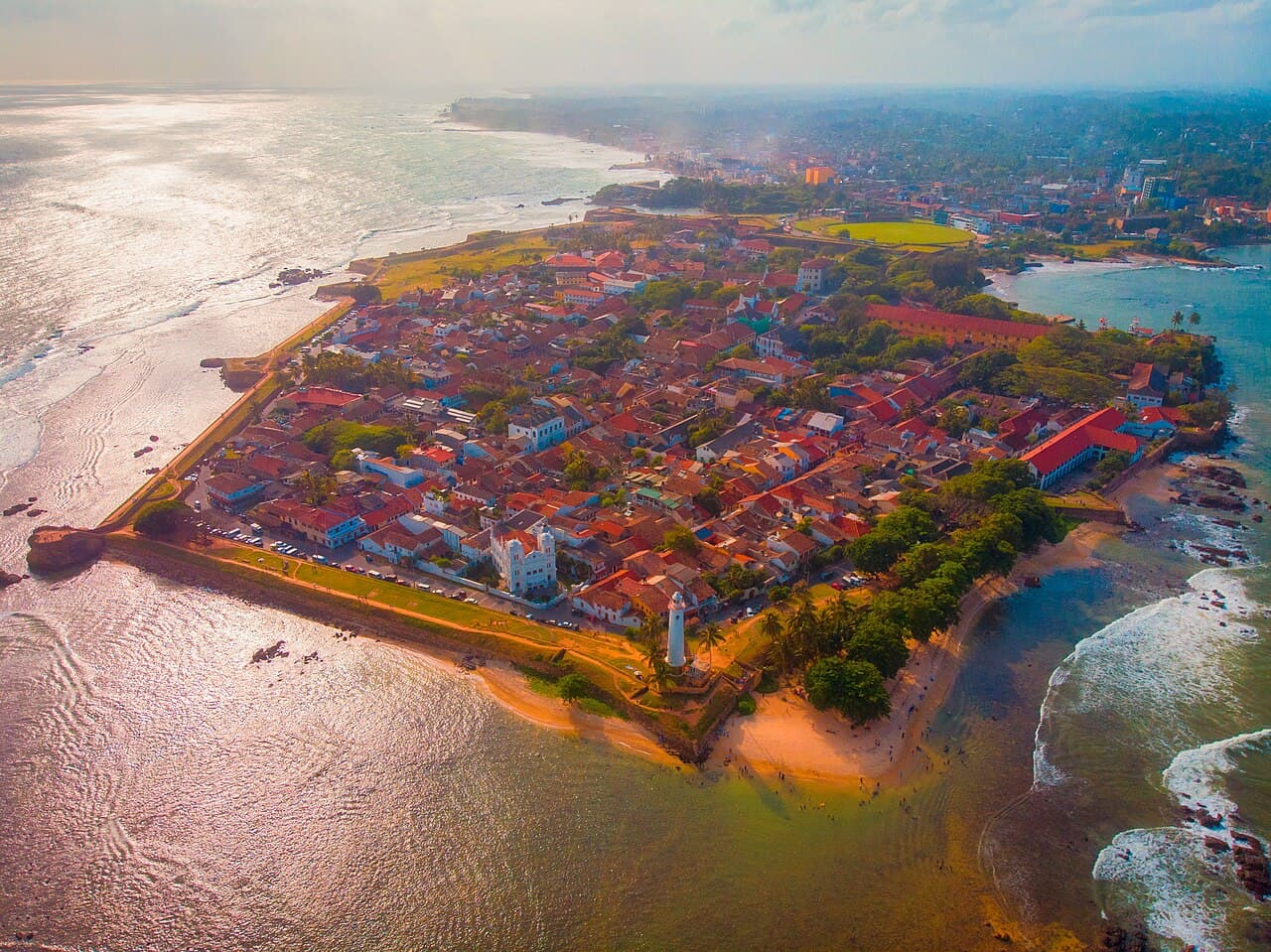
Galle is the Dutch-built fortified port on Sri Lanka's south coast — a 36-hectare walled town inside 17th-century granite ramparts that survived both colonial sieges and the 2004 tsunami almost untouched. UNESCO listed Galle Fort in 1988 as the best-preserved European-built fortified town in South Asia. Inside the walls, gridded streets are lined with white-washed Dutch and British colonial houses, churches, the 1939 lighthouse, and a wave of boutique cafés, design shops, and small hotels that have turned the fort into Sri Lanka's most stylish weekend escape. The southern beaches — Unawatuna, Mirissa, Weligama — are 15–40 minutes east.
The two links below are affiliate links — MapSorted earns a small commission if you book through them, at no extra cost to you. How this works.
Tours & Experiences
Bookable tours, activities, and day trips in Galle
Where to Stay
Compare hotels and rentals in Galle
📍 Points of Interest
Galle Fort Ramparts
3-km circuit of 17th-century Dutch granite-and-coral walls — best walked at sunset, with Triton Bastion and Flag Rock as highlights
Galle Lighthouse
1939 white-painted brick lighthouse at the south-east corner of the fort — the iconic Galle photo with coconut palms
Old Gate & Maritime Museum
1668 original landward gate flanked by Dutch and British coats of arms; museum housed in a 1671 Dutch warehouse
Dutch Reformed Church
1755 oldest Protestant church in Sri Lanka — stone floor paved with 17th–18th-century gravestones
Pedlar's Street
The fort's commercial spine — cafés (Pedlar's Inn, Poonie's), boutiques (Barefoot, Stick No Bills), galleries
Unawatuna Beach
1-km crescent of golden sand 6 km east — calm protected swimming and reliable snorkelling at the eastern end
Mirissa Whale Watching· 30 km SE
World-class blue whale spotting 30 km east — boats depart 06:30, 80–90% sighting rate November–April
Galle International Stadium
Test cricket ground with the fort ramparts as backdrop — among the most picturesque test grounds in the world
Stilt Fishermen of Koggala· 14 km SE
Traditional fishermen on slender wooden poles in the surf — National Geographic icon, now mostly tourist-pose
★ Local Picks
Rumassala Hill & Jungle Beach
Wooded hill with Japanese Peace Pagoda; descend to half-hidden Jungle Beach for quiet swimming and snorkelling
At a Glance
- Pop.
- Galle 100K (city) / 250K (district)
- Timezone
- Colombo
- Dial
- +94
- Emergency
- 119
Galle Fort is a 36-hectare walled town on a small peninsula on Sri Lanka's south coast — built by the Portuguese in 1588, fortified by the Dutch from 1640, and inherited by the British in 1796. UNESCO inscribed it in 1988 as the best-preserved European-built fortified town in South and Southeast Asia
The Dutch ramparts — 14 bastions, 92 cannons originally, and 3 km of granite-and-coral walls up to 14 m thick — held back the 2004 Indian Ocean tsunami, which devastated the surrounding city of Galle but caused minimal damage inside the fort. The fort's elevation and granite walls effectively channelled the wave around the peninsula
The fort was originally built by the Portuguese after Lourenço de Almeida landed here in 1505, but the current ramparts and street grid are entirely Dutch — built between 1660 and 1684, after Dutch East India Company forces took the fort from the Portuguese in 1640. The grid pattern has not changed since
The Galle Lighthouse, at the south-east tip of the fort, was built by the British in 1939 to replace an earlier 1848 structure — still operational, with its light visible 23 nautical miles offshore. Climb impossible (private to the harbour authority), but the foreground beach is one of the fort's defining photo spots
Around 400 colonial-era buildings — Dutch, British, and Moor Sri Lankan — survive inside the walls, of which roughly 300 are formally protected. The fort has been progressively gentrified since 2000; what was once a sleepy town is now home to ~50 boutique hotels, 80+ cafés and restaurants, dozens of design shops, and a permanent expat community
Galle is the capital of the Southern Province (population ~250,000 in the district, ~100,000 in the urban area). Outside the fort's walls, it's a working Sri Lankan port city — fishing harbour, cricket stadium, busy markets, and the regional bus terminus — providing context that the inside-the-walls boutique scene cannot
The Galle International Cricket Stadium (capacity ~35,000) sits literally in the shadow of the fort's ramparts — one of the most picturesque test-match grounds in the world. Sri Lanka has hosted England, Australia, and India here in matches where the fort's skyline forms the backdrop to the wicket
Top Sights
Walk the Fort Ramparts
📌The 3-km circuit of granite-and-coral walls is the single defining Galle experience — easily walked in 60–90 minutes, ideally at sunset. Start at the Old Gate near the harbour, walk anticlockwise around to the Sun Bastion, the Triton Bastion (best sunset spot), the Flag Rock (where local boys cliff-jump from the bastion into the surf), past the lighthouse, and back. Free entry; the walls are wide enough to walk in pairs but watch your step on the seaward edge — there are no railings.
Galle Lighthouse & Lighthouse Beach
📌The 1939 white-painted brick lighthouse at the south-east corner of the fort is the most iconic Galle photograph — particularly with a coconut palm or two foregrounded. The small Lighthouse Beach below is suitable for a quick paddle but not real swimming. Best photos at golden hour, looking back from Flag Rock or down from the Triton Bastion.
Old Gate & Maritime Museum
🏛️The Old Gate (built 1668) was the original landward entrance to the fort, now flanked by the Dutch coat of arms outside and the British coat of arms inside. The Maritime Archaeological Museum, housed in a 1671 Dutch warehouse just inside the gate, has displays on Dutch East India Company shipwrecks recovered from the harbour, ship models, and traditional Sri Lankan fishing techniques. Entry 600 LKR ($2); skip the air-conditioning blast at peak heat.
Dutch Reformed Church (Groote Kerk)
📌The 1755 Dutch Reformed Church on Church Street is the oldest Protestant church in Sri Lanka still in use — a small, white-painted plastered building with a stone floor entirely paved with 17th and 18th-century gravestones (lifted from the surrounding graveyard during a 19th-century renovation). Stained-glass windows commemorate Dutch governors. Free entry; donations welcome.
Pedlar's Street & Café Strip
📌The fort's commercial spine — narrow Pedlar's Street and the parallel Lighthouse Street are lined with 18th-century single-storey colonial townhouses converted into cafés (Pedlar's Inn, Poonie's Kitchen, Café Royal Dutch), boutique shops (Barefoot, Stick No Bills posters, Mimimango ceramics), and small art galleries. The strip runs from the Old Gate to the lighthouse and is the place to spend a slow morning over coffee and people-watching.
Unawatuna Beach
🏖️The classic Galle area beach — a 1-km crescent of golden sand 6 km east of the fort, calm protected swimming, and a strip of casual restaurants, beach bars, and boutique guesthouses. Tuk-tuk from the fort: 600–1,000 LKR ($2–3.30). Get there before 11:00 to claim a sun lounger, or come for sunset with a fish curry at one of the beach restaurants. Also has reliable snorkelling at the eastern end of the bay.
Mirissa Whale Watching
📌Mirissa, 30 km east of Galle, is one of the world's most reliable spots for blue whale sightings — the deepwater shelf comes close to shore and blue whales pass within 15–20 km of the coast on their migration. Boats depart 06:30–07:00 from Mirissa Harbour, return by 12:00; cost $40–60 per person. Sightings rate 80–90% November–April, when blues, sperms, fins, Bryde's, and pilot whales pass. May–October, the fleet shifts to Trincomalee on the east coast.
Stilt Fishermen of Koggala
🏖️15 km east of Galle, between Ahangama and Koggala, the traditional stilt fishermen perched on slender wooden poles in the surf became a National Geographic icon decades ago. The genuine practice is largely gone (replaced by tourist-oriented poses for photographs, $5 per shoot per fisherman); but the visual is still striking and the underlying tradition was real until the 2004 tsunami devastated the local fishing community. Negotiate the fee in advance.
Climate & Best Time to Go
Galle is on Sri Lanka's south-west coast — the country's wet zone — and gets significantly more rainfall than Sigiriya or the east coast. The Yala monsoon (May–September) brings the wettest months; the inter-monsoon periods (October–November) bring heavy showers but interspersed with bright days. The dry season is December–April — coinciding with peak international tourism. Daytime temperatures are reliably 28–32°C year-round; sea temperature 27–29°C is excellent for swimming throughout.
December - April (Dry Season)
December - April75 to 90°F
24 to 32°C
The optimal window — clear skies, low rainfall (50–100 mm/month), excellent surfing on south-coast breaks, and reliable whale watching from Mirissa. Peak international tourism December 20–January 15; book accommodation 3+ months ahead. Daytime hot but tempered by sea breeze inside the fort.
May - June (Yala Monsoon Onset)
May - June77 to 88°F
25 to 31°C
The Yala monsoon arrives — heavy short-burst showers most days, often in the late afternoon, with bright mornings. Swimming and surfing largely uninterrupted on the calmer days. Lower prices and fewer crowds. The fort still functions normally; sit-down dining shifts to covered terraces.
July - September (Yala Monsoon Peak)
July - September77 to 86°F
25 to 30°C
The wettest period — daily heavy showers, occasional 2–3-day storms, and rough seas (whale watching shifts to the east coast at Trincomalee). The fort itself is atmospheric in monsoon, with thick stone walls keeping rooms cool, and many travellers actively prefer this season for the lower crowds. Surfers head to the east coast.
October - November (Inter-Monsoon)
October - November75 to 86°F
24 to 30°C
Mixed weather — the Yala monsoon is winding down but the second-inter-monsoon brings irregular rainfall and occasional cyclones. Rooms drop 30–40% on December prices; travellers willing to roll the weather dice get serious value. By late November the dry season pattern reasserts itself.
Best Time to Visit
December–April is the optimal window: dry, sunny, calm seas, peak whale-watching, and the south-coast surf season at its most consistent. May–October is the Yala monsoon and many beach activities (whale-watching, certain surf breaks) shift to the east coast — but the fort itself remains atmospheric and prices drop 40–50%.
December - February (Peak)
Crowds: Very highThe textbook Galle window — dry, sunny, daytime 28–30°C, sea calm and warm (28°C), and all activities running. December 20–January 15 is the highest-priced fortnight of the year; book accommodation 3+ months ahead. The Galle Literary Festival is in late January.
Pros
- + Most reliable weather
- + Whale-watching peak
- + All activities running
- + Best surfing on south coast
- + Galle Literary Festival
Cons
- − Highest prices of the year
- − Crowded fort streets
- − Need to book months ahead
- − Some restaurants fully reserved
March - April (Late Dry Season)
Crowds: HighStill dry and bright but heat builds — daytime 31–32°C with humidity rising. Lower prices than December–February (10–20% off) but still firmly peak season. Sinhala-Tamil New Year (April 13–14) is a busy domestic-tourism window with some businesses closed.
Pros
- + Slightly lower prices
- + Still excellent weather
- + Whale-watching reliable
- + Last chance before monsoon
Cons
- − Heat increasing
- − Sinhala-Tamil New Year disruption mid-April
- − Crowds remain high
May - October (Yala Monsoon)
Crowds: LowThe monsoon — heavy daily rain showers, often in afternoons, with bright mornings. Whale-watching shifts to Trincomalee on the east coast. Prices drop 40–50%; the fort itself stays active and atmospheric. South-coast surfing slows (waves are bigger but less consistent), and beach loungers come in. Travellers willing to roll the weather dice get serious value.
Pros
- + Lowest prices of the year
- + Atmospheric fort in monsoon
- + Lush green countryside
- + Mornings often dry
- + No crowds
Cons
- − Frequent afternoon downpours
- − No south-coast whale-watching
- − Some beach activities suspended
- − Dengue mosquitoes peak
November (Inter-Monsoon)
Crowds: ModerateLate November is the transition to the dry season — irregular rainfall winding down, prices still 25–35% below December peak, and most activities restarting. A solid shoulder window for travellers wanting Galle weather minus crowds.
Pros
- + Shoulder pricing
- + Whale-watching restarting late November
- + Lower crowds
- + Weather improving daily
Cons
- − Still some rainfall
- − Cyclone risk early November
- − Some hotels still on monsoon hours
🎉 Festivals & Events
Galle Literary Festival
Late JanuaryA 4–5-day international literary festival held in the fort — international and Sri Lankan authors, panel discussions, readings, and food events at fort venues. Founded 2007, now a fixture in the South Asia literary calendar. Tickets sell out months ahead; book accommodation around the festival 4+ months ahead.
Sinhala & Tamil New Year
April 13-14The most important secular holiday — many businesses close for 3–4 days; some restaurants and tour operators are skeleton-staffed. Traditional games, family rituals, and fireworks. Galle Fort's Sri Lankan-owned restaurants close.
Vesak (Buddha's Birthday)
May full moonColoured paper lanterns illuminate the fort's temples and Buddhist homes; free dansala food stalls operate near the bus stand. Most government and private workplaces close for two days.
Galle Cricket Test Matches
Variable (Sri Lanka cricket calendar)Sri Lanka often hosts test matches at the Galle International Stadium with the fort skyline as backdrop — England, Australia, India typically tour every 2–3 years. Local hotels book out and the rampart-overlooking-stadium views become coveted.
Off the Beaten Path
Sunset Drinks at the Triton Bastion
Walk up to the Triton Bastion at the western tip of the ramparts about 45 minutes before sunset and watch the sun drop into the Indian Ocean from the highest point on the seaward walls. Bring a takeaway beer or arrack-and-coke from any nearby café (Pedlar's Inn liquor counter, Hideaway 1684) — the bastion itself has no bar but allows drinks. By 17:30 there's a small crowd of locals and travellers; a guitar usually appears.
The fort's rampart walk is its defining experience, and the Triton Bastion sunset is the iconic moment — but most travellers join the cliff-jumpers at Flag Rock instead. Triton has a wider arc, a higher vantage, and a much smaller crowd.
Curd & Treacle at a Roadside Stand
Sri Lankan buffalo curd (kiri) drizzled with kithul palm treacle (paani) is the country's defining dessert — and the small clay-pot stalls along the Matara Road east of Galle (especially around Ahangama) sell pots of this for 200–400 LKR ($0.65–1.30). Look for stalls hung with rows of small, conical, earth-coloured clay pots; the curd is served at room temperature, and locals tear off chunks of the surface skin and dip them in the treacle. Diabetes risk; transcendent.
Western desserts at fort cafés are competent but generic — buffalo curd and kithul treacle is a true regional product, made within a 30-km radius from animals that graze inland from the coast. Stops 200 LKR are an honest, locally-rooted thing.
Rumassala Hill & Jungle Beach
A small wooded hill (the legendary "fragment of the Himalayas" in the Ramayana, dropped here by Hanuman) on the east shore of Unawatuna Bay — a 30-minute walk from Unawatuna Beach to a Japanese-built Peace Pagoda (1976) at the summit, with sweeping views back toward Galle. From the pagoda, descend the back side to Jungle Beach — a small, half-hidden cove with calm swimming and a single shack café. Combines into a 3-hour morning circuit.
Unawatuna Beach is the popular choice; Jungle Beach is its quieter cousin, 200 m of sand reachable only by foot or tuk-tuk, with a fraction of the crowds and arguably better swimming and snorkelling.
Kanneliya Rainforest
35 km north-east of Galle in the Kanneliya–Dediyagala–Nakiyadeniya Forest Complex — Sri Lanka's second-largest remaining rainforest, with three main trails (1–4 km), waterfalls, and viewpoint platforms. Less famous and less crowded than Sinharaja further inland. Entry $6, plus a mandatory guide ($15). Half-day trip from Galle by tuk-tuk ($40 round trip including waiting time).
The vast majority of Galle visitors stay south-coast for the entire trip and miss the rainforest entirely. Kanneliya is a manageable half-day, with leeches but also the chance to spot the endemic Sri Lanka grey hornbill and several frog species found nowhere else.
Safety Breakdown
Very Safe
out of 100
Galle is one of the safer destinations in Sri Lanka — violent crime is very rare, the fort is heavily walked and well-policed, and the Sri Lankan tourist police are visible and helpful. Solo female travellers report Galle Fort as comfortable; the surrounding city of Galle and the south-coast beach towns also rank well. Main risks: ocean currents (rip currents on certain south-coast beaches), tuk-tuk overcharging, occasional pickpocketing in the crowded Pettah-style markets outside the fort, and the fixed Sri Lankan health risks (dengue, rabies via stray dogs).
Things to Know
- •Inside Galle Fort, walking at any hour day or night is generally safe; the streets are well-lit and patrolled
- •Tuk-tuk drivers around the fort entrance often quote 2–3× fair prices to tourists — agree on a price before getting in, or use the PickMe app for metered rides
- •Rip currents are common on south-coast beaches outside Unawatuna's sheltered bay — particularly Mirissa, Hikkaduwa, and the unsheltered Bay of Galle; if caught, swim parallel to the beach, not against the current
- •Lighthouse Beach inside the fort has heavy backwash and submerged rocks; locals do swim here but it's not recommended for casual paddlers
- •Stilt fishermen at Koggala and similar pose-for-photos arrangements: agree the price (typically $5/photographer) in advance to avoid escalation afterwards
- •Dengue fever is endemic year-round on the south coast, peaking June–November; pack repellent and use it dawn and dusk
- •Rabies in stray dogs and macaques is real — keep distance from dogs, never feed monkeys (Rumassala has macaque troops that grab food bags), and seek immediate medical care for any bite
- •The 2004 tsunami sirens are tested periodically — a long single tone for 90 seconds is a test; multiple tones are a real warning, follow signs to higher ground
- •Galle's general hospital is reliable for routine care; serious cases are evacuated to Colombo (3 hours by ambulance, 30 minutes by helicopter)
- •LGBTQ+ travellers should note same-sex relations remain technically illegal under colonial-era laws, though enforcement is rare and Galle's expat-influenced fort scene is socially permissive
Emergency Numbers
Police Emergency
119
Tourist Police (Galle)
+94 91 222 5103
Ambulance
110
Fire & Rescue
111
Karapitiya Teaching Hospital (Galle)
+94 91 223 2261
Costs & Currency
Where the money goes
USD per dayBackpacker = hostel dorm + street food + public transit. Mid-range = 3-star hotel + neighbourhood restaurants + transit cards. Luxury = 4/5-star + fine dining + taxis. How we calibrate these numbers →
Quick cost estimate
Customize per category →Estimates based on regional averages. Flight prices vary by season and airline.
budget
$40-80
Guesthouse outside the fort or hostel inside ($15–30), local rice & curry meals, public transit + tuk-tuks, free fort walking + ramparts
mid-range
$120-220
Boutique fort hotel ($80–160), restaurant dinners on Pedlar's Street, occasional whale-watching or Yala day trip, private tuk-tuk for sightseeing
luxury
$400-1000
Amangalla, Galle Fort Hotel, or Fort Bazaar at $300–700/night, fine dining at the Sun House, private safaris, NGJA gem purchases
Typical Costs
| Item | Local | USD |
|---|---|---|
| AccommodationGuesthouse double outside fort | 4,000-8,000 LKR/night | $13-27 |
| AccommodationBoutique fort hotel double | 20,000-50,000 LKR/night | $67-167 |
| AccommodationAmangalla / Galle Fort Hotel | 90,000-200,000 LKR/night | $300-700 |
| FoodLocal rice & curry (outside fort) | 500-1,000 LKR | $1.65-3.30 |
| FoodPedlar's Inn breakfast | 1,200-2,500 LKR | $4-8 |
| FoodSit-down restaurant dinner inside fort (mains + drink) | 3,000-6,500 LKR | $10-22 |
| FoodHotel buffet dinner | 6,000-12,000 LKR | $20-40 |
| FoodLion Lager (large bottle, restaurant) | 700-1,200 LKR | $2.30-4 |
| FoodKing coconut from a roadside stand | 100-200 LKR | $0.33-0.65 |
| TransportTuk-tuk inside Galle area | 200-500 LKR | $0.65-1.65 |
| TransportTuk-tuk Galle Fort → Mirissa | 2,500-3,500 LKR | $8-12 |
| TransportTrain Galle → Colombo Fort | 200-500 LKR | $0.65-1.65 |
| TransportPrivate car & driver from Colombo | $70-100 one way | $70-100 |
| ActivityMirissa whale-watching tour | 12,000-18,000 LKR | $40-60 |
| ActivityYala safari (half-day jeep + park fees) | 20,000-30,000 LKR | $67-100 |
| AttractionMaritime Archaeological Museum | 600 LKR | $2 |
| AttractionNational Maritime Museum | 500 LKR | $1.65 |
💡 Money-Saving Tips
- •Stay outside the fort walls (Closenberg, Talpe, or even Hikkaduwa 18 km north-west) for 50–60% off equivalent inside-fort hotels — and rooms have ocean views the fort hotels rarely offer
- •Eat one rice & curry meal per day at a non-fort local restaurant (Lucky Fort, Mama's Royal Kitchen) — same dish costs 500 LKR vs 2,500 LKR at a Pedlar's Inn type place
- •The fort itself, the ramparts walk, and the Dutch Reformed Church are all free — skip the museums on a tight schedule
- •Take the Galle ↔ Colombo train rather than a car for the journey one way — at $0.65–1.65 it's a fraction of a private transfer and the coastal view is the experience
- •Whale-watching is best November–April (cheaper, more reliable than May–October Trincomalee) — book 1–2 days ahead direct from a Mirissa harbour office for $40, not via a Colombo agency for $90
- •Skip the fort gem dealers and visit Ratnapura (the gem capital, 100 km north) directly — same NGJA certificates, 30–40% off
- •Combine Mirissa whale-watching with a Weligama surfing afternoon and a Mirissa Coconut Tree Hill sunset into a single full-day tuk-tuk charter ($30) instead of three separate trips
- •Off-season May–October cuts fort hotel rates 40–60% — and the monsoon mostly affects the afternoons, leaving mornings clear
Sri Lankan Rupee
Code: LKR
Sri Lanka uses the Sri Lankan Rupee (LKR or Rs.). At writing, $1 ≈ 300 LKR. The currency was hit hard by the 2022–2023 economic crisis and remains volatile; check current rates. ATMs in Galle are widespread (multiple at the fort's northern entrance, more outside the walls). Most charge 600 LKR foreign-card fee. USD cash is accepted at upmarket hotels but rates are typically below market — convert at the airport, an ATM, or an authorized money changer in Colombo. Card acceptance at fort hotels and restaurants is universal; outside the fort, cash is needed.
Payment Methods
Cash for tuk-tuks, markets, street food, small guesthouses. Cards (Visa/Mastercard) accepted at fort hotels and restaurants, the cricket stadium, and most boutique shops. AmEx acceptance is patchy. ATM withdrawal is the cheapest way to get LKR; carry small notes (100s and 500s) for tips and tuk-tuks. PickMe app for tuk-tuks accepts card payment.
Tipping Guide
10% service charge is added at most fort restaurants; if not, leave 200–400 LKR ($0.65–1.30) for casual meals or 5–10% for sit-down dinners. Hotel restaurants nearly always add the charge.
Bellboy: 100–200 LKR per bag. Housekeeping: 200–500 LKR/day for multi-day stays. Concierge: 500–1,000 LKR for substantial help.
Half-day fort guide: 500–1,500 LKR ($1.65–5). Full-day driver-guide: 1,000–2,000 LKR/day above agreed fare.
Round up to nearest 100 LKR; longer charters typically include the tip in negotiated rate.
500–1,000 LKR per person at the end of the trip is appreciated.
Agree on price upfront ($5/photographer typical); some fishermen demand more after the photo — politely decline escalation.
How to Get There
✈️ Airports
Bandaranaike International Airport (Colombo)(CMB)
155 km north (2-3 hr by Southern Expressway)The default arrival point — Sri Lanka's only major international gateway, 35 km north of central Colombo. The Southern Expressway makes the run from CMB to Galle in 2.5–3 hours. Private car CMB → Galle Fort: $70–100, 3 hours. Direct airport transfer buses (Eastern Bus Company): $5–10 to Colombo, then connecting bus or train to Galle. Most upmarket Galle hotels include the airport transfer.
✈️ Search flights to CMBKoggala Airport(KCT)
15 km eastDomestic STOL airport with Cinnamon Air seaplane services from Colombo (45 min, $250+) and from Bentota and Trincomalee. Tuk-tuk Koggala → Galle Fort: 1,200–1,800 LKR ($4–6). Useful only for travellers on a tight schedule willing to pay for the time saving.
✈️ Search flights to KCT🚆 Rail Stations
Galle Railway Station
On the southern coastal line, 10 minutes' walk from the fort's Old Gate. Direct trains to Colombo Fort (2.5–3 hr, 200–500 LKR), Matara (1 hr, 60–150 LKR), and connecting services to Mirissa, Weligama, and Hikkaduwa. The coastal line's scenic value alone justifies one rail journey on a Galle visit.
🚌 Bus Terminals
Galle Main Bus Stand
Just outside the fort's northern wall — direct services to Colombo (3.5 hr), Matara (1 hr), Mirissa (45 min), Tangalle, Weligama, and beyond to Tissamaharama (Yala) and Kandy. The most convenient public transit for inland day trips. Crowded; pickpocketing is occasional rather than common.
Getting Around
Galle Fort itself is small (36 hectares) and entirely walkable — most visitors park outside and never use vehicle transport within the walls. For the south-coast hop (Unawatuna, Weligama, Mirissa), tuk-tuks are universal and cheap. For longer trips (to Colombo, Yala, Ella, the Cultural Triangle), most travellers use a private car with driver. The Southern Expressway makes Galle 2 hours from Colombo, transformed in the past decade.
Tuk-Tuk
200-3,500 LKR per rideThe default for short distances and south-coast hops. Inside Galle: 200–500 LKR ($0.65–1.65) for any move. Galle Fort to Unawatuna: 600–1,000 LKR ($2–3.30). To Mirissa (30 km east): 2,500–3,500 LKR ($8–12). PickMe app provides metered fares; otherwise negotiate before boarding. Drivers will offer half-day and full-day charters at 4,000–8,000 LKR ($13–27).
Best for: Short hops, south-coast beach runs, day charters
Walking (within fort)
FreeGalle Fort is small enough that walking is the default — the longest distance inside the walls is 1 km, and most visitors cover all the major sights in a half-day stroll. Pedestrians have priority (motor vehicles are still allowed but slow); the cobblestone streets are uneven so wear comfortable shoes.
Best for: Inside the fort, ramparts circuit
Private Car & Driver
$50-80/dayStandard mode for multi-day Sri Lanka itineraries — $50–80/day plus driver lodging (most guesthouses provide a free driver room). The Southern Expressway from Colombo to Galle takes 2 hours; from Mirissa to Yala via the southern coast 3 hours. Drivers double as guides at most sites and will adjust itineraries on the road.
Best for: Multi-day itineraries, group of 2-4
Coastal Railway
200-500 LKR each wayThe southern coastal line — Colombo Fort to Galle to Matara — is one of Sri Lanka's most scenic rail rides, hugging the Indian Ocean for most of its length. Colombo to Galle: 2.5–3 hours, 200–500 LKR ($0.65–1.65) depending on class. The Galle station is a 10-minute walk from the fort's Old Gate. Trains can be packed in peak times; reserve a window seat.
Best for: Colombo arrival, scenic experience, Mirissa day trip
Public Bus
30-250 LKR ($0.10-0.85)SLTB and private buses connect Galle to every major city — Colombo (Maradana terminal, 3.5 hr, 250 LKR/$0.85), Matara (1 hr, 80 LKR/$0.27), Mirissa (45 min, 60 LKR/$0.20). The Galle main bus stand is just outside the fort's northern walls. Local "town" buses make the 6 km hop to Unawatuna for 30 LKR ($0.10) but get crowded.
Best for: Backpackers, very budget-conscious trips
Walkability
Galle Fort is one of the most walkable historic centres in Sri Lanka — small, compact, with limited motorised traffic and a uniform grid layout. The 3-km rampart walk forms the core experience. Outside the fort, the surrounding city is busy and not pleasant for walking; tuk-tuks for short hops.
Travel Connections
Entry Requirements
Sri Lanka requires almost all foreign visitors to obtain an Electronic Travel Authorization (ETA) before arrival, applied for online or on arrival at Bandaranaike International Airport (CMB). The ETA permits a 30-day stay, extendable in country to 90 days for tourism. Standard fee $50 for most nationalities (single entry); $55 if applied for on arrival. Maldives, Singapore, and Seychelles passport holders enter visa-free for 30 days. Passport must be valid 6+ months beyond intended departure.
Entry Requirements by Nationality
| Nationality | Visa Required | Max Stay | Notes |
|---|---|---|---|
| US Citizens | Yes | 30 days (ETA, extendable to 90) | Apply at eta.gov.lk before travel — $50 single entry, processed within 24 hours. Approval letter required for some airlines' check-in. Extend in Colombo at Department of Immigration ($55 per 60-day extension, max 90 days total). |
| UK Citizens | Yes | 30 days (ETA, extendable to 90) | Apply at eta.gov.lk — $50 single entry. Same process as US. |
| EU Citizens | Yes | 30 days (ETA, extendable to 90) | Apply at eta.gov.lk — $50 single entry. Same process for all EU nationalities. |
| Canadian Citizens | Yes | 30 days (ETA, extendable to 90) | Apply at eta.gov.lk — $50 single entry. |
| Australian Citizens | Yes | 30 days (ETA, extendable to 90) | Apply at eta.gov.lk — $50 single entry. |
Visa-Free Entry
Visa on Arrival
Tips
- •Apply for the ETA via the official eta.gov.lk site only — there are dozens of look-alike agency sites that charge $80–120 for the same outcome
- •ETA approval is usually within 24 hours; print the approval letter and carry it with your passport on arrival
- •On-arrival ETA at Colombo airport is reliable but adds $5 — pay $50 online instead of $55 at the counter
- •Galle has no separate entry fees beyond the country ETA; the fort is free to enter and walk
- •Extending ETA from 30 to 90 days is done in person at the Department of Immigration in Battaramulla (Colombo) — straightforward but a half-day process
- •Sri Lankan customs is strict on antiques (export permits required for items 50+ years old, including some Buddha statues), tobacco (max 2 packs cigarettes), and wildlife products
- •The country's 2022–2023 economic crisis is largely past but ATM cash availability can still be variable; arrive with $200–300 USD cash as backup
- •Yellow fever vaccination certificate required only if arriving from a yellow-fever country
Shopping
Galle Fort has become Sri Lanka's most stylish small-shopping destination — a concentration of designer ceramics, homeware, fashion, prints, and gemstones inside a 36-hectare walled town. Quality is high; prices reflect the boutique positioning (typically 3–5× equivalent goods in Colombo's Pettah market). Outside the fort, the working-Galle market and the regional gem-cutting industry offer more authentic and cheaper alternatives.
Pedlar's Street & Lighthouse Street
boutique districtThe fort's commercial spine — the 800-m strip from Old Gate to lighthouse contains 80% of the boutique shops. Barefoot (handloom textiles, books, ceramics), Stick No Bills (vintage Sri Lanka travel poster art), Mimimango (ceramics by a Sri Lankan-Australian designer), and Mlesna (tea) are the marquee names. Daytime hours 10:00–18:00; many close Mondays.
Known for: Handloom textiles, ceramics, vintage prints, designer homeware
Church Street Galleries
art galleriesA handful of small art galleries on Church Street showcase Sri Lankan contemporary painting, photography, and sculpture — Saskia Fernando Gallery (the strongest, with rotating exhibitions of established Sri Lankan artists), Anoma Gallery, and the photography-focused Yu Hong Art Gallery. Free entry; most pieces $200–$5,000.
Known for: Contemporary Sri Lankan art, photography
Galle Main Market
wet marketOutside the fort's northern walls — the working market for fish (excellent, just landed at the harbour), produce, meat, and household goods. Open 06:00–17:00 daily. Tourists are welcome but it's a hot, busy, tightly-packed market geared at locals; come for the photographic experience rather than substantial purchasing. Bargain on fish (2,000–4,000 LKR/kg for tuna; 800–1,500 LKR/kg for sardines).
Known for: Fresh fish, produce, household goods
Ratnapura Gem Workshops
gem tradeSri Lanka's gem-cutting capital is Ratnapura, 100 km north — but Galle has several reputable lapidary workshops where you can watch sapphires, rubies, and moonstones being cut and polished, then buy. Stick to NGJA-certified dealers (the National Gem & Jewellery Authority logo); the certificate establishes weight, clarity, and origin and is essential for export and customs.
Known for: Blue sapphires, moonstones, rubies, NGJA-certified
🎁 Unique Souvenirs to Look For
- •Stick No Bills vintage Sri Lanka travel-poster reprint — high-quality giclée prints on cotton paper, $30–80, signature Galle Fort souvenir; ships rolled in tubes
- •Barefoot handloom cotton tea-towel set or table runner — bold-coloured handwoven Sri Lankan textile, $25–80, packs flat
- •Mlesna or Bharath Tea — Sri Lankan loose-leaf black tea (single-estate Pekoe, BOP, or Earl Grey), $5–15 for 200g
- •NGJA-certified blue sapphire (Ceylon Blue) ring or earrings — $200+ for small stones, $1,000+ for serious pieces, all with authority certificate
- •Hand-painted devil-dance mask (Daha-Ata Sanniya series) from a Galle or Ambalangoda workshop — $30–100, hand-carved kaduru wood with paint
- •Spice gift pack from a Matale spice garden or Galle market — true Ceylon cinnamon, cardamom, cloves, and pepper, $10–25
Language & Phrases
Sinhala is the dominant language in Galle and the south coast. English is widely spoken at fort hotels, restaurants, tour operators, and by drivers — far more so than in Sigiriya village. Locals deeply appreciate even one or two Sinhala words from foreign visitors. The Galle district also has a small Muslim Moor community speaking Tamil, particularly in the area around the fort's Meeran Mosque.
| English | Translation | Pronunciation |
|---|---|---|
| Hello / Greetings | Ayubowan | aa-yu-BO-wan |
| Thank you | Sthuthi | STOO-tee |
| Yes / No | Ow / Naa | oh-w / naa |
| How much? | Kiyada? | KEE-ya-da |
| Delicious | Rasai | RA-sai |
| Where is the bathroom? | Vesikiliya kohe da? | we-si-KILL-i-ya KO-heh da |
| Cheers! | Bonna! | BON-na |
| Sorry / Excuse me | Samavenna | sa-ma-VEN-na |
If you like Galle, you'll love…
4 cities with a similar vibe, outside of the same country.

Slovenia · OVR 75
eminently walkable core · nomad-ready infrastructure

Portugal · OVR 77
compact, pedestrian-first layout · easy to live online

South Africa · OVR 76
you barely need transit · nomad-ready infrastructure

Italy · OVR 73
low-anxiety streets · strong food culture