
Nizwa
THE QUICK VERDICT
By Anthony · Updated April 2026
Choose Nizwa if You want old-Arabia heritage — a giant fort, a Friday livestock auction, silver souqs and Jebel Akhdar mountain villages — 1.5 hours from a modern airport..
- Best for
- Friday goat market auction, 1668 round-tower fort, Jebel Akhdar rose-harvest villages, falaj-fed date oasis
- Best window
- Oct–Mar
- Budget anchor
- $150/day mid-range
- Worth a look
- April-May rosewater distilling on Jebel Akhdar terraces is a window most Oman itineraries miss
The cradle of Islam in Oman and the country's capital under the imamate from 1624, sitting in a date-palm oasis 1.5 hours inland from Muscat at the foot of the Hajar mountains. The town is dominated by Nizwa Fort, the giant 1668 round tower built to defend the falaj-irrigated oasis, and by its Friday goat market where Bedouin traders parade live animals around a circular auction floor while silversmiths hammer khanjar daggers in the adjoining souq. Half an hour up the switchbacks lies Jebel Akhdar, the green mountain whose terraced villages distil rosewater each April and May from the Damascene roses that bloom on the cliff edges.
The two links below are affiliate links — MapSorted earns a small commission if you book through them, at no extra cost to you. How this works.
Tours & Experiences
Bookable tours, activities, and day trips in Nizwa
Where to Stay
Compare hotels and rentals in Nizwa
📍 Points of Interest
Nizwa Fort
1668 round-tower fort with cannon ports and a panoramic rooftop over the oasis
Nizwa Souq
The most authentic working souq in Oman — silver, daggers, halwa, dates and frankincense
Friday Goat Market
500-year-old Bedouin livestock auction held every Friday morning beside the souq
Jebel Akhdar (Saiq Plateau)· 19 km NE
2,000m mountain plateau of terraced rose gardens, pomegranate orchards and cliff-edge resorts
Misfat al Abriyeen· 38 km NW
Preserved 400-year-old mud-brick village with a working falaj and date-palm terraces
Bahla Fort· 24 km W
UNESCO-listed 13th-century mud-brick fort city surrounded by a 12-kilometre oasis wall
Jabrin Castle· 31 km W
17th-century palace-castle with painted ceilings, intricate woodwork and the Imam's tomb
★ Local Picks
Tanuf Ruins· 16 km NW
Abandoned mud-brick village destroyed in the 1959 Jebel Akhdar War
Wadi Ghul Balcony Walk· 43 km NW
4km canyon-rim trail to the abandoned village of As Sab on Jebel Shams
Wadi Bani Habib· 19 km NE
Hidden wadi on Jebel Akhdar with abandoned village among walnut and pomegranate trees
At a Glance
- Pop.
- 100K (town)
- Timezone
- Muscat
- Dial
- +968
- Emergency
- 9999
Nizwa was the capital of Oman under the imamate from 1624 and is regarded as the cradle of Islam in the country, where the Ibadi school of Islam first took root in Oman in the 8th century
Nizwa Fort was completed in 1668 by Imam Sultan bin Saif Al Yarubi after 12 years of construction — its central tower is 36 metres across, with 24 cannon ports and seven hidden wells
The Friday goat market (Souq Al Habta) is more than 500 years old — Bedouin traders parade live goats, sheep, cattle and camels around a circular auction floor between roughly 6am and 9am every Friday
Nizwa sits at the foot of Jebel Akhdar (the "Green Mountain") whose terraced villages distil rosewater from Damascene roses each April and May, perfuming the entire mountain
The town's oasis is irrigated by a 1,300-year-old falaj system — UNESCO-listed underground channels delivering mountain water to date palms and fields, still operated by community shareholders
The Nizwa souq remains the most important silver-jewellery market in Oman — silversmiths still hand-hammer khanjar daggers, bracelets and incense burners in workshops behind the souq facade
Top Sights
Nizwa Fort
📌Oman's most-visited national monument, an enormous 1668 round tower built to defend the falaj-irrigated oasis. Climb the spiralling internal ramp through honey traps, murder holes and date-syrup-pour defences to a panoramic rooftop overlooking the souq, the date palm sea and the Hajar mountains. Allow 90 minutes; the museum spaces inside the older 12th-century walls are excellent.
Nizwa Souq
🏪The most authentic working souq in Oman — a low whitewashed complex selling Omani silver jewellery, hand-hammered khanjar daggers, halwa, dates and frankincense. Designed in traditional Omani style and packed with local rather than tourist trade. Adjoining halls host the daily fish, meat and date markets.
Friday Goat Market (Souq Al Habta)
📌The most famous livestock market in the Gulf — Bedouin sellers parade goats, sheep, cattle and camels around a circular auction stage from roughly 6am to 9am every Friday. Drive in on Thursday evening and stay overnight; the spectacle is over by mid-morning.
Jebel Akhdar (Green Mountain)
🌿A 30-minute switchback drive (4WD required by law for the final ascent) climbs to a 2,000-metre plateau of terraced villages, pomegranate orchards and Damascene rose gardens. The Diana's Point viewpoint over Wadi Ghul is named for Princess Diana's 1986 visit. Anantara and Alila operate two of the most dramatic hotels in Arabia on the cliff edge.
Misfat al Abriyeen
📌A perfectly preserved 400-year-old mud-brick village clinging to the side of a wadi 50 km west of Nizwa, with a working falaj running through terraced gardens, date palm groves and pomegranate trees. Hike the trail down through the village and along the falaj — one of the most photogenic walks in Oman.
Bahla Fort
📌The first Omani site inscribed by UNESCO (1987), a vast 13th-century mud-brick fort city 35 km west of Nizwa surrounded by a 12-kilometre oasis wall. Restored over decades and reopened to visitors. The adjoining Bahla town remains famous as the centre of Omani pottery.
Jabrin Castle
📌A spectacular 17th-century palace-castle 50 km west of Nizwa, built as the residence of Imam Bil'arab bin Sultan in 1670. Famous for its painted ceilings, intricate woodwork and the Imam's tomb in an inner room. Far less visited than Nizwa Fort but in some ways more atmospheric.
Tanuf Ruins
📌A haunting cluster of abandoned mud-brick houses 15 km from Nizwa, destroyed by RAF airstrikes during the 1959 Jebel Akhdar War. The wadi behind the ruins offers a beautiful short hike past the Tanuf falaj into the mountains.
Climate & Best Time to Go
Nizwa sits inland in a date-palm oasis at 470m elevation — slightly cooler than coastal Muscat in summer but with stronger temperature swings between day and night in winter. Jebel Akhdar (2,000m) is 10-15°C cooler than Nizwa year-round and gets occasional winter snow on the highest ridges.
Winter (Peak)
November - February54-77°F
12-25°C
Comfortable warm days and genuinely cool evenings — desert nights can drop below 10°C, so pack a fleece. The best weather of the year for fort visits, hiking and the Friday market.
Spring (Rose Harvest)
March - April63-91°F
17-33°C
Warming fast on the plain but Jebel Akhdar stays pleasant. The Damascene rose harvest peaks in April — rosewater distilleries open across the mountain and the entire plateau perfumes the air.
Summer
May - September77-113°F
25-45°C
Genuinely hot — Nizwa regularly tops 42°C in July and August. Jebel Akhdar at 2,000m is 10-15°C cooler and many Omani families use it as a summer escape.
Autumn
October68-99°F
20-37°C
The heat begins to break by late October — early October is still summer, late October is shoulder season. The pomegranate harvest on Jebel Akhdar peaks in October.
Best Time to Visit
October through March is the prime season — comfortable warm days, cool desert nights, and the fort and souq become genuinely pleasant rather than oppressive. April adds the Jebel Akhdar rosewater harvest. Avoid May through September unless you are prepared for 40°C+ heat.
Peak Season (November - February)
Crowds: Moderate — peaks Thursday-Friday for the goat marketThe best weather — warm sunny days, cool evenings, and the Friday market spectacle in comfortable temperatures. Hotels around the fort fill up on Thursday nights ahead of the Friday auction.
Pros
- + Perfect weather for the fort, souq and hiking
- + Cool nights for desert camping
- + Best Jebel Akhdar trekking conditions
- + Low rain risk for wadi walks
Cons
- − Hotel availability tight on Thursday-Friday
- − Anantara and Alila rates highest in December-January
- − Cool desert nights need a fleece
Spring (March - April)
Crowds: ModerateWarming on the plains but Jebel Akhdar stays delightful. The Damascene rose harvest peaks in April — copper stills appear across the mountain villages and rosewater is sold straight from the cooling rack.
Pros
- + Rose harvest on Jebel Akhdar (April)
- + Pomegranate blossom on the mountain
- + Lower hotel prices than peak
- + Wadi waters at their fullest
Cons
- − Plains over 35°C by late April
- − Limited rosewater workshop opening hours
- − Some wadi flash-flood risk in March
Summer (May - September)
Crowds: Low in town; high on Jebel Akhdar weekendsGenuinely hot — Nizwa town regularly tops 42°C and the fort becomes a midday oven. Jebel Akhdar at 2,000m offers a 10-15°C escape and is popular with Omani families seeking cooler weekends.
Pros
- + Hotel rates in town discounted 30-50%
- + Jebel Akhdar 10-15°C cooler than the plain
- + Pomegranate harvest on the mountain in October
- + Empty fort and souq
Cons
- − Plains heat genuinely dangerous
- − Outdoor activity limited to dawn/dusk
- − Friday market still happens but is shorter and quieter
- − Some local restaurants close mid-afternoon
Autumn (October)
Crowds: Low to moderateA transitional month — early October is still summer hot, late October sees the first real evenings of relief. Pomegranate harvest peaks on Jebel Akhdar.
Pros
- + Pomegranate harvest on Jebel Akhdar
- + Hotel prices still below peak
- + Cooling trend through the month
- + Empty souq mid-week
Cons
- − Early October still 35°C+
- − Tropical-cyclone risk on coastal Oman can flood inland roads
- − Some festival venues only open for full peak season
🎉 Festivals & Events
Friday Goat Market
Every FridayThe weekly Bedouin livestock auction at Souq Al Habta beside the fort, running roughly 6am to 9am. The cultural set-piece of Oman and the single best reason to time a visit for a Friday morning.
Jebel Akhdar Rose Festival
AprilA one-month celebration of the Damascene rose harvest on Jebel Akhdar. Family-run distilleries open their copper stills to visitors and the cliffs of Saiq turn pink with petals.
Nizwa Heritage Festival
FebruaryA multi-day celebration of Omani crafts, music, traditional cuisine and falaj culture, held in the heritage area around the fort. Camel races, sword dancing and Bedouin storytelling.
Oman National Day
November 18Oman's national day with public celebrations, fireworks at the fort and traditional cultural events. Hotels often offer special heritage menus.
Off the Beaten Path
Wadi Ghul Balcony Walk (Jebel Shams)
A flat 4-kilometre out-and-back trail tracing an abandoned village track around the rim of Oman's deepest canyon. The path ends at the deserted hamlet of As Sab where mud-brick houses still cling to a ledge above a 1,000m drop.
Most Jebel Shams visitors stop at the viewpoint car park — the Balcony Walk is the actual experience and is genuinely uncrowded most days.
Aljabal Aljreen Rosewater Distillery
In April and May the Damascene roses on Jebel Akhdar are picked at dawn and distilled in copper stills in family workshops in Al Aqr, Al Ain and Wadi Bani Habib. Visit the workshops to see the petals boiled in coal-fired stills and buy a bottle straight off the cooling rack.
The rose harvest is one of Oman's great culinary traditions and surprisingly few tourists time their visit for the brief April-May window when the entire mountain perfumes the air.
Bahla Pottery Workshops
Bahla town next to the UNESCO fort has been Oman's pottery centre for centuries — small unmarked workshops behind the main road throw and fire traditional terracotta water jars, incense burners and bowls on kick wheels. Watch the firing and buy direct.
Most tourists tick Bahla Fort and leave — staying half an hour to find the pottery quarter behind the souq turns it into a craft pilgrimage.
Wadi Bani Habib (Jebel Akhdar)
A short steep stone-staircase walk down into a hidden wadi on the Saiq plateau where an entire abandoned mud-brick village sits among walnut trees and pomegranate orchards. Spring blossoms in March-April make the walk extraordinary.
Tucked off the main Jebel Akhdar viewpoint road, this wadi is missed by tour buses and rewards a 30-minute scramble with a perfectly photogenic ghost village.
Friday Pre-dawn at the Goat Market
Most travellers arrive at the goat market around 7am — the real spectacle starts at 5am when sellers truck in animals and drink kahwa around small fires before the auction officially begins.
The two pre-dawn hours give you the same scene with one-tenth the camera-toting tourists; bring a torch and sit on the stone wall of the auction ring.
Safety Breakdown
Very Safe
out of 100
Oman is consistently ranked one of the safest countries in the world. Nizwa is a small, religious town with virtually no street crime, but it is more conservative than Muscat in dress and conduct. The bigger risks are environmental: heat, flash flooding in wadis and the unpaved 4WD ascent to Jebel Akhdar.
Things to Know
- •Dress conservatively — cover shoulders and knees in town, especially around the souq, mosques and the goat market. Women should bring a light scarf for impromptu mosque visits
- •Photographing local people, particularly women at the Friday market, requires explicit permission — many traders will ask for a small tip in return
- •The final ascent to Jebel Akhdar is law-restricted to 4WD vehicles — police checkpoints turn back saloon cars and rental contracts often exclude saloon cars from the climb
- •Wadis in the surrounding mountains are flash-flood prone after rare heavy rain — never camp in a wadi bed and check forecasts before any canyon walk
- •Summer heat is genuinely dangerous in June-August — carry at least 2 litres of water per person and avoid midday outdoor activity
- •Alcohol is sold only at licensed Muscat hotels — Nizwa is effectively dry, with no alcohol available in any restaurant or hotel in town
Natural Hazards
Emergency Numbers
Royal Oman Police
9999
Ambulance
9999
Tourist Police
1699
Costs & Currency
Where the money goes
USD per dayBackpacker = hostel dorm + street food + public transit. Mid-range = 3-star hotel + neighbourhood restaurants + transit cards. Luxury = 4/5-star + fine dining + taxis. How we calibrate these numbers →
Quick cost estimate
Customize per category →Estimates based on regional averages. Flight prices vary by season and airline.
budget
$60-100
Budget hotel near the souq, casual restaurant meals, shared rental car, fort entry, free souq browsing
mid-range
$130-220
4-star hotel (Golden Tulip Nizwa or Antique Inn), rental car, Bahla and Jabrin entries, half-day Jebel Akhdar tour
luxury
$350-700
Anantara Al Jabal Al Akhdar or Alila Jabal Akhdar (cliff-edge resorts), private 4WD guide, Misfat overnight, fine dining
Typical Costs
| Item | Local | USD |
|---|---|---|
| AccommodationBudget hotel (Nizwa town) | OMR 18-35 | $47-91 |
| AccommodationMid-range hotel (4-star) | OMR 35-70 | $91-182 |
| AccommodationAnantara / Alila (Jebel Akhdar) | OMR 200-450+ | $520-1,170+ |
| FoodLocal cafeteria meal (biryani, kebab) | OMR 1.5-3 | $3.90-7.80 |
| FoodMid-range restaurant | OMR 6-12 | $16-31 |
| FoodFine dining (no alcohol) | OMR 20-40 | $52-104 |
| FoodKarak chai or kahwa at a souq stall | OMR 0.200-0.500 | $0.50-1.30 |
| TransportRental car per day | OMR 15-30 | $39-78 |
| TransportMwasalat bus Muscat-Nizwa | OMR 3 | $7.80 |
| TransportHalf-day driver hire | OMR 25-50 | $65-130 |
| AttractionsNizwa Fort entry | OMR 5 | $13 |
| AttractionsBahla Fort entry | OMR 5 | $13 |
| AttractionsJabrin Castle entry | OMR 5 | $13 |
| AttractionsHalf-day Jebel Akhdar 4WD tour | OMR 30-60 | $78-156 |
💡 Money-Saving Tips
- •Eat at the cafeterias just outside the Nizwa souq — biryani, mishkak and kebab plates for OMR 1.5-3 versus OMR 8+ in hotel restaurants
- •A combined fort ticket covers Nizwa, Bahla and Jabrin — buy at any of the three for slightly less than buying separately
- •Stay in town rather than at the cliff-edge Jebel Akhdar resorts — even a 4-star Nizwa hotel is a tenth the price of Anantara
- •Mwasalat bus Muscat-Nizwa is OMR 3 versus OMR 30+ for a private transfer
- •Time your visit for Thursday-Friday to combine the Friday goat market with weekend hotel rates
- •Buy halwa, dates and frankincense at the Nizwa souq itself, not at Muscat hotel gift shops, for one-third the price
- •Bahla pottery is sold direct from workshops at a fraction of Muscat retail prices
- •A saloon-car rental is enough for Nizwa, Bahla, Jabrin and Misfat — only upgrade to a 4WD if you intend to climb Jebel Akhdar yourself
Omani Rial
Code: OMR
1 OMR is approximately 2.60 USD — pegged to the dollar so the rate is stable. 1 OMR = 1,000 baisa. ATMs are available at the Nizwa souq, the bus station and the larger hotels. Bank Muscat and NBO branches handle currency exchange. The OMR is one of the highest-valued currencies in the world by face value.
Payment Methods
Credit cards (Visa and Mastercard) are accepted at hotels, the higher-end restaurants and larger souq shops. The smaller souq stalls, the Friday market and Bahla pottery prefer cash. Carry small notes (500 baisa, 1 OMR, 5 OMR) for taxis and tips. US dollars are sometimes accepted at hotels at poor rates.
Tipping Guide
10% if a service charge has not been added — most Nizwa hotel restaurants add 10% automatically. Souq cafeterias do not expect tips.
OMR 0.500-1 (~$1.30-2.60) per bag for porters; OMR 1 per day for housekeeping at higher-end properties.
OMR 5-10 ($13-26) for a half-day tour; OMR 10-15 for a full Jebel Akhdar day. Tip at the end of the experience.
OMR 1 (~$3) is appreciated when photographing a goat trader after asking permission.
No tipping — bargaining hard and paying in cash with a "shukran" closes the deal.
How to Get There
✈️ Airports
Muscat International Airport(MCT)
130 km northeast of NizwaRental car is the standard option — pick up at MCT and drive 1.5 hours on the Sultan Qaboos Highway and Route 15. Mwasalat bus and pre-arranged hotel transfer are alternatives. Nizwa hotels can usually arrange a private transfer for OMR 30-50.
✈️ Search flights to MCT🚌 Bus Terminals
Nizwa Bus Station
Mwasalat intercity buses to Muscat (2 hours, OMR 3, multiple daily), Bahla and Ibri (continuing to Buraimi/Al Ain border), and one daily night bus to Salalah (12 hours, OMR 7-10). The station is a 5-minute drive from the fort.
Getting Around
Nizwa is a small town with no public transit inside it — the souq, fort and main streets are walkable but everything beyond them needs a car. A rental car is essential for Jebel Akhdar, Misfat, Bahla, Jabrin and Wadi Ghul. Inter-city Mwasalat buses connect Nizwa to Muscat and Salalah.
Rental Car
OMR 15-30 (~$39-78) per day for a saloon; OMR 25-50 (~$65-130) for a 4WDThe only sensible way to explore Nizwa's region. International chains operate at Muscat airport, where most travellers pick up a car. A 4WD is required by law for the final Jebel Akhdar ascent and useful for wadi tracks; a saloon car is fine for Bahla, Jabrin, Misfat and central Nizwa.
Best for: The whole region — Jebel Akhdar requires a 4WD by law
Mwasalat Intercity Bus
OMR 3 (~$8) Muscat-Nizwa; OMR 10 (~$26) Nizwa-SalalahMwasalat operates comfortable air-conditioned buses from Muscat's Azaiba terminal to Nizwa (2 hours, OMR 3) several times daily, continuing onward to Bahla and Ibri. The Salalah overnight bus passes through Nizwa once a day.
Best for: Budget travellers without a car — though local exploration still requires a taxi or tour from Nizwa
Local Taxis
OMR 1-3 (~$3-8) within town; OMR 25-50 (~$65-130) for half-day driver hireOrange-and-white taxis cluster near the Nizwa souq and bus station. Most drivers speak basic English and can be negotiated for short trips around town or hired by the half-day for excursions to Bahla and Jabrin.
Best for: Short trips around town, Friday market drop-off, half-day driver hire to Bahla and Jabrin
Guided Tours
OMR 30-80 (~$78-208) per person for a half or full-day tourMost Muscat tour operators run day or overnight Nizwa packages combining the fort, souq, Bahla, Jabrin and Misfat. Half-day Jebel Akhdar tours leave from Nizwa hotels — a good option if you do not want to drive yourself.
Best for: Travellers without a car, or those wanting the Jebel Akhdar 4WD without renting one
Walkability
The Nizwa souq, fort and the streets immediately around them are walkable in cool months. Beyond a 500-metre radius, however, the town spreads out across hot tarmac with no shade. The Friday goat market is a 2-minute walk from the souq.
Travel Connections

Muscat
Oman's elegant low-rise capital, with the Sultan Qaboos Grand Mosque, Mutrah Souq and the Royal Opera House. The natural pairing for a Nizwa trip — fly in, base in Muscat, day-trip or overnight to Nizwa.
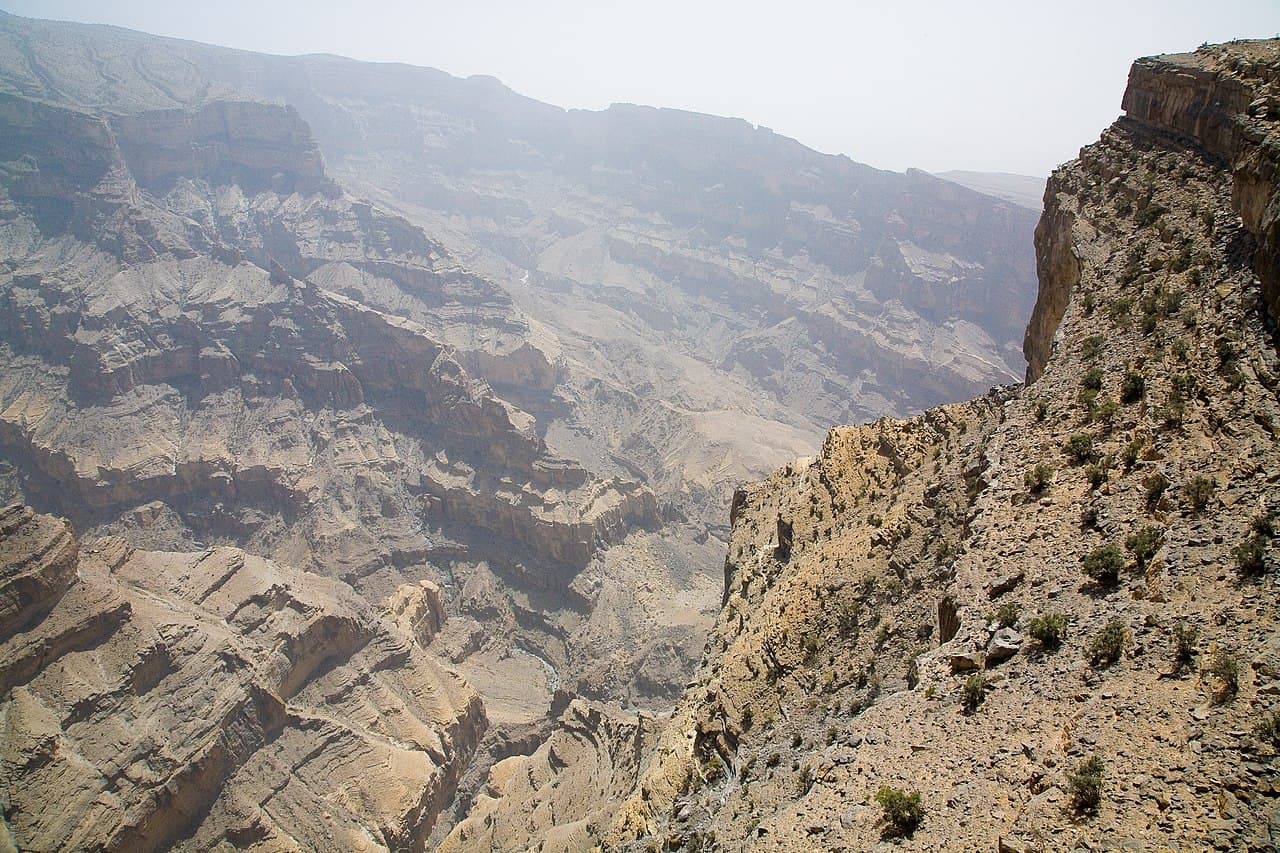
Jebel Shams
Oman's highest peak (3,009m) and the rim of Wadi Ghul — Arabia's "Grand Canyon," a kilometre-deep gorge with the celebrated Balcony Walk hugging an abandoned village track around the canyon wall. One of the great hikes of the Middle East.

Wahiba Sands
The classic Arabian desert of red-orange dunes, an easy onward hop from Nizwa. Most travellers do Nizwa by day, then drive south to a Wahiba Sands camp for sunset 4WD bashing and a night under the stars.
Sur
A historic dhow-building port on the east coast, near the Wadi Shab swimming canyon and Ras al Jinz turtle reserve where green turtles nest year-round. A natural extension of a Nizwa-Wahiba loop back to Muscat.
Al Ain (UAE)
The UAE's "Garden City" with the Al Ain Oasis (UNESCO falaj system), Jebel Hafeet and the Hili archaeological park. A short hop into the Emirates that lets you compare Omani and Emirati interpretations of the same Hajar landscape.
Entry Requirements
Oman visa policy is straightforward — most Western nationalities and several others receive a free 14-day visa-free entry stamp at Muscat International Airport. Longer stays require an e-visa applied for at evisa.rop.gov.om in advance, typically processed in 24-72 hours. GCC nationals enter freely.
Entry Requirements by Nationality
| Nationality | Visa Required | Max Stay | Notes |
|---|---|---|---|
| US Citizens | Visa-free | 14 days visa-free; up to 30 days with e-visa | Free 14-day stamp at Muscat airport. For longer stays apply online at evisa.rop.gov.om ($20 for 10-day; $50 for 30-day). |
| UK Citizens | Visa-free | 14 days visa-free; up to 30 days with e-visa | Same as US — free 14 days, e-visa for longer. Passport must be valid for 6 months. |
| EU Citizens | Visa-free | 14 days visa-free; up to 30 days with e-visa | Most EU nationalities qualify for visa-free entry up to 14 days. E-visa for longer trips. |
| Indian Citizens | Yes | Up to 30 days | E-visa required ($20-50). Apply at evisa.rop.gov.om — processing 1-3 days. Requires accommodation booking and return ticket. |
| Australian Citizens | Visa-free | 14 days visa-free; up to 30 days with e-visa | Free 14 days; e-visa for extended stays. |
Visa-Free Entry
Tips
- •Apply for the e-visa at least one week before travel — processing is usually fast but can take up to 3 days
- •If you only need 14 days, many nationalities enter visa-free — check eligibility before paying for an e-visa
- •Dress code is enforced at immigration — shorts and sleeveless tops can attract scrutiny
- •If driving across the UAE-Oman border, ensure your rental car insurance covers Oman — many UAE rentals do not
- •There is no separate Nizwa visa requirement — the Oman visa covers the entire country
Shopping
Nizwa is the silver-jewellery capital of Oman and the best place in the country to buy traditional craft. The main souq beside the fort is divided into halls for silver, daggers, halwa, dates, fish, meat and vegetables. Bargaining is expected at silver and antique stalls and pointless at fixed-price food halls.
Nizwa Silver Souq
traditional souqA double row of small workshops and shops selling hand-hammered Omani silver — khanjar daggers, anklets, bracelets, incense burners, prayer-bead chains and rifle-butt fittings. Most pieces are made in workshops behind the souq facade.
Known for: Khanjar daggers, Bedouin silver, Omani filigree work, frankincense burners
Nizwa Halwa & Date Souq
food marketA long aisle of stalls selling Omani halwa (a sticky, rosewater-and-saffron sweet), more than 20 varieties of dates from the Nizwa oasis, almonds, pistachios, frankincense and bukhoor.
Known for: Omani halwa, Khalas and Fardh dates, frankincense, almonds, kahwa coffee
Friday Goat & Cattle Market
livestock auctionThe 500-year-old Bedouin livestock auction held in a circular enclosure beside the souq from roughly 6am to 9am every Friday. Even non-buyers can sit and watch the spectacle.
Known for: Goats, sheep, cattle and camels — the cultural set-piece of Oman
Bahla Pottery Souq
craft marketA small cluster of pottery workshops and stalls in nearby Bahla town, selling traditional Omani terracotta — water jars, incense burners, bowls and bukhoor cups. Far cheaper to buy direct than in Muscat hotel shops.
Known for: Traditional Omani terracotta pottery, mukhmar incense burners, kahwa pots
🎁 Unique Souvenirs to Look For
- •Hand-hammered Omani silver from the Nizwa souq — antique pieces are sold by weight plus craftsmanship
- •Khanjar dagger — the curved ceremonial dagger that appears on the Omani flag, in decorative or functional versions
- •Omani halwa — a sticky rosewater-and-saffron sweet sold in decorative tubs
- •Jebel Akhdar rosewater (April-May only) — copper-still distilled rose petals, sold direct from family workshops
- •Bahla pottery — handmade terracotta water jars and bukhoor incense cups
- •Frankincense and bukhoor incense from the Nizwa souq
- •Nizwa-grown dates — Khalas, Fardh and Khasab varieties in vacuum-sealed bags
- •Omani kahwa coffee with cardamom and a brass dallah pot to brew it in
Language & Phrases
Arabic is the official language of Oman and the Nizwa region speaks classical Omani Arabic, considered one of the most measured and conservative Gulf dialects. English is spoken at hotels and by younger guides but much less common at the souq and Friday market than in Muscat. Even small Arabic phrases earn warm responses in Nizwa.
| English | Translation | Pronunciation |
|---|---|---|
| Hello / Peace be upon you | As-salamu alaykum | as-sah-LAH-moo ah-LAY-koom |
| Reply to greeting | Wa alaykum as-salam | wah ah-LAY-koom as-sah-LAHM |
| Good morning | Sabah al-khayr | sah-BAH al-KHAYR |
| Thank you | Shukran | SHOO-krahn |
| Please | Min fadlak (m) / Min fadlik (f) | min FAD-lak / min FAD-lik |
| Yes / No | Na'am / La | NAH-ahm / lah |
| How much? | Bi kam? | bee KAM? |
| God willing | Insha'Allah | in-SHAH al-LAH |
| Welcome (to a guest) | Ahlan wa sahlan | AH-lan wah SAH-lan |
| May I take a photo? | Mumkin sura? | MOOM-kin SOO-rah |
| Goodbye | Ma'a salama | MAH-ah sah-LAH-mah |
| No problem | Mafi mushkila | MAH-fee moosh-KEE-lah |
If you like Nizwa, you'll love…
4 cities with a similar vibe, outside of the same country.

United Arab Emirates · OVR 73
immaculate streets · low-anxiety streets

Saudi Arabia · OVR 72
immaculate streets · rich cultural layers

Japan · OVR 75
public spaces stay spotless · remarkably safe

New Zealand · OVR 70
easy to live online · generally safe