How many days in Pamukkale?
Plan 1-2 days for Pamukkale. 1 day catches the highlight; 2 lets you slow down for sunrise/sunset light, hiking, and a backup weather day.
The minimum
1 day
One full day on-site to see the headline view in good light, plus arrival/departure time.
The sweet spot
2 days
2 days adds a back-up weather day, an alternative viewpoint, and a deeper hike or guided experience.
Slow travel
4 days
4 days is for travellers who want to chase weather, hike multi-day routes, or combine with the wider area.
The headline things to do in Pamukkale
From the Pamukkale guide — these are the items that anchor a 1-day visit. For the full breakdown, read the Pamukkale travel guide.
- The Travertine Terraces — Western flank of Hierapolis
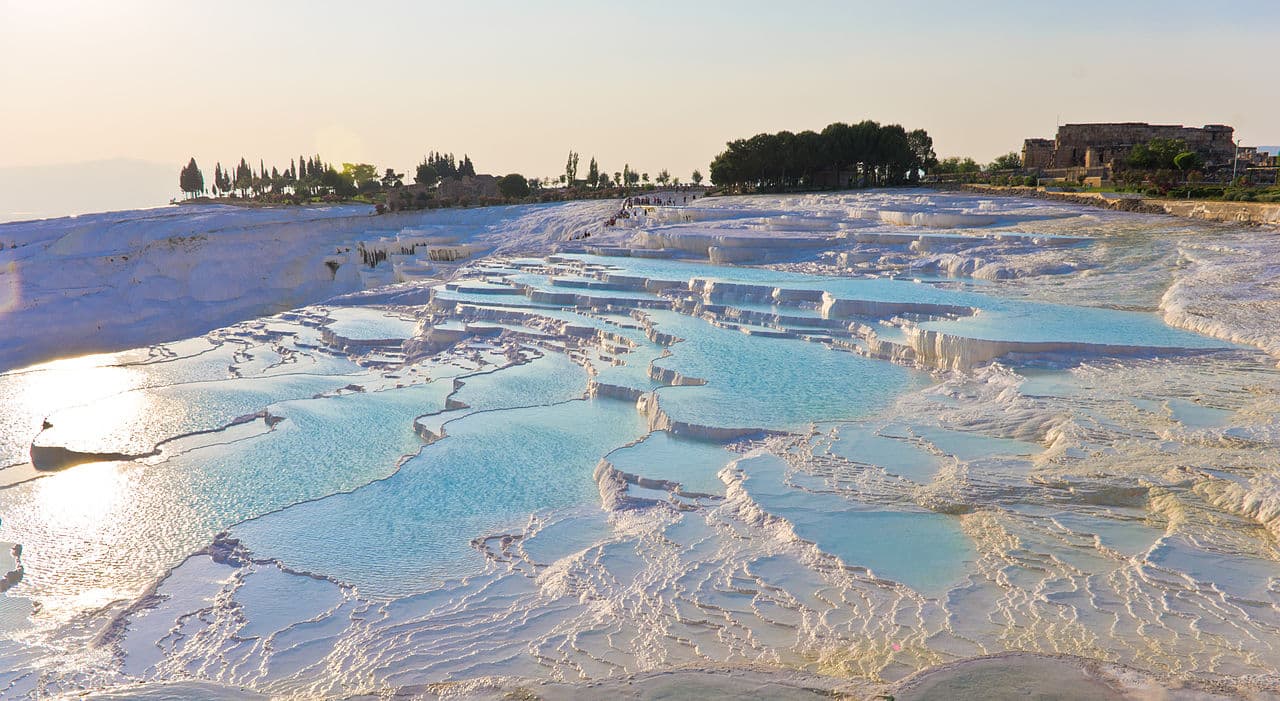
The reason you came — a cascade of brilliant-white calcium carbonate pools tiered down a 200-metre cliff, fed by hot mineral springs. The walking path runs from the Hierapolis upper gate down through the terraces to the village of Pamukkale, barefoot only. Most pools are dry or shallow due to water-flow management; the active filled sections are at the top and middle. Sunset turns the white pools pink and gold.
- Hierapolis Ancient City — Above the travertines
The sprawling ruins of the Greco-Roman spa city sit directly above the travertines — the well-preserved Roman theatre (12,000 seats, restored 2013), the colonnaded Frontinus Street, the Necropolis (one of the largest in Anatolia with 1,200+ tombs), the Plutonium (a sacred cave releasing toxic CO₂ believed to be the entrance to the underworld), and the 4th-century Martyrium of St Philip on the hill above. Allow 3 hours minimum.
- Cleopatra's Antique Pool — Centre of Hierapolis (next to museum)
A natural mineral pool (water 36°C, carbonated bubbles, mildly radioactive — believed therapeutic) where Roman columns from a 7th-century earthquake-toppled temple lie submerged on the floor. You swim around them. Separate ticket from Hierapolis (~₺250) and worth every lira; you can spend hours in the warm carbonated water. Towel and locker rental on-site; modest swimwear required.
- Hierapolis Archaeology Museum — Inside Hierapolis ruins
The on-site museum housed in the restored Roman bath complex — the Sarcophagus Gallery has extraordinary pieces from the Hierapolis necropolis with carved relief decoration in remarkable preservation. The Small Finds gallery includes glassware, jewellery, and the inscribed bronze statues recovered from the Frontinus Gate area. Included in the Hierapolis ticket.
- Roman Theatre of Hierapolis — Hierapolis upper city
Built into the hillside in the 2nd century AD under Hadrian and restored to remarkable condition by an Italian archaeology team in the 2010s. The theatre seats 12,000 and the carved scaenae frons (stage backdrop) is among the best-preserved in Anatolia, with intact reliefs of Apollo, Dionysus, and Artemis. Climb to the top tier for the panoramic view.
- Hierapolis Necropolis — Hierapolis, north end
The northern necropolis of Hierapolis stretches over 2 km along the road out of the city — more than 1,200 tombs in three styles: tumulus (earth mounds), sarcophagi, and mausolea (small temple-tombs). Pilgrims and the dying came to Hierapolis from across the Roman world for the curative waters; many ended up buried here. The Tomb of Flavius Zeuxis is the headline piece.
- Martyrium of St Philip — Hill above Hierapolis (20-min climb)
A 5th-century octagonal church on the hill above Hierapolis, built on the site where the apostle Philip was reportedly crucified upside-down in 80 AD. His tomb was rediscovered by Italian archaeologists in 2011 in a separate adjacent structure. The 20-minute climb up the marked path from the main Hierapolis area is worth it for the views back over the travertines and Menderes Valley.
- Karahayıt Red Springs — Karahayıt, 6 km north
Six kilometres from Pamukkale village, the spring at Karahayıt deposits iron-rich red and orange minerals instead of white calcium carbonate — a small but striking colour contrast to the main travertines, and a destination for thermal hotels with private pools fed by the same waters. Many visitors stay overnight in Karahayıt rather than Pamukkale village for better facilities.
Frequently asked
Is 1 day enough in Pamukkale?
1 day is the minimum for a satisfying visit — you'll see the headline sights but won't have flex time. If you can stretch to 2, you unlock a day trip and the food walks that make the trip memorable.
Is 4 days too long in Pamukkale?
4 days is on the upper end — most travellers feel it once they've done the headline experiences twice. Either island-hop, take a multi-day course, or split with another base.
What's the ideal trip length for first-time visitors to Pamukkale?
2 days is the sweet spot for a first visit — long enough to cover the must-sees, eat at three good spots, take one day trip, and not feel like you're racing a checklist. Less than 1 usually feels rushed; more than 4 is into slow-travel territory.
Should I add Pamukkale to a longer regional trip?
Yes — Pamukkale works well as a 1-2-day stop on a longer regional itinerary. Pair it with a nearby destination via the trip planner so the transit days don't compress your time on the ground.