
Yangon
THE QUICK VERDICT
By Anthony · Updated June 2026
Choose Yangon if you want the golden Shwedagon Pagoda, colonial-era architecture, and an off-the-beaten-path Southeast Asian experience.
- Best for
- Shwedagon Pagoda at sunset, Bogyoke Aung San Market, decaying colonial Pansodan Street, mohinga noodle breakfasts
- Best window
- Nov–Feb
- Budget anchor
- $80/day mid-range
- Visa first
- No visa-free entry listed — check requirements before booking anything
- Needs care
- Scores below most of the catalog on safety — read that section before you go
- Skip if
- you want easy connectivity — visa hurdles, weak wifi, and limited card acceptance complicate every step
Myanmar's largest city dazzles with the golden Shwedagon Pagoda, faded colonial grandeur, vibrant street food, and a pace of life that feels decades removed from neighboring capitals.
The two links below are affiliate links — MapSorted earns a small commission if you book through them, at no extra cost to you. How this works.
Tours & Experiences
Bookable tours, activities, and day trips in Yangon
Where to Stay
Compare hotels and rentals in Yangon
📍 Points of Interest
Shwedagon Pagoda
99-meter gold-covered stupa, Myanmar's most sacred site
Sule Pagoda
2,000-year-old octagonal pagoda at the center of downtown
Bogyoke Aung San Market
Colonial-era bazaar with jade, lacquerware, and textiles
Downtown Colonial District
Southeast Asia's largest collection of colonial buildings
Kandawgyi Lake
Peaceful lake with Shwedagon reflections and Karaweik Palace
Chaukhtatgyi Buddha
Massive 66-meter reclining Buddha with ornate decorated feet
★ Local Picks
19th Street BBQ Alley
Chinatown's vibrant evening street food and beer strip
Secretariat Building
Historic colonial seat of government where Aung San was assassinated
At a Glance
- Pop.
- 5.2M (metro)
- Timezone
- Yangon
- Dial
- +95
- Emergency
- 199
Shwedagon Pagoda, Yangon's crown jewel, is covered in genuine gold plates and topped with over 5,000 diamonds and 2,000 rubies — it has been gilded for over 2,500 years
Yangon has the largest collection of colonial-era buildings in Southeast Asia, with crumbling British, Indian, and Chinese architecture lining downtown streets
Despite being Myanmar's largest city (5+ million people), Yangon is no longer the capital — the government relocated to the purpose-built city of Naypyidaw in 2006
Street food in Yangon is among the cheapest and most diverse in Asia, blending Burmese, Indian, Chinese, and Shan cuisines on every block
The Circular Railway — a 46 km loop around the city — offers a 3-hour window into everyday Yangon life for less than $0.50
Yangon's Bogyoke Aung San Market has been the city's premier bazaar since 1926, selling jade, lacquerware, textiles, and gems under colonial-era iron roofing
Top Sights
Shwedagon Pagoda
📌Myanmar's most sacred Buddhist site — a 99-meter gilded stupa visible from across the city, surrounded by dozens of smaller temples, shrines, and pavilions. The pagoda is mesmerizing at sunset when the gold catches the fading light.
Downtown Colonial District
🗼A dense grid of crumbling colonial buildings dating from British rule, mixing Victorian, Edwardian, and Art Deco styles. Key buildings include the Secretariat (where Aung San was assassinated), the High Court, and the former Strand Hotel.
Bogyoke Aung San Market (Scott Market)
🗼A sprawling indoor market built in 1926 with over 2,000 shops selling jade jewelry, lacquerware, textiles, traditional Burmese clothing (longyi), antiques, and handicrafts. The best one-stop shopping in Yangon.
Sule Pagoda
📌A 2,000-year-old pagoda at the literal center of downtown Yangon, surrounded by a traffic roundabout. An important religious site and political gathering point. The octagonal shape is unique among Myanmar's pagodas.
Yangon Circular Railway
📌A 46 km commuter rail loop circling the entire city in about 3 hours. The slow journey passes through markets, suburbs, rice paddies, and the lively Insein Market. A fascinating glimpse of everyday Yangon life.
Kandawgyi Lake & Park
🌳A peaceful artificial lake east of the city center with views of Shwedagon Pagoda reflected in the water. The ornate Karaweik Palace (a concrete replica of a royal barge) sits on the eastern shore.
Chaukhtatgyi Buddha Temple
📌A massive 66-meter reclining Buddha housed in a large open-sided hall. The statue's serene face and ornately decorated feet are impressive. Much less crowded than Shwedagon despite being equally striking.
Inya Lake
🌳The larger of Yangon's two main lakes, surrounded by embassies, universities, and the home of Aung San Suu Kyi. The lakeside road is popular for evening walks and the area has Yangon's best upscale restaurants.
Entry Requirements
Most visitors to Myanmar require a visa. The eVisa system allows online applications for tourism visas before travel. Some ASEAN nationalities can enter visa-free. Due to political instability since 2021, visa policies and entry requirements may change with little notice — always check the latest information before booking travel.
Entry Requirements by Nationality
| Nationality | Visa Required | Max Stay | Notes |
|---|---|---|---|
| US Citizens | Yes | 28 days (tourist eVisa) | Apply for eVisa online ($50) at least 3 business days before travel. Single entry only. Passport must be valid for 6 months. Political situation may affect processing. |
| UK Citizens | Yes | 28 days (tourist eVisa) | eVisa available online ($50). Standard tourist visa through embassy also available. Check FCDO travel advisories before booking. |
| Australian Citizens | Yes | 28 days (tourist eVisa) | eVisa recommended ($50). DFAT travel advisories strongly recommended before travel to Myanmar. |
| ASEAN Citizens | Visa-free | 14-30 days (varies by country) | Most ASEAN nationals can enter visa-free for 14-30 days. Check specific bilateral agreements for your nationality. |
| Indian Citizens | Yes | 28 days | eVisa available ($50). Can also apply at Myanmar embassy. India-Myanmar border crossings have separate regulations. |
Visa-Free Entry
Visa on Arrival
Tips
- •The eVisa must be applied for before arrival — there is no visa-on-arrival for most nationalities except Japan and South Korea
- •Print your eVisa approval letter — immigration officers may not accept digital copies
- •The political situation since the 2021 coup means visa policies can change suddenly — verify requirements close to your travel date
- •Your passport must have at least 6 months validity and two blank pages
- •Yangon International Airport is the primary entry point — overland crossings from Thailand (Mae Sot-Myawaddy) have variable opening status
- •Keep your immigration card — you will need it when departing Myanmar
Safety Breakdown
Exercise Caution
out of 100
Yangon itself is relatively safe for tourists in terms of street crime — violent crime against foreigners is rare and the Burmese people are overwhelmingly warm and welcoming. However, Myanmar's broader political instability following the 2021 military coup has created significant safety concerns. Check current travel advisories from your government before planning a trip. Some areas of Myanmar are off-limits or dangerous.
Things to Know
- •Check your government's travel advisory for Myanmar before booking — conditions can change rapidly due to political instability
- •Avoid political demonstrations, military checkpoints, and any gatherings that could turn confrontational
- •Internet restrictions and VPN blocks are common — download offline maps and have backup communication plans
- •Petty theft is uncommon but use normal precautions — don't flash expensive electronics or large amounts of cash
- •Power outages are frequent, especially during the hot season — carry a portable charger and flashlight
- •Be respectful at religious sites — remove shoes and socks before entering pagodas, cover shoulders and knees
- •The sidewalks in downtown Yangon are broken, uneven, and often occupied by vendors — watch your footing
Natural Hazards
Emergency Numbers
Police
199
Fire
191
Ambulance
192
Red Cross (Myanmar)
01-383 680
Language & Phrases
Burmese is the official language, written in a distinctive circular script. English proficiency is low outside of hotels and tourist services. Even basic Burmese phrases will earn you enormous smiles and warmth from locals. Burmese has gendered endings — "kha" for female speakers and "khrab" for male speakers.
| English | Translation | Pronunciation |
|---|---|---|
| Hello | Mingalaba | min-gah-LAH-bah |
| Thank you | Kyay zu tin ba deh | CHAY-zoo tin bah DAY |
| Please | Kyeizu pyu' | CHAY-zoo pyoo |
| Excuse me / Sorry | Sawr ri ba deh | SAW-ree bah DAY |
| Yes / No | Houk-keh / Ma houk bu | HOUK-keh / mah HOUK boo |
| How much is this? | Da beh lout leh? | dah BEH lout LAY? |
| Too expensive | Zay mya deh | ZAY myah DAY |
| Where is...? | ...beh hma leh? | ...BEH hmah LAY? |
| Delicious | Sa kaung deh | sah GOWN day |
| I don't understand | Na ma leh bu | nah mah LAY boo |
| Beautiful (for pagodas) | Hla deh | HLAH day |
| Cheers! | Aung myin ba say | OWNG myin bah SAY |
Climate & Best Time to Go
Yangon has a tropical monsoon climate with three distinct seasons: a cool season, a hot season, and a monsoon season. The monsoon brings torrential rain from May to October, often flooding streets. The cool season (November-February) has the most pleasant temperatures and is the peak tourist season.
Cool Season
November - February64-91°F
18-33°C
The most comfortable season with lower humidity, warm days, and pleasantly cool evenings. Clear skies make this ideal for sightseeing. December-January mornings can feel genuinely cool.
Hot Season
March - May77-100°F
25-38°C
Intensely hot and humid, especially April when temperatures regularly exceed 37°C. Pre-monsoon thunderstorms begin in May. The Thingyan Water Festival in mid-April provides relief.
Monsoon Season
June - October75-91°F
24-33°C
Heavy, sustained rain — Yangon receives over 2,700mm annually, most of it during these months. Streets flood regularly. Rain can last all day, unlike brief tropical showers elsewhere in Southeast Asia.
Best Time to Visit
The cool season from November to February offers the most comfortable weather with lower humidity and pleasant temperatures. This is peak tourist season. Avoid the deep monsoon months (July-September) when relentless rain and flooding make sightseeing difficult.
Cool Season (November - February)
Crowds: Moderate to high — peak tourist seasonThe best time to visit with warm, sunny days and cooler evenings. Humidity drops and clear skies make pagoda visits and photography ideal. This is high season for tourism.
Pros
- + Most comfortable temperatures
- + Clear skies for Shwedagon sunsets
- + Low humidity
- + Best overall travel conditions
Cons
- − Peak season hotel prices
- − Popular sites more crowded
- − Limited domestic flight availability during holidays
- − Cool mornings may surprise tropical expectations
Hot Season (March - May)
Crowds: Low except during Thingyan weekExtremely hot and increasingly humid leading into the monsoon. April is the hottest month but also hosts Thingyan (Water Festival), Myanmar's biggest celebration when the entire country erupts in water fights.
Pros
- + Thingyan Water Festival in April
- + Lowest hotel prices
- + Few tourists
- + Mangoes and tropical fruit in season
Cons
- − Oppressive heat (35-38°C)
- − High humidity
- − Most businesses close during Thingyan week
- − Difficult to spend extended time outdoors
Monsoon Season (June - October)
Crowds: Very lowHeavy, sustained rain that can last all day. Streets flood regularly, transport is disrupted, and outdoor sightseeing becomes challenging. Some domestic flights are cancelled. Not recommended for first-time visitors.
Pros
- + Lowest prices and fewest tourists
- + Lush green landscapes
- + Atmospheric rain-soaked pagodas
- + Authentic, tourist-free experience
Cons
- − Torrential rain — sometimes all day
- − Severe street flooding
- − Transport disruptions
- − Some attractions difficult to reach
🎉 Festivals & Events
Thingyan (Water Festival)
Mid-April (typically April 13-16)Myanmar's most exuberant festival marking the Burmese New Year. The entire country celebrates with massive water fights — everyone on the street gets soaked. Stages with high-powered hoses line major roads.
Thadingyut (Festival of Lights)
October (full moon)A three-day festival marking the end of Buddhist Lent. Buildings, pagodas, and homes are illuminated with candles, lanterns, and electric lights. People pay respect to elders and teachers.
Shwedagon Festival
February/March (full moon of Tabaung)The largest pagoda festival in Myanmar with thousands of pilgrims, market stalls, theatrical performances, and all-night celebrations around the golden stupa.
Tazaungdaing (Balloon Festival period)
November (full moon)Marks the end of the rainy season with lights, robe-weaving competitions, and pagoda festivals. The Taunggyi Balloon Festival in Shan State (not Yangon) features fire balloons.
Off the Beaten Path
19th Street (Chinatown BBQ Alley)
A bustling evening street food strip in Chinatown where plastic tables spill onto the road between tea shops and BBQ stalls. Skewers of meat, seafood, and vegetables are grilled over charcoal while Myanmar Beer flows freely.
This is Yangon at its most vibrant and social. Locals and travelers mix on tiny stools, pointing at skewers and sharing tables. A full dinner with beers rarely exceeds $5.
Secretariat Building (Ministers' Building)
The massive red-brick colonial building where General Aung San and six cabinet members were assassinated in 1947, just months before independence. After decades of closure, parts are now accessible for guided heritage tours.
This building is the most historically significant site in modern Myanmar. The bullet holes in the cabinet room walls remain — a powerful, under-visited monument.
Yangon Heritage Trust Walking Tours
Guided walking tours through downtown's colonial architecture led by heritage preservation advocates. The tours reveal stories behind the crumbling facades and the multicultural history of the city.
Many of these colonial buildings are under threat of demolition. The trust is fighting to preserve them — the tours fund conservation work.
Shwedagon Pagoda at Dawn
While most tourists visit Shwedagon at sunset, arriving at dawn (the pagoda opens at 4 AM) reveals a completely different experience. Monks chant, devotees sweep the marble platform, and golden light creeps across the stupa.
At dawn, Shwedagon belongs to the faithful, not to tourists. The atmosphere is profoundly spiritual and deeply peaceful — the quintessential Myanmar experience.
Musmeah Yeshua Synagogue
One of only two synagogues remaining in Myanmar, built in 1896 by Baghdadi Jewish immigrants. The caretaker, Moses Samuels, opens the building to visitors and shares the story of Yangon's once-thriving Jewish community.
Yangon's Jewish community has dwindled to just a handful of people. This beautiful synagogue is a testament to the city's once-incredible religious diversity.
Costs & Currency
Where the money goes
USD per dayBackpacker = hostel dorm + street food + public transit. Mid-range = 3-star hotel + neighbourhood restaurants + transit cards. Luxury = 4/5-star + fine dining + taxis. How we calibrate these numbers →
Quick cost estimate
Customize per category →Estimates based on regional averages. Flight prices vary by season and airline.
budget
$25-45
Budget guesthouse, street food and tea shop meals, bus and circular railway, walking the colonial district
mid-range
$60-100
Mid-range hotel, restaurant meals, Grab taxis, guided walking tour, Bogyoke Market shopping
luxury
$150+
The Strand or Belmond hotel, fine dining, private car and guide, spa treatments
Typical Costs
| Item | Local | USD |
|---|---|---|
| AccommodationBudget guesthouse (double) | K 20,000-40,000 | $10-19 |
| AccommodationMid-range hotel (double) | K 60,000-120,000 | $29-57 |
| AccommodationLuxury hotel | K 250,000-600,000 | $119-286 |
| FoodStreet food meal (mohinga, etc.) | K 1,500-3,000 | $0.70-1.45 |
| FoodTea shop meal with tea | K 2,000-4,000 | $0.95-1.90 |
| FoodRestaurant dinner | K 8,000-20,000 | $3.80-9.50 |
| FoodMyanmar Beer (draft) | K 1,500-3,000 | $0.70-1.45 |
| TransportGrab ride (city trip) | K 2,000-5,000 | $0.95-2.40 |
| TransportCircular Railway (full loop) | K 300 | $0.15 |
| TransportYBS bus | K 200-300 | $0.10-0.15 |
| AttractionsShwedagon Pagoda entrance (foreigners) | K 10,000 | $4.80 |
| AttractionsSule Pagoda entrance | K 3,000 | $1.45 |
| AttractionsBogyoke Market shopping | Varies | Varies — bargain hard |
💡 Money-Saving Tips
- •Eat at tea shops and street stalls — mohinga (fish noodle soup) is the national dish and costs under $1
- •The Circular Railway is the cheapest city tour in Asia at K 300 for a 3-hour loop
- •Walk the downtown colonial district for free — the most impressive facades are visible from the street
- •Ride the YBS bus system — K 200-300 per trip makes it incredibly cheap if you can navigate the routes
- •Stay in guesthouses on the outskirts of downtown — much cheaper than the colonial center hotels
- •Shwedagon Pagoda is the main paid attraction — most pagodas and temples in Yangon are free for everyone
- •Buy street food and drinks from vendors rather than restaurants — prices are 3-5x lower
- •Carry small kyat bills (K 1,000 and K 5,000) as vendors often cannot make change for large notes
Myanmar Kyat
Code: MMK
1 USD is approximately 2,100 MMK at the official rate (as of early 2026), though black market rates may differ significantly. US dollars are widely accepted at hotels, tour agencies, and some shops — bring clean, crisp, post-2006 US bills as damaged or old notes are routinely refused. ATMs (KBZ, CB Bank, AYA) dispense kyat and accept international cards but charge fees.
Payment Methods
Cash is essential in Yangon. Most local businesses, markets, street food stalls, and taxis are cash-only. Credit cards are accepted at international hotels, upscale restaurants, and major shopping malls. Visa is more widely accepted than Mastercard. Mobile payments (KBZPay, Wave Money) are growing among locals but rarely used by tourists.
Tipping Guide
Tipping is not traditionally expected in Myanmar. At upscale restaurants, 5-10% is increasingly appreciated but not required. Small change is a kind gesture at local restaurants.
$5-10 per person per day for guides, $3-5 for drivers. Guides in Myanmar are often underpaid and tips make a real difference.
K 1,000-2,000 ($0.50-1) per bag for porters. Housekeeping tips at international hotels: K 2,000-3,000 per day.
Not expected. The agreed fare is the fare. Round up for convenience if you wish.
Unofficial guides may approach at Shwedagon — if you use one, K 5,000-10,000 ($2.40-4.80) is appropriate.
How to Get There
✈️ Airports
Yangon International Airport(RGN)
15 km northTaxi or Grab to downtown takes 30-60 minutes depending on traffic (K 10,000-15,000/~$4.80-7.20). No rail link or airport bus. Traffic can be brutal during rush hours — allow 1.5+ hours for the return trip to the airport.
✈️ Search flights to RGN🚆 Rail Stations
Yangon Central Railway Station
Central — adjacent to Bogyoke MarketTrains to Mandalay (15h, ordinary/upper class $4-35), Bago (2h, $1-2), Mawlamyine (10h, $5-10), and other cities. Myanmar railways are slow, aging, and basic — but atmospheric. Book upper class for more comfort.
🚌 Bus Terminals
Aung Mingalar Highway Bus Terminal
The main long-distance bus station with services to Bagan (9-10h, $10-15), Inle Lake/Nyaungshwe (12h, $12-18), Mandalay (8-9h, $10-15), Hpa-An (7-8h, $8-12), and Golden Rock (5h, $5-8). VIP buses have reclining seats and are recommended. Located far north of the city center — taxi K 8,000-12,000.
Getting Around
Yangon's transport is chaotic but cheap. Taxis are the most practical option for tourists — always negotiate the fare before getting in. The Grab app works in Yangon and provides transparent pricing. Local buses are crowded and confusing. The Circular Railway is a great experience but impractical for getting around quickly.
Taxis / Grab
K 2,000-5,000 (~$0.95-2.40) for city trips; Grab prices are similar but fixedRegular taxis (no meters — negotiate first) and Grab ride-hailing are the main transport for visitors. Grab provides transparent pricing and GPS routing. Regular taxis are older but cheap.
Best for: Getting anywhere in the city reliably — essential for reaching Shwedagon, the airport, and distant neighborhoods
YBS (Yangon Bus Service)
K 200-300 (~$0.10-0.15) per tripA network of public buses covering the city. Routes are complicated and signage is mostly in Burmese. Air-conditioned buses run on major routes. The YBS app helps with route planning.
Best for: Budget travelers comfortable navigating local systems — the Sule to Shwedagon route is straightforward
Circular Railway
K 300 (~$0.15) for the full loopA commuter rail loop circling the city in approximately 3 hours. Slow, rattling, and thoroughly local — more of an experience than practical transport. Departs from Yangon Central Station.
Best for: A unique cultural experience and a window into everyday Yangon life — not for getting somewhere quickly
Trishaw (Sidecar Bicycle)
K 1,000-3,000 (~$0.48-1.45) for short tripsTraditional bicycle-powered sidecars still operating in some neighborhoods. Slow but atmospheric. Negotiate the fare before riding.
Best for: Short trips through quieter neighborhoods for a traditional experience — mainly found outside the congested downtown
Walkability
Downtown Yangon is compact and walkable for the colonial district, Sule Pagoda, Chinatown, and the markets. Sidewalks are challenging — broken, narrow, and shared with vendors, parked cars, and food stalls. Crossing major roads requires patience and nerve. Shwedagon is a 30-minute walk from downtown or a short taxi ride.
Travel Connections

Bagan
An ancient city with over 2,000 Buddhist temples and pagodas scattered across a vast plain. Hot air balloon rides at sunrise over the temple-studded landscape are one of Asia's most iconic experiences.

Inle Lake
A serene highland lake famous for its leg-rowing fishermen, floating gardens, stilt-house villages, and atmospheric boat trips through lotus-filled channels. The heart of Shan State.
Golden Rock (Kyaiktiyo)
A gravity-defying golden boulder balanced on the edge of a cliff, one of Myanmar's most sacred pilgrimage sites. The overnight stay at the summit for sunrise is unforgettable.
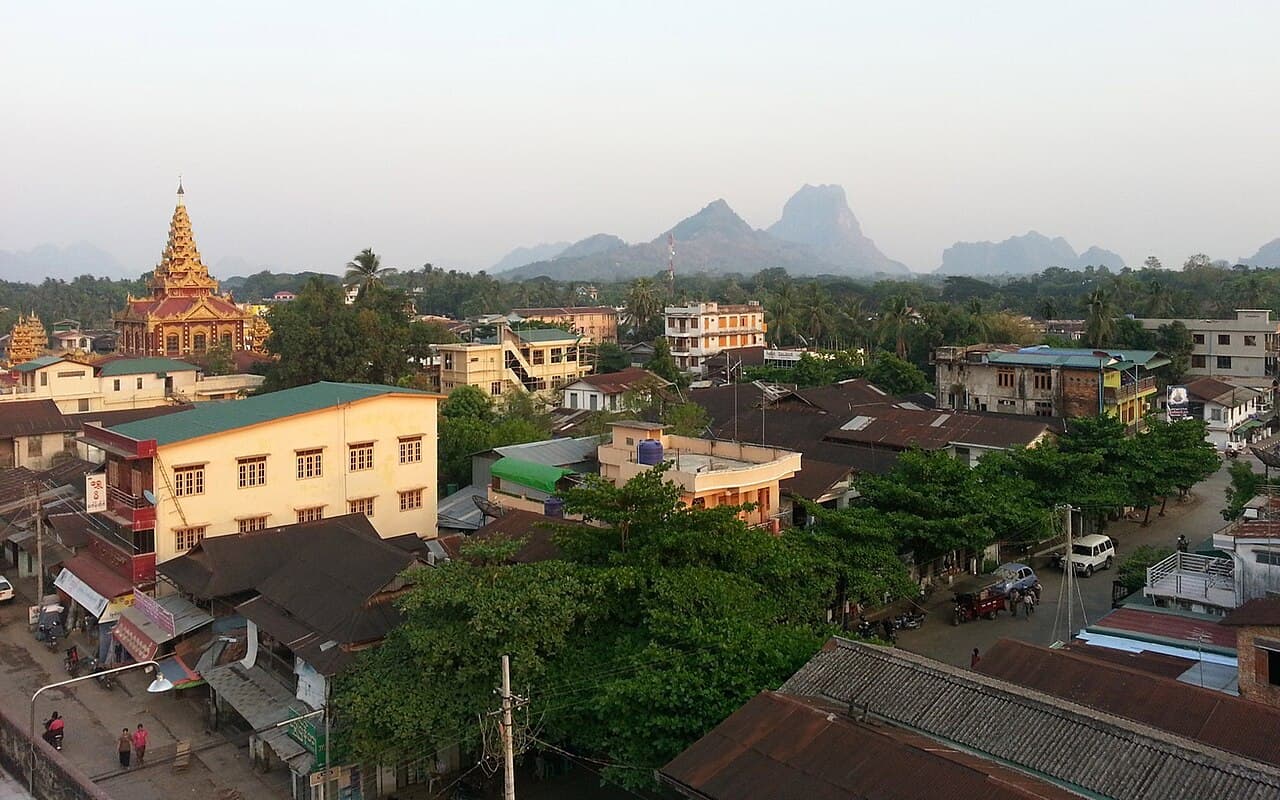
Hpa-An
A laid-back town in Kayin State surrounded by dramatic karst limestone mountains, sacred caves filled with thousands of Buddhas, and rice paddies stretching to the horizon.
Bago
The ancient Mon capital with a massive reclining Buddha (55m), the ruined palace of King Bayinnaung, and the beautiful Shwemawdaw Pagoda — taller than Shwedagon. An easy and rewarding day trip.
Shopping
Yangon offers excellent shopping for traditional Burmese crafts, gemstones, and textiles. Bogyoke Aung San Market is the main destination for tourists, but the chaotic downtown street markets offer more authentic experiences. Myanmar is famous for jade and rubies, but buy from reputable dealers only.
Bogyoke Aung San Market (Scott Market)
covered marketThe premier shopping destination with over 2,000 shops under colonial-era roofing. Well-organized sections for jade, gems, lacquerware, textiles, art, antiques, and clothing. Closed on Mondays and public holidays.
Known for: Jade jewelry, Burmese lacquerware, longyi (sarongs), Shan bags, oil paintings, antiques, gemstones
Theingyi Zei Market
wholesale marketA massive downtown market where Yangon residents shop for fabrics, traditional medicine, thanaka (bark paste used as sunscreen/cosmetic), and household goods. Authentic and overwhelming.
Known for: Thanaka, traditional Burmese textiles, herbal medicine, longyis in every pattern imaginable
Chinatown Street Markets
street marketThe streets between Maha Bandula Road and the waterfront come alive in the evening with food stalls, produce vendors, and household goods. Raw, chaotic, and thoroughly local.
Known for: Street food, fresh produce, household goods, Chinese goods, the evening market atmosphere
Junction City / Sule Square
modern shopping mallModern air-conditioned malls near Sule Pagoda with international brands, supermarkets, food courts, and cinemas. A contrast to the traditional markets and a welcome refuge from the heat.
Known for: International brands, air conditioning, Western-style food courts, supermarkets with packaged souvenirs
🎁 Unique Souvenirs to Look For
- •Burmese lacquerware — intricate black and red bowls, boxes, and trays from Bagan-style workshops
- •Jade jewelry — Myanmar produces over 70% of the world's jade. Buy from reputable shops at Bogyoke Market
- •Longyi (sarong) fabric — traditional wrap-around garments worn by both men and women. Look for high-quality Acheik-pattern longyis
- •Thanaka paste and bark — the traditional Burmese cosmetic/sunscreen ground from bark
- •Shan bags — colorful woven shoulder bags from Shan State
- •Burmese sand paintings and traditional oil paintings
- •Pickled tea leaf (laphet) — Myanmar's most distinctive food product, available in gift packaging
- •Puppet marionettes — traditional Burmese string puppets (yokthe thay) used in classical theater
If you like Yangon, you'll love…
4 cities with a similar vibe, outside of the same country.

India · OVR 71
rich cultural layers · genuinely affordable

Indonesia · OVR 71
deep artistic heritage · easy on the wallet

India · OVR 70
rich cultural layers · strong food culture

Morocco · OVR 70
not wallet-breaking · museum-dense old core