Trinidad
THE QUICK VERDICT
By Anthony · Updated April 2026
Choose Trinidad if you want Cuba's best-preserved colonial UNESCO city — cobblestone streets, 1950s pastel houses, salsa pouring from every doorway, and horseback rides to Topes de Collantes waterfalls.
- Best for
- Plaza Mayor cobblestones, live son at Casa de la Música steps, horseback rides to Salto del Caburní
- Best window
- Nov–Apr
- Budget anchor
- $80/day mid-range
- Language gap
- English gets thin outside tourist areas — a translation app earns its keep
- Skip if
- you need fast wifi or English signage — bring offline maps and basic Spanish
UNESCO-listed colonial city frozen in the 18th century — founded in 1514, Trinidad's pastel-painted houses and cobblestone streets have barely changed since sugar wealth peaked. Plaza Mayor is the finest colonial square in Cuba. Valle de los Ingenios preserves the sugar-plantation landscape that made the city rich and enslaved thousands.
The two links below are affiliate links — MapSorted earns a small commission if you book through them, at no extra cost to you. How this works.
Tours & Experiences
Bookable tours, activities, and day trips in Trinidad
Where to Stay
Compare hotels and rentals in Trinidad
📍 Points of Interest
Plaza Mayor
Trinidad's colonial heart — a shaded square flanked by four 18th-century buildings including the Iglesia Parroquial and Museo Romántico. Wrought-iron balustrades, ceramic urns, and bronze greyhound statues unchanged in 200 years.
Casa de la Música
A 19th-century mansion whose grand staircase becomes an outdoor concert stage each evening — locals and travelers sit with rum watching live salsa and son performances under the stars.
Valle de los Ingenios
UNESCO site — the "Valley of the Sugar Mills" stretches east of Trinidad with 70 former plantation ruins. The 43-metre Manaca-Iznaga bell tower, from which overseers watched enslaved workers, is the most striking monument to Cuba's sugar history.
Playa Ancón
Cuba's finest south coast beach — 4 km of white Caribbean sand with clear turquoise water and offshore coral reefs. Day-trip from Trinidad by bicycle (flat 12 km ride) or taxi.
Museo Romántico
A 19th-century aristocratic mansion on Plaza Mayor preserving the furnishings, silverware, and domestic life of Trinidad's sugar-era elite — Bohemian crystal, French furniture, and Wedgwood porcelain acquired from plantation wealth.
Topes de Collantes
Cloud forest reserve in the Escambray Mountains — 800m above sea level with waterfalls, orchid-draped trails, and swimming holes at El Salto del Caburní. A cool escape 20 km from the tropical heat below.
At a Glance
- Pop.
- 75K
- Timezone
- Havana
- Dial
- +53
- Emergency
- 106 / 104
Trinidad was founded in 1514 by Diego Velázquez de Cuéllar — one of the first seven settlements established in Cuba — and its 16th–18th century colonial core is so intact it was frozen in time when sugar wealth collapsed after the 1800s
The historic centre and the nearby Valle de los Ingenios (Valley of the Sugar Mills) were jointly inscribed as a UNESCO World Heritage Site in 1988 — the valley's 70 former sugar plantations document the brutal history of Caribbean slavery
Trinidad's distinctive multi-coloured colonial houses — yellow, terracotta, blue, and ochre — were painted in vegetable dyes mixed with egg white, and many still use original formulas two centuries later
Live son, salsa, and bolero music plays every night at the Casa de la Música and Casa de la Trova — Trinidad has produced more celebrated Cuban musicians per capita than almost any other city
Playa Ancón, 12 km from Trinidad, is widely regarded as the finest beach on Cuba's south coast — a 4 km strip of white sand and turquoise Caribbean water with offshore reefs for snorkeling
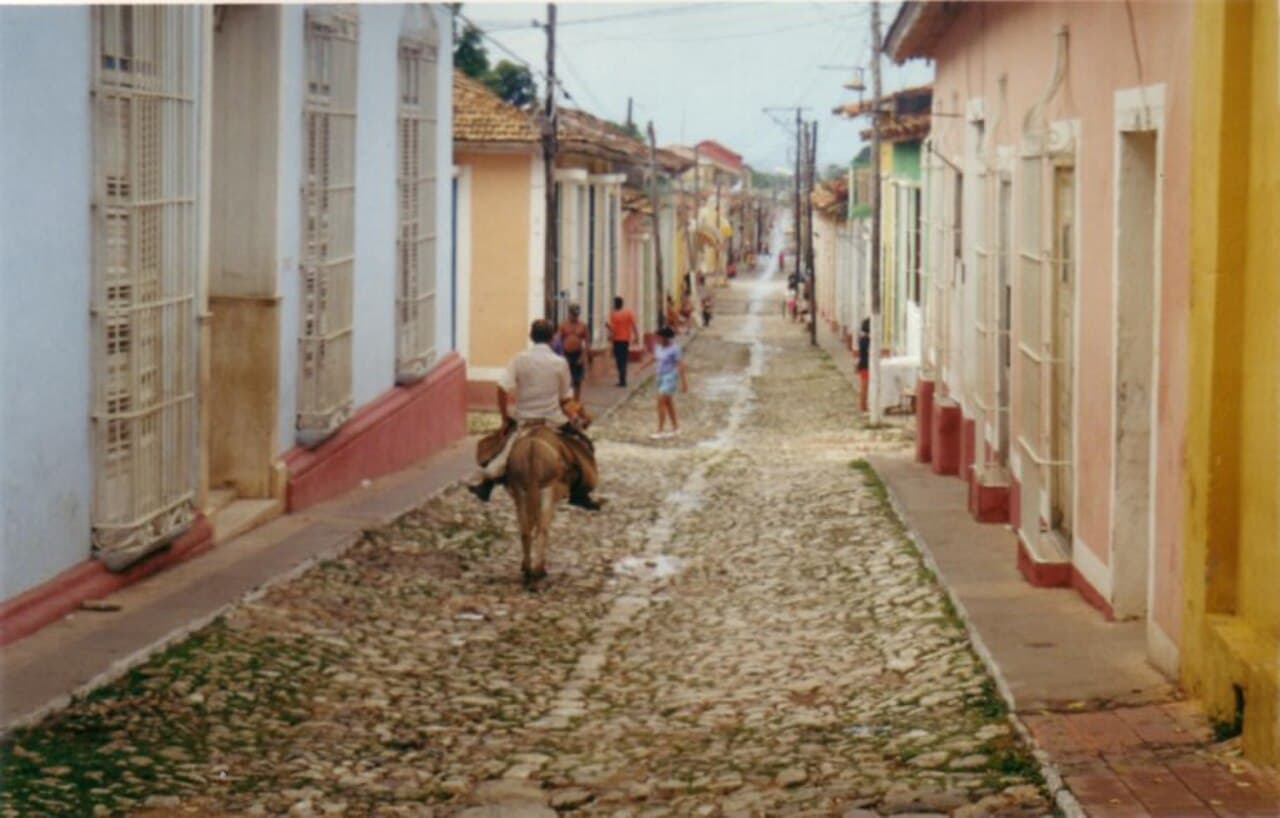
Horse-drawn carriages (coches) are the primary local transportation in Trinidad — not a tourist gimmick but a practical response to the shortage of fuel and vehicle parts since the 1990s Special Period
Top Sights
Plaza Mayor
🗼The colonial heart of Trinidad — a shaded square flanked by four of the city's finest 18th-century buildings: the Iglesia Parroquial de la Santísima Trinidad, the Museo Romántico (displaying 19th-century aristocratic furnishings), the Museo de Arquitectura Colonial, and the Casa de los Sánchez Iznaga. The square's wrought-iron balustrades, ceramic urns, and bronze greyhound statues have barely changed in 200 years.
Cobblestone Streets & Colonial Quarter
📌The entire historic centre is paved in smooth river cobblestones — installed in the 18th century and still original. The streets are wide enough for one carriage, lined with one-storey colonial houses whose carved wooden window grilles (rejas) and interior courtyards (patios) are living museum pieces. Wandering without a map, getting lost, and stumbling into tiled courtyards is the point.
Casa de la Música
📌A 19th-century mansion whose broad staircase steps function as an outdoor concert venue every evening — locals and tourists sit on the steps drinking Cuban rum and watching live salsa, son, and trova. One of the most vivid live music scenes in the Caribbean, completely free to attend (drinks optional but encouraged).
Valle de los Ingenios
📌The "Valley of the Sugar Mills" stretches 12 km east of Trinidad — 70 sugar plantation ruins, including the striking Manaca-Iznaga estate with its 43-metre bell tower (the tallest in Cuba), from which overseers watched the enslaved workforce. A UNESCO site documenting 19th-century sugar wealth and the human cost behind it. Accessible by horse, bicycle, or the tourist steam train.
Playa Ancón
🌿The south coast's finest beach — 4 km of white sand backed by mangroves, with crystal Caribbean water and coral reefs within swimming distance. Day-trip buses run from Trinidad; the full-service Ancón Hotel sits mid-beach. Snorkelling and diving equipment available at the beach kiosks.
Topes de Collantes
🌿A 800m cloud forest reserve in the Escambray Mountains — 20 km north of Trinidad, with waterfalls (El Salto del Caburní), orchid-draped trails, and cool air a full 10°C below the city. A dramatic contrast to the coastal heat below.
Language & Phrases
| English | Translation | Pronunciation |
|---|---|---|
| What's up, mate? (Cuban greeting) | ¿Qué bola, asere? | keh BOH-lah ah-SEH-reh |
| It's all good, cool | Está bien, chévere | es-TAH byen SHEH-veh-reh |
| Where can I listen to music? | ¿Dónde puedo escuchar música? | DON-deh PWEH-doh es-koo-CHAR MOO-see-kah |
| A room in a private homestay | Una habitación en casa particular | OO-nah ah-bee-tah-SYON en KAH-sah par-tee-koo-LAR |
| How much is the bill? | ¿Cuánto es la cuenta? | KWAN-toh es lah KWEN-tah |
| A mojito, please | Un mojito, por favor | oon moh-HEE-toh por fah-VOR |
| No, thank you | No, gracias | noh GRAH-syahs |
| How delicious! | ¡Qué sabroso! | keh sah-BROH-soh |
Climate & Best Time to Go
Trinidad has a tropical savanna climate — hot and humid year-round, with a rainy season (May–October) and a drier, milder winter (November–April). The Escambray Mountains to the north moderate the heat slightly. Hurricane season runs June–November.
Dry Season
November–April72–86°F
22–30°C
The prime tourist season — reliable sunshine, low humidity, warm enough to swim. Christmas and New Year are especially festive with rooftop parties and street celebrations.
Early Wet Season
May–July79–93°F
26–34°C
Heat builds; afternoon thunderstorms become frequent but usually brief. Crowds thin, prices drop. Good for those who tolerate humidity.
Hurricane Season
August–October79–91°F
26–33°C
Peak of rainy and hurricane season — heavy rainfall possible. Cuba is hit by major hurricanes less often than other Caribbean islands, but storms can disrupt travel.
Best Time to Visit
November–April (dry season) is optimal. Christmas and Semana Santa (Easter) are especially vibrant but very busy. Avoid August–October for hurricane risk and the wettest months.
Dry Season (Nov–Apr)
Crowds: High (Christmas, Easter peak)The ideal window — clear skies, comfortable temperatures, and the most lively cultural calendar.
Pros
- + Best weather
- + Christmas and Semana Santa festivities
- + Clear days for Playa Ancón
Cons
- − Christmas and Semana Santa accommodation books up months ahead
- − Tourist prices at their highest
Shoulder (May, Oct)
Crowds: LowWet season edges, manageable rainfall, and significantly lower tourist prices. Carnival in July is an exception.
Pros
- + Lower prices
- + Carnaval de Trinidad (July)
- + Fewer tourists
Cons
- − Increasing humidity
- − Some afternoon rain
Hurricane Season (Aug–Sep)
Crowds: Very LowHighest rainfall and hurricane risk — not recommended for most travelers. Travel disruptions possible.
Pros
- + Absolute lowest prices
Cons
- − Hurricane risk
- − Very hot and humid
- − Travel disruptions possible
🎉 Festivals & Events
Semana de Cultura Trinitaria
JanuaryWeek of cultural events celebrating Trinidad's founding — music, dance, and street celebrations
Carnaval de Trinidad
JulySummer street carnival with rumba, conga drums, and elaborately costumed parades
Festival de Música Guarachando
OctoberSon and guaracha music festival drawing musicians from across Cuba
Off the Beaten Path
Casa de la Trova
A different vibe from the Casa de la Música — smaller, more intimate, with older trovadores playing traditional son and bolero for a mostly local crowd. Daytime sessions happen with no cover charge; just order a mojito and absorb 400 years of Cuban musical tradition.
The trova tradition predates the revolution — these musicians are custodians of Cuba's deepest musical roots.
Paladares on Simón Bolívar
The blocks around Simón Bolívar Street are lined with paladares (family-run restaurants) serving the best lobster, ropa vieja, and rice-and-beans at a fraction of state-restaurant prices. Look for the hand-painted signs in doorways — the most authentic ones have no exterior signage.
Cuba's paladar system is one of the most interesting restaurant formats anywhere — family cooking in family homes, every plate different.
Early Morning on the Cobblestones
Before 9am, Trinidad's streets belong to its residents — women in housedresses chatting across window grilles, schoolchildren in uniforms, a man walking a pig on a rope. The light is golden, the air cool, and the colonial architecture untouched by tourists for another hour.
Trinidad is genuinely inhabited — it's not a museum town. The early morning shows you the real city.
Horses to the Valley
Renting a horse from the corrals outside town to ride through the Valle de los Ingenios at sunrise — passing ruined sugar mill chimneys, royal palms, and oxen working the fields — is the most cinematic 3 hours available in Cuba.
The valley hasn't been mechanized — it still operates the way Cuba's countryside has worked for generations.
Safety Breakdown
Moderate
out of 100
Trinidad is very safe by Caribbean standards. The main nuisance is jineteros — persistent touts trying to direct tourists to specific casas, restaurants, or taxi drivers for a commission. Violent crime against tourists is extremely rare. Exercise normal caution with valuables.
Things to Know
- •Jineteros (touts) will approach constantly in the historic centre — a firm but polite "no gracias" usually suffices; they rarely persist
- •Never exchange money on the street — use CADECA (official exchange bureau) or your casa particular
- •Keep valuables out of sight — petty theft exists but is not common
- •Walk the cobblestones in closed shoes — the uneven stones are ankle-roll hazards in sandals
- •Carry your own water — the heat is intense and rehydration vendors are not on every corner
- •Travel insurance is mandatory for entry to Cuba; verify your policy covers Cuba before departure
Emergency Numbers
Police
106
Ambulance
104
Fire
105
Costs & Currency
Where the money goes
USD per dayBackpacker = hostel dorm + street food + public transit. Mid-range = 3-star hotel + neighbourhood restaurants + transit cards. Luxury = 4/5-star + fine dining + taxis. How we calibrate these numbers →
Quick cost estimate
Customize per category →Estimates based on regional averages. Flight prices vary by season and airline.
budget
$30–50
Casa particular, paladar meals, local rum, walking everywhere — the most authentic and affordable way to travel Cuba.
mid-range
$60–100
Comfortable casa, mix of paladares and nicer restaurants, day trips to Playa Ancón and the valley.
luxury
$120–200
Trinidad's few boutique properties, private taxis everywhere, guided excursions, and the full splurge on lobster dinners.
Typical Costs
| Item | Local | USD |
|---|---|---|
| AccommodationCasa particular (per night) | CUP $600–1,200 | $25–50 |
| FoodPaladar dinner (lobster) | CUP $600–1,200 | $25–50 |
| TransportViazul bus to Havana | CUC $25 | $25 |
| ActivitiesTopes de Collantes park entry | CUC $5–8 | $5–8 |
💡 Money-Saving Tips
- •Stay in casas particulares — far better value and more authentic than state hotels
- •Eat at paladares (private restaurants) for better food at lower prices than state restaurants
- •Buy rum and cigars at ARTEX shops rather than tourist-facing stalls
- •Walk everywhere in Trinidad — the cobblestone city is very compact and taxis are tourist-priced
Cuban Peso
Code: CUP
Since the 2021 unification of Cuba's dual currency system, only the Cuban Peso (CUP) is official currency. USD can be exchanged at CADECA bureaux — Euro and CAD often get better rates than USD due to US banking restrictions. US credit and debit cards do NOT work in Cuba — bring all the cash you need.
Payment Methods
Cash only. US cards do not work in Cuba. Bring all cash needed for your entire stay. ATMs exist but frequently run out of cash.
Tipping Guide
10–15% in CUP — service staff are poorly paid and tips make a significant difference
CUP $50–200 — always tip live musicians; it's their primary income
CUP $200–500 total stay — optional but very appreciated; leave at checkout
CUP $200–500/day — tipping is expected for organized tours
How to Get There
✈️ Airports
Abel Santamaría Airport (Santa Clara)(SNU)
90 km northwestPrivate taxi: ~2 hr, CUC $40–60. No direct public bus from airport to Trinidad.
✈️ Search flights to SNUJaime González Airport (Cienfuegos)(CFG)
75 km westPrivate taxi: ~1.5 hr, CUC $30–50. Limited international flights.
✈️ Search flights to CFG🚌 Bus Terminals
Viazul Bus Terminal (Trinidad)
Viazul operates comfortable tourist buses connecting Trinidad to Havana (5–6 hr, CUC $25), Varadero (6 hr), and Santiago de Cuba (12 hr). Book online or at the terminal — seats fill quickly in high season.
Getting Around
The historic centre of Trinidad is entirely walkable — most sites are within 10 minutes on foot. For the beach, valley, and mountains, taxis (shared or private), horse-drawn carriages, bicycles, and organized excursions are the options.
Walking
FreeThe only way to experience the historic centre properly — all major sites are within easy walking distance on cobblestone streets.
Best for: Historic centre exploration
Private Taxis (Almendrones)
CUC $5–15 to Playa AncónVintage American cars operating as private taxis — negotiate the price before getting in. Shared taxi (colectivo) options to Playa Ancón and Cienfuegos are cheaper.
Best for: Playa Ancón, Valle de los Ingenios, Cienfuegos
Bicycle Rental
CUC $3–5/dayCasas particulares and rental shops offer bicycles for the flat ride to Playa Ancón — a popular half-day option through farmland and mangroves.
Best for: Playa Ancón, gentle countryside cycling
Horse-Drawn Carriage (Coche)
CUP $5–20Horse-drawn carriages are the primary local transport around the historic centre and nearby barrios. More cultural experience than transport efficiency.
Best for: Local colour, transport between barrios
Walkability
Very high within the historic centre. Cobblestones require sturdy footwear.
Travel Connections
Entry Requirements
Most visitors require a tourist card (tarjeta del turista) — not a full visa but a required landing document purchased before arrival. US citizens face additional restrictions due to the embargo and must qualify under a licensed travel category.
Entry Requirements by Nationality
| Nationality | Visa Required | Max Stay | Notes |
|---|---|---|---|
| USA | Visa-free | 90 days (tourist card) | Must qualify under a licensed category; Support for Cuban People is most common — consult current US Treasury OFAC guidelines. US cards do not work in Cuba. |
| EU | Visa-free | 90 days (tourist card) | Tourist card required — purchase from Cuban embassy, airline, or travel agent; EUR 25–35 |
| UK | Visa-free | 90 days (tourist card) | Buy tourist card from travel agent or airline before departure |
| Canada | Visa-free | 90 days (tourist card) | Available at Cuban embassies or some Canadian airports |
| Australia | Visa-free | 90 days (tourist card) | Purchase via Cuban embassy or specialist travel agent |
Visa-Free Entry
Tips
- •Travel insurance with medical coverage is mandatory — border officials may check proof at arrival
- •US credit and debit cards do not work in Cuba — bring all cash needed for your entire stay
- •Do not list "tourism" as your purpose if American — select an approved travel category
- •No Cuban exit tax since 2015 — previously CUC $25 at the airport
- •ATMs exist but frequently run out of cash — never rely on them as your primary funds
Shopping
Trinidad has a vibrant artisan market scene — lace tablecloths (a local speciality), ceramics, painted woodwork, guayabera shirts, handmade cigars, and rum. The craft markets are among the best in Cuba for quality and variety.
Calle Jesús Menéndez Craft Market
Open-air artisan marketThe main craft market runs along the street below Casa de la Música — stalls selling hand-crocheted lace, embroidered linens, paintings of colonial streets, and wooden carvings.
Known for: Handmade lace (encaje), embroidery, colonial paintings
Plaza Mayor Surrounds
Boutique galleriesSmall galleries and shops around the main square sell quality Cuban art, ceramics, and handcrafted jewellery at prices higher than the market but with better provenance.
Known for: Cuban art, ceramics, jewellery
🎁 Unique Souvenirs to Look For
- •Handmade lace tablecloths and linens
- •Hand-rolled Trinidad cigars
- •Santiago de Cuba rum (7-year aged)
- •Painted colonial street scenes
- •Guayabera shirts from local seamstresses
If you like Trinidad, you'll love…
4 cities with a similar vibe, outside of the same country.

Bolivia · OVR 75
you barely need transit · museum-dense old core

Morocco · OVR 72
eminently walkable core · reasonable value

China · OVR 73
you barely need transit · deep artistic heritage

Bolivia · OVR 71
you barely need transit · genuinely affordable