Compare 576 Travel Destinations
13 of 576 guides match

Abisko
Sweden
A 200-person village 250 km north of the Arctic Circle that has become Europe's most reliable Northern Lights base — a microclimate produced by the Lapporten U-shaped valley keeps a hole in the cloud cover even when the rest of Swedish Lapland is socked in, giving Abisko roughly 200 clear nights a year. The Aurora Sky Station gondola climbs 900 m up Mount Nuolja for cloud-free aurora viewing from November through March. In summer the village is the southern trailhead of the Kungsleden, Sweden's classic 440 km long-distance hike, with the midnight sun above the horizon from late May to mid-July.

Cappadocia
Turkey
Cappadocia is an otherworldly landscape of fairy chimneys, cave churches, and underground cities carved into volcanic rock. The sunrise hot air balloon flights over the valleys are bucket-list worthy, the cave hotels are unique, and the hiking through Rose Valley and Love Valley is spectacular. One of Turkey's most unforgettable destinations.

Cliffs of Moher
Ireland
Ireland's most-visited natural attraction — 14 km of vertical sandstone sea cliffs on the County Clare coast, rising to 214 m at Knockardakin and dropping straight into the Atlantic. O'Brien's Tower (1835) marks the highest viewpoint; the Cliffs of Moher Visitor Experience charges €10 admission for the central platform and exhibition. The 20 km Cliff Walk runs from Hag's Head south of the visitor centre north to Doolin, with no fences along most of its length. Galway is 1 hr 30 by bus (€15 return); Doolin village is the closest base, 6 km north.

Dolomites
Italy
A UNESCO World Heritage mountain range in northeastern Italy with dramatic limestone peaks, alpine meadows, world-class skiing, and via ferrata climbing routes through the clouds.

Hardangerfjord
Norway
The fourth-longest fjord in the world at 179km — the Queen of the Fjords — softer and more agricultural than Sognefjord or Geirangerfjord, with apple and pear orchards on the slopes and Norway's only DOP cider. Trolltunga, the rock tongue jutting 700m above Lake Ringedalsvatnet, is the headline hike (10–12 hours round-trip from Skjeggedal, safe mid-June to mid-September). Vøringsfossen thunders 182m near Eidfjord. Europe's largest mountain plateau, Hardangervidda, is just beyond.

Hjørundfjord
Norway
A 35km fjord in the Sunnmøre Alps — one of Norway's most spectacular fjords and somehow still one of its least visited. No cruise ships call. The mountains rise nearly sheer from the water to 1,500m peaks: Slogen, Kolåstinden, Saksa. In April–May this is arguably the world's best summit-to-sea ski touring; in summer the Sagafjord ferry still links Sæbø, Urke and Øye, where historic Hotel Union Øye hosted Kaiser Wilhelm II. If you want the fjords without the crowds of Geiranger, this is it.

Lake Balaton
Hungary
Central Europe's largest lake, 77 km of warm shallow water that Hungarians without sea access have claimed as their summer beach. The Tihany peninsula juts halfway across with its 11th-century Benedictine abbey and lavender fields, the south shore is wall-to-wall family resorts (Siófok, Zamárdi), and the north shore is wine country: Badacsony's volcanic basalt vineyards, Balaton-felvidék uplands, and the Festetics Palace at Keszthely. Trains from Budapest reach Balatonfüred in about two hours, and the lake never gets deeper than 12 metres so the water warms quickly in June.

Lake Bled
Slovenia
An impossibly photogenic 2.1 km alpine lake at the foot of the Julian Alps — fed by underground hot springs, with Slovenia's only natural island (a 17th-century pilgrimage church reached by 99 steps) at its centre and a 1,000-year-old castle on a 130m cliff above. Hand-rowed pletna boats, the original 1953 Bled cream cake (kremšnita) on the lake-facing terraces, and the dramatic Vintgar Gorge boardwalk 4 km away. Triglav National Park's gateway — pair Bled with Lake Bohinj for the broader alpine experience.

Lake Garda
Italy
Italy's largest lake — 370 km² of glacial water, 51 km long, straddling Lombardy, Veneto, and Trentino. The northern half is fjord-like, walled by 2,000-metre Alpine peaks; the southern half opens into a broad amphitheatre with the Sirmione thermal peninsula's 13th-century Scaligero Castle (the only one in Italy with a working drawbridge), the medieval walls of Lazise, and the lemon-grove terraces of Limone sul Garda. Riva del Garda at the northern tip is one of Europe's premier windsurfing spots thanks to the reliable Ora wind. Add the Monte Baldo cable car, Gardaland Italy's largest theme park, the Bardolino wine region, and 30+ ferry-connected lakeshore villages — Lake Garda is northern Italy's most varied single destination.

Norwegian Fjords
Norway
Norway's fjords are nature at its most dramatic — sheer cliffs plunging into deep blue water, thundering waterfalls, and tiny villages clinging to narrow shores. Geirangerfjord and Sognefjord are the most famous, but the entire western coast is jaw-dropping. Bergen is the gateway city, and the Norway in a Nutshell route is the classic way to see it all.
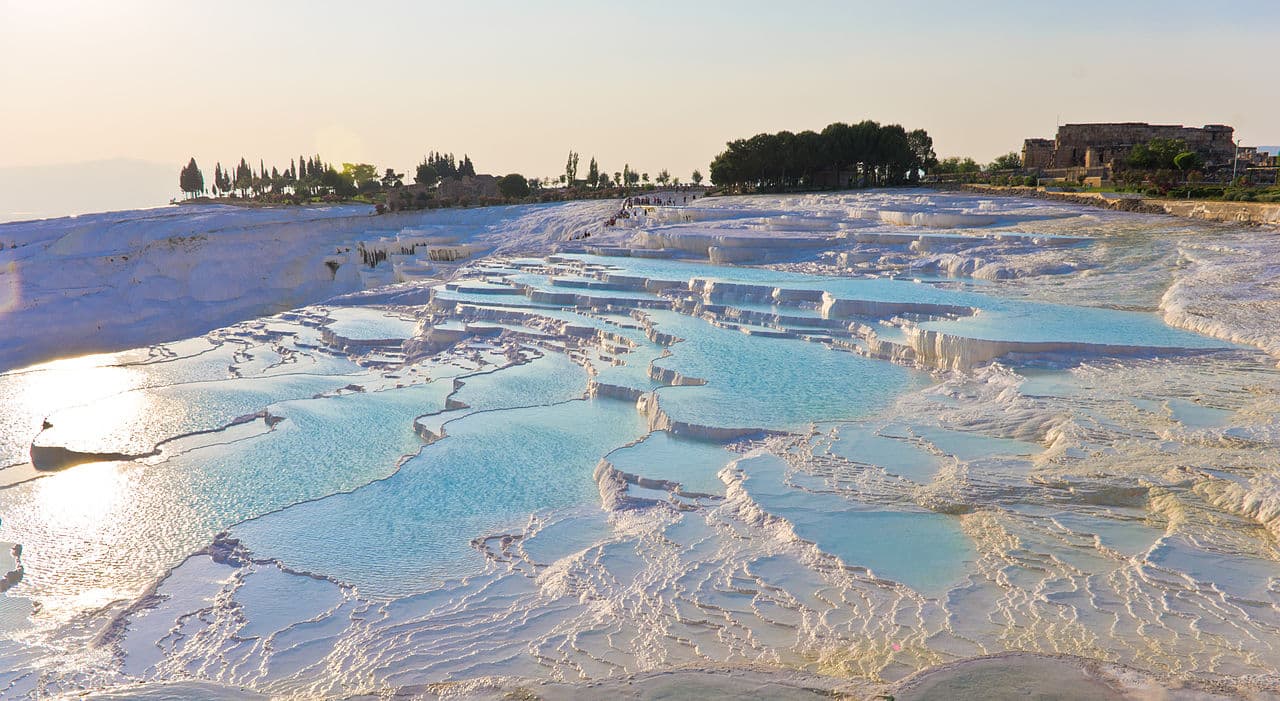
Pamukkale
Turkey
A surreal cascade of blinding-white travertine terraces — calcium carbonate platforms shaped over 14,000 years by hot mineral springs flowing down a 200m cliff in southwestern Turkey. Above the terraces sits Hierapolis, the Greco-Roman spa city Marcus Antonius gifted to Cleopatra, with a 12,000-seat theatre, the largest necropolis in Anatolia, and the still-bathable Cleopatra's Pool studded with toppled marble columns. UNESCO-listed since 1988; visited by 2.5 million per year, but most arrive on day buses from Antalya, Kuşadası, or Marmaris and clear out by 17:00.

Plitvice Lakes National Park
Croatia
Sixteen turquoise lakes terraced by travertine dams growing 1cm a year, connected by 78m waterfalls and a wooden boardwalk you cannot swim from (fines enforced). Croatia's most famous national park, UNESCO since 1979, packed in summer — arrive at the 7am opening. Between Zagreb (2h) and Split.

Swiss Alps
Switzerland
The Swiss Alps are the definition of mountain perfection — the Matterhorn, Jungfrau, and Eiger tower above pristine valleys of wildflower meadows, crystal lakes, and picturesque villages. Scenic train journeys (Glacier Express, Bernina Express) connect it all, and the infrastructure for hiking, skiing, and paragliding is world-class. Expensive but extraordinary.