Serengeti National Park vs Sossusvlei
Which destination is right for your next trip?
Last updated
Quick Verdict
Pick Serengeti National Park for 1.5 million wildebeest crossing the Mara, dawn balloon flights, and predator-rich kopjes. Pick Sossusvlei for Dune 45 sunrises, 900-year-old Deadvlei trees, and NamibRand stargazing under Milky-Way shadow.
Clear winner on the data
Sossusvlei leads in daily cost, safety, walkability, English friendliness, and cleanliness — but Serengeti National Park still takes cultural sites. If cultural sites iswhat your trip hinges on, the scoreboard doesn't matter.
Can't pick? Visit both.
Build a trip that includes Serengeti National Park and Sossusvlei, with complementary stops we'll suggest.
🏆 Sossusvlei wins 70 OVR vs 66 · attribute matchup 1–5
Keep exploring

Serengeti National Park
Tanzania
Sossusvlei
Namibia
Serengeti National Park
Sossusvlei
How do Serengeti National Park and Sossusvlei compare?
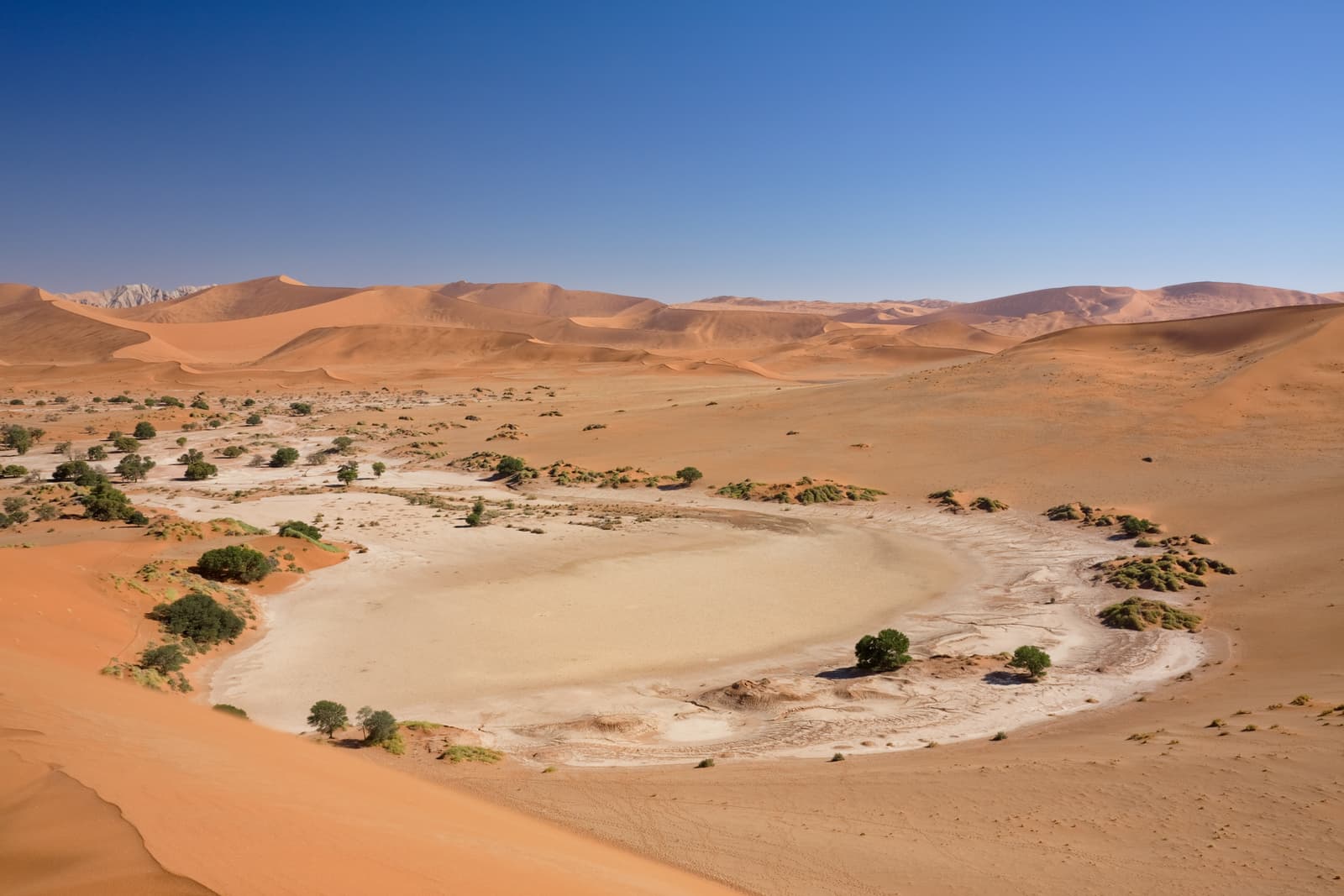
Two African dream trips, two completely different landscapes. Sossusvlei is desert silence — Namib's signature red dunes rolling toward the Atlantic, the Dune 45 climb at dawn for the first sun-line on the crest, Deadvlei's white clay pan studded with 900-year-old skeletal camelthorn trees against the orange dune walls, and NamibRand's stargazing reserve so dark the Milky Way casts a shadow. Serengeti is predator-prey theater — 1.5 million wildebeest pounding across the Mara River July through September, lions sprawled on kopjes at noon, and dawn balloon flights drifting over the plains as the herds wake.
Budgets are the decider. Sossusvlei runs $220/day mid-range and rewards self-drive — pick up a 4WD in Windhoek, plan 3-4 nights at Sesriem and another 2-3 in Swakopmund, and stretch the trip across two weeks for the cost of a single Serengeti week. Serengeti starts at $600/day and climbs fast; mid-tier camps run $700-$1,200 per person per night all-inclusive, and there's no real budget version that gets you into the migration corridor. Both demand 4WD; the Namibia version you drive yourself, the Tanzania version your guide drives while you photograph cheetahs.
Sossusvlei peaks May through September with cold mornings (4°C at sunrise, 30°C by noon) and clear skies. Serengeti's June-September window catches the Mara crossings; January-February delivers calving season in the southern Ndutu plains with predator action almost guaranteed. Pro tip for Namibia: do Deadvlei at sunrise, not sunset — the light is better and the gate-to-pan walk in the cool hour is far more pleasant. Pick Sossusvlei for landscape photography, self-drive freedom, and stargazing. Pick Serengeti for the animal density that no other park on earth matches, and bring the budget it requires.
Two African dream trips, two completely different landscapes — and the budget is the real decider for most travelers. Sossusvlei runs $220/day mid-range with a 4WD self-drive trip you can stretch over two weeks. Serengeti starts at $600/day and climbs fast, with no real budget version that gets you into the migration corridor. The two pair naturally on a 14-day Africa loop — fly into Windhoek for 7-8 days self-driving Namibia, then connect through Johannesburg to Kilimanjaro for 5-6 days in northern Tanzania — but the cost stack lands above $10,000 per person. Pick one per trip unless the budget is unconstrained.
💰 Budget
🛡️ Safety
Serengeti National Park
Serengeti National Park is extremely safe for visitors traveling with registered guides and reputable operators. The principal risks are wildlife-related if you ignore safety protocols, and health-related (malaria, sun, and dehydration). Crime is negligible inside the park. Tanzania itself is a stable country with a long history of safe tourism, though normal urban precautions apply in Arusha.
Sossusvlei
Namibia is one of the safest countries in sub-Saharan Africa for tourists — politically stable, low crime outside urban areas, and with a well-organized national parks infrastructure. The main safety concerns at Sossusvlei are environmental: extreme heat, dehydration, isolation, and wildlife. There is no violent crime risk in the park itself. Solo travelers and families are both common.
🌤️ Weather
Serengeti National Park
The Serengeti has a semi-arid climate with two wet seasons and two dry seasons, directly driving the Great Migration cycle. Temperatures are moderate year-round at this altitude (roughly 920-1,850 m), rarely exceeding 30°C or dropping below 15°C. The dry season from June through October is the most popular time to visit, but each season offers distinct wildlife experiences.
Sossusvlei
Sossusvlei sits in the hyper-arid Namib Desert with almost no rainfall and extreme temperature swings between day and night. Daytime temperatures are warm to hot year-round; nights can be surprisingly cold, especially in winter (May-August). Brief and unpredictable rains fall occasionally between January and March. The desert sun is intense — sunscreen, hat, and at least 2 litres of water per person per day are essential.
🚇 Getting Around
Serengeti National Park
Inside Serengeti National Park, a closed or open-roof 4WD safari vehicle is the only practical and legal mode of transport. Self-drive is technically possible with your own 4WD but almost never attempted by foreign visitors due to road conditions and navigation challenges. The vast majority of visitors travel in operator-supplied Land Cruisers or Land Rovers.
Walkability: There is zero independent walkability inside Serengeti National Park. Walking safaris with armed rangers are offered only by a small number of licensed camps in adjacent private concessions. Inside the park, all movement between destinations must be by vehicle.
Sossusvlei
Sossusvlei is a self-drive destination — there is no public transport to or within the park. A rental car is essential for independent travel. The road from Sesriem Gate to the 2x4 parking area (4.5 km before Sossusvlei pan) is tarred; the final 5 km to the pan requires 4x4 or the NWR shuttle. Within the park, distances are significant — the one-way journey from Sesriem Gate to the Sossusvlei pan is 60 km.
Walkability: Driving is required between sites — distances inside the park are too great to walk. Hiking on foot is permitted within the vleis and on the dunes themselves. The walk from the 2x4 parking area to Deadvlei is approximately 5 km one-way through soft sand. Comfortable closed shoes are essential; sandals are not recommended on hot sand.
📅 Best Time to Visit
Serengeti National Park
Jan–Feb, Jun–Oct
Peak travel window
Sossusvlei
May–Sep
Peak travel window
The Verdict
Choose Serengeti National Park if...
you want the world's most famous safari — the Great Migration, Mara River crossings, balloon dawns, and the Big Four (rhino is rare here)
Choose Sossusvlei if...
you want Earth's tallest red dunes and Deadvlei's black tree skeletons on white clay — a self-drive highlight of any Namibia itinerary
Serengeti National Park
Sossusvlei
Frequently asked
Is Serengeti National Park or Sossusvlei cheaper?
Sossusvlei is cheaper on average. A mid-range day in Serengeti National Park costs about $550 vs $225 in Sossusvlei, so Sossusvlei saves you roughly $325 per day compared to Serengeti National Park.
Is Serengeti National Park or Sossusvlei safer?
Sossusvlei scores higher on our safety index (82/100 vs 70/100). Namibia is one of the safest countries in sub-Saharan Africa for tourists — politically stable, low crime outside urban areas, and with a well-organized national parks infrastructure.
Which has better weather, Serengeti National Park or Sossusvlei?
Serengeti National Park has the more temperate climate year-round. The Serengeti has a semi-arid climate with two wet seasons and two dry seasons, directly driving the Great Migration cycle. Temperatures are moderate year-round at this altitude (roughly 920-1,850 m), rarely exceeding 30°C or dropping below 15°C. The dry season from June through October is the most popular time to visit, but each season offers distinct wildlife experiences.
Is it easier to get by with English in Serengeti National Park or Sossusvlei?
English is more widely spoken in Sossusvlei (5/5 vs 4/5 on our scale). You'll find it easier to order food, ask for directions, and navigate transit in Sossusvlei.
When is the best time to visit Serengeti National Park vs Sossusvlei?
Serengeti National Park peaks in Jan–Feb, Jun–Oct. Sossusvlei peaks in May–Sep. Both peak in Jun–Sep, so a single trip pairs them naturally.
How long is the flight from Serengeti National Park to Sossusvlei?
Roughly 4h 25m on a direct flight (about 3,255 km / 2,021 mi). One-way fares typically run $250-700 depending on season and how far in advance you book.
How do daily costs in Serengeti National Park and Sossusvlei compare?
In Serengeti National Park: budget ~$200-350/day, mid-range ~$400-700/day, luxury ~$1,000-3,500+/day. In Sossusvlei: budget ~$50-80/day, mid-range ~$150-300/day, luxury ~$550+/day.
How many days do I need at each?
Plan 7-10 days in Namibia covering Sossusvlei, Swakopmund, and Etosha as a self-drive loop from Windhoek. Sossusvlei alone is 3-4 nights at Sesriem. The Serengeti needs 5-7 days minimum in northern Tanzania including Ngorongoro Crater and Tarangire as a multi-park circuit, with at least 3 nights inside the Serengeti corridor itself.
Which has better wildlife?
Serengeti by an order of magnitude — 1.5 million wildebeest, 250,000 zebra, every Big Five species at high density, and the Mara River crossings July-September. Sossusvlei is desert with oryx, springbok, occasional ostrich, and very little else; you don't go to Namibia for wildlife volume. Etosha (further north in Namibia) is the better Namibian wildlife park but doesn't compare to the Serengeti either.
Is self-driving Namibia really doable?
Yes, and it's the standard way to do it. Pick up a 4WD with rooftop tent or a regular SUV in Windhoek, plan a counterclockwise loop through Sesriem-Swakopmund-Damaraland-Etosha, book lodges 6+ months out for the dry season, and budget extra fuel time. Roads are gravel but well-graded; signage is decent. English is the working language. Tanzanian self-drive is technically possible but everyone uses guides.
What's the best time to visit each?
Sossusvlei peaks May-September with cold mornings (4°C at sunrise, 30°C by noon) and clear skies; avoid December-February rains. Serengeti splits between June-September (Mara crossings, dry, busy) and January-February (calving in the southern Ndutu plains with predator action almost guaranteed). Both are dry-season destinations with no real shoulder discount.
Can I combine them on one trip?
Yes with 14+ days. Fly into Windhoek, do a 7-8 day Namibia loop, return to Windhoek and fly via Johannesburg to Kilimanjaro for a 5-6 day Tanzania safari. Expect 2 full travel days each direction and budget $10,000+ per person for the combined experience. Many travelers do them separately rather than burn the connecting days.
What food shouldn't I miss?
Namibia: kapana street meat in Windhoek, oryx steak at Joe's Beerhouse, fresh oysters in Walvis Bay, biltong from any roadside stop, and Windhoek Lager which is genuinely good. Tanzania: nyama choma grilled meat, ugali maize porridge with stew, mishkaki skewers, samaki wa kupaka coconut fish on the coast, and Tanga-style chips mayai (chips omelette) at any roadside café.
You might also compare
Serengeti National ParkvsSossusvlei
Try another