Quick Verdict
Pick Cappadocia for cave-hotel mornings, the $200 sunrise balloon over Love Valley, and Derinkuyu's 60-meter underground city. Pick Pamukkale for white travertine terraces cascading down the hillside, Hierapolis ruins above, and a quick 1-2 night stop on a Turkey loop.
The real difference is price
These two play in different price tiers: Pamukkale runs roughly 114% cheaper day to day ($70 vs $150 per day mid-range). Start with your budget — everything else on this page is secondary to that gap.
Can't pick? Visit both.
Build a trip that includes Cappadocia and Pamukkale, with complementary stops we'll suggest.
🏆 Pamukkale wins 83 OVR vs 79 · attribute matchup 2–4
Keep exploring

Cappadocia
Turkey
Pamukkale
Turkey
Cappadocia
Pamukkale
How do Cappadocia and Pamukkale compare?
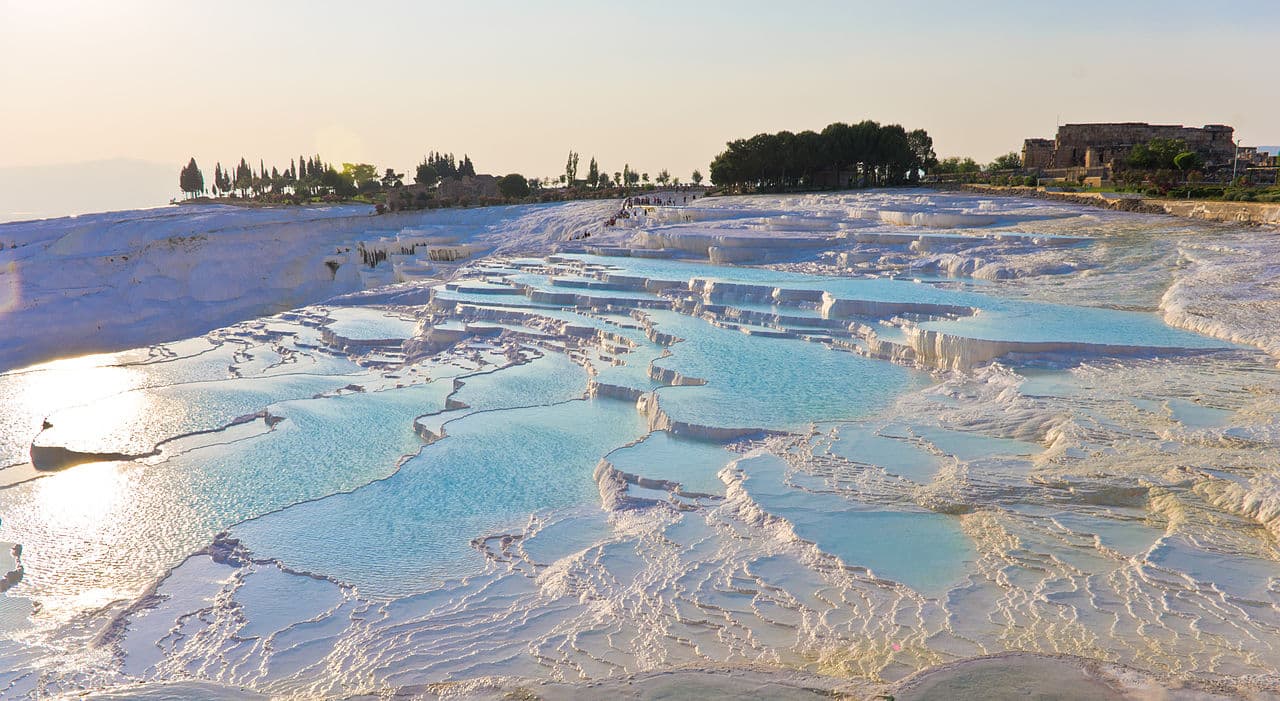
Every Turkey itinerary eventually faces this question: do you tack Pamukkale onto your Cappadocia run, or skip it. Cappadocia is the headline experience of central Anatolia — fairy chimneys at Göreme, cave hotels in Uçhisar, the Derinkuyu underground city carved 60 metres deep, and that hot-air balloon dawn over Love Valley that earns its place on every reel. Pamukkale is a 1-2 night detour, not a base. The white travertine terraces cascade down a hillside above Hierapolis, the ancient Greco-Roman spa city whose ruins (theatre, necropolis, Cleopatra's pool) sit right at the top of the calcium pools.
Logistics shape the choice. Pamukkale has no airport — you fly into Denizli (DNZ, 1 hour transfer) or bus from Antalya (4 hours, $15) or Selçuk (3 hours). Cappadocia gets direct flights to Kayseri (ASR) or Nevşehir (NAV) from Istanbul for around $40 on Pegasus. Mid-range budgets favor Pamukkale at roughly $70/day versus $150/day in Cappadocia, where cave-hotel rooms and balloon tickets ($180-220) push the line. Pamukkale is essentially one half-day site plus a sunset on the terraces. Cappadocia rewards three nights — one for ballooning, one for valley hikes, one for the underground cities and Avanos pottery workshops.
Both share the same spring and autumn windows (April-June, September-October) when terrace water levels stay high and balloon flights run six days in seven. Pro tip: most travelers fold both into one trip via the overnight bus from Pamukkale to Göreme (10 hours, $25 on Pamukkale Turizm) or a 1-hour Denizli-Kayseri connection through Istanbul. If forced to pick, Pick Cappadocia — the balloon dawn alone justifies the flight, and there's enough variety to fill three or four days. Pamukkale is a remarkable photo and a one-night memory; Cappadocia is the trip people come back talking about for years.
💰 Budget
🛡️ Safety
Cappadocia
Cappadocia is one of the safest tourist destinations in Turkey with very low crime. The main risks are environmental — uneven terrain in valleys, unmarked cliff edges, and the heat in summer. The hot air balloon industry has an excellent safety record but is not risk-free. Turkish hospitality toward tourists is genuine and generous.
Pamukkale
Pamukkale is a very safe destination — small village, organised tourism site, professional spa/thermal hotels, and visible site staff. Safety concerns are largely physical (slippery travertine surface, sun exposure) rather than crime-related. The village is small enough that residents notice strangers and look out for visitors.
🌤️ Weather
Cappadocia
Cappadocia has a semi-arid continental climate at 1,000-1,300 m elevation. Summers are hot and dry, winters are cold with snow. The region gets about 300 days of sunshine per year. Temperature swings between day and night are significant — always pack layers. Balloon flights are weather-dependent and cancelled on about 30% of winter days due to wind.
Pamukkale
Pamukkale sits in inland southwestern Turkey at 350m elevation in the Menderes Valley — Mediterranean continental climate with hot, dry summers (July–August often 35°C+) and cool, rainy winters (occasionally below freezing at night). The mineral waters maintain 36°C year-round, so swimming in Cleopatra's Pool is comfortable in any season; the travertines feel more atmospheric in cooler months without the haze.
🚇 Getting Around
Cappadocia
Cappadocia's attractions are spread across a wide area (roughly 50 km across), making some form of transport essential. Within Goreme village everything is walkable, but reaching other valleys, underground cities, and viewpoints requires a car, tour, or limited public transport. Renting a car offers the most flexibility.
Walkability: Goreme village is compact and fully walkable. Many valleys (Rose Valley, Love Valley, Pigeon Valley) are accessible on foot from Goreme or Uchisar. However, reaching Derinkuyu, Ihlara Valley, and Soganli requires motorized transport. Valley hiking trails are 3-8 km and mostly moderate difficulty.
Pamukkale
Pamukkale is small (~3,000 residents) and entirely walkable — the village, the lower travertine entrance, the upper Hierapolis gate, and Karahayıt 6 km away are connected by minibus (dolmuş) and easy walking paths. Most visitors arrive on day tours from İzmir, Selçuk (Ephesus), or Antalya, which include their own transport. Independent travellers use Denizli (DNZ airport, 60 km) as the gateway.
Walkability: Pamukkale village and the entire UNESCO site (travertines + Hierapolis) are walkable in a single day on foot. The 1.5 km uphill walk through the travertines from the lower gate is itself one of the highlights — a unique sensory experience walking barefoot on warm white stone with mineral water flowing around your ankles.
📅 Best Time to Visit
Cappadocia
Apr–Jun, Sep–Oct
Peak travel window
Pamukkale
Apr–Jun, Sep–Oct
Peak travel window
The Verdict
Choose Cappadocia if...
you want the sunrise balloon over fairy chimneys — cave hotels in Göreme, Derinkuyu underground city, Uçhisar castle, and Zelve open-air museum
Choose Pamukkale if...
you want the white travertine terraces and Hierapolis ruins as a 1-2 night detour, often paired with Cappadocia
Cappadocia
Pamukkale
Frequently asked
Is Cappadocia or Pamukkale cheaper?
Pamukkale is cheaper on average. A mid-range day in Cappadocia costs about $150 vs $70 in Pamukkale, so Pamukkale saves you roughly $80 per day compared to Cappadocia.
Is Cappadocia or Pamukkale safer?
Pamukkale scores higher on our safety index (82/100 vs 78/100). Pamukkale is a very safe destination — small village, organised tourism site, professional spa/thermal hotels, and visible site staff.
Which has better weather, Cappadocia or Pamukkale?
Pamukkale has the more temperate climate year-round. Pamukkale sits in inland southwestern Turkey at 350m elevation in the Menderes Valley — Mediterranean continental climate with hot, dry summers (July–August often 35°C+) and cool, rainy winters (occasionally below freezing at night). The mineral waters maintain 36°C year-round, so swimming in Cleopatra's Pool is comfortable in any season; the travertines feel more atmospheric in cooler months without the haze.
When is the best time to visit Cappadocia vs Pamukkale?
Cappadocia peaks in Apr–Jun, Sep–Oct. Pamukkale peaks in Apr–Jun, Sep–Oct. Both peak in Apr–Jun, Sep–Oct, so a single trip pairs them naturally.
How long is the flight from Cappadocia to Pamukkale?
Roughly 1h 11m on a direct flight (about 505 km / 313 mi). One-way fares typically run $120-350 depending on season and how far in advance you book.
How do daily costs in Cappadocia and Pamukkale compare?
In Cappadocia: budget ~$40-70/day, mid-range ~$100-200/day, luxury ~$300+/day. In Pamukkale: budget ~$25-45/day, mid-range ~$50-90/day, luxury ~$150-280/day.
You might also compare
CappadociavsPamukkale
Try another