Quick Verdict
Pick Chiang Mai for $1.50 khao soi, 300+ temples in a moated old city, and ethical elephant sanctuaries. Pick Yangshuo if Yulong River bicycle loops, Li River raft views, and Impression Sanjie Liu light-shows are the draw.
Can't pick? Visit both.
Build a trip that includes Chiang Mai and Yangshuo, with complementary stops we'll suggest.
🏆 Yangshuo wins 80 OVR vs 77 · attribute matchup 4–2
Keep exploring
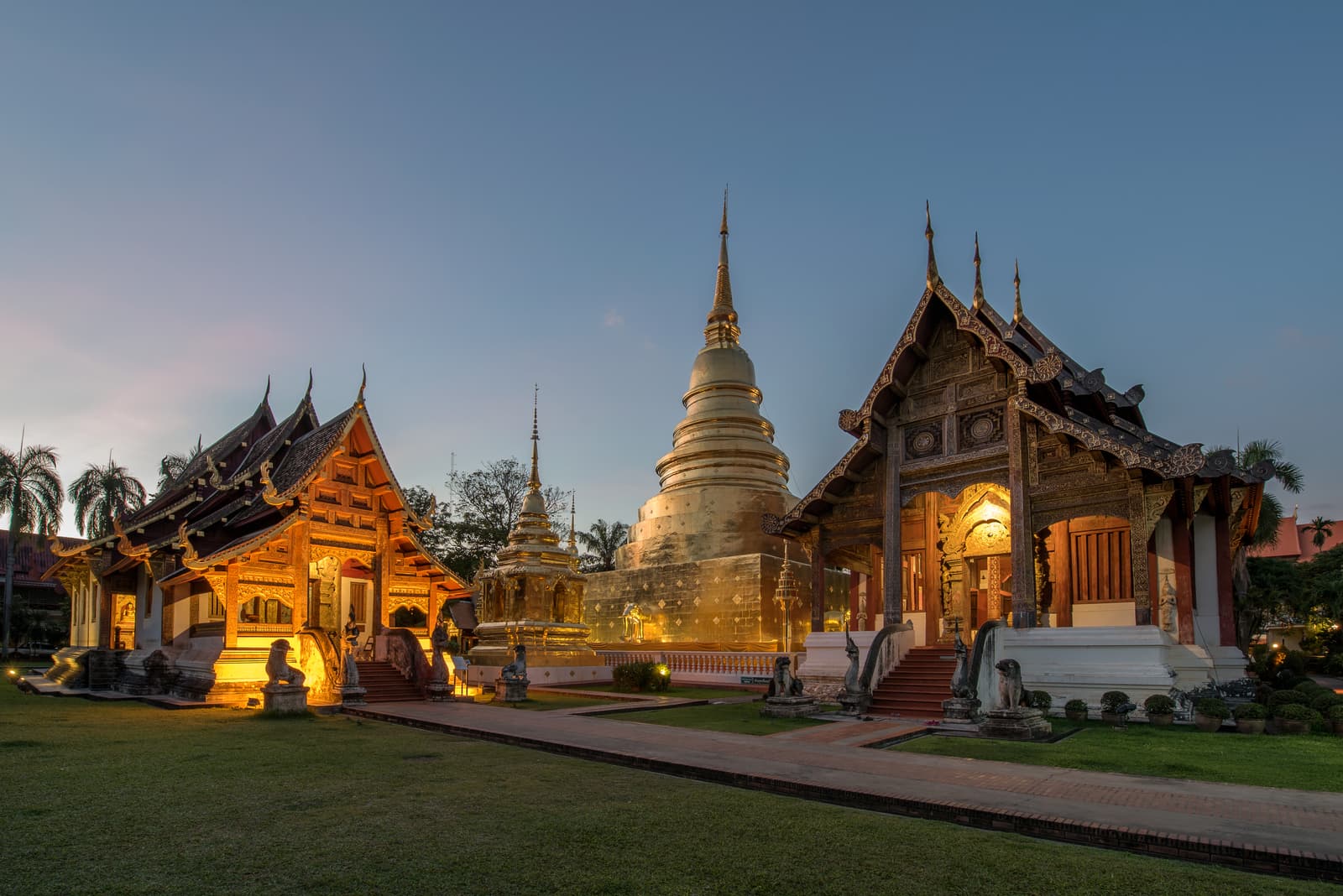
Chiang Mai
Thailand

Yangshuo
China
Chiang Mai
Yangshuo
How do Chiang Mai and Yangshuo compare?
Both are small-town hubs surrounded by countryside and built for travelers who want to slow down — the choice comes down to whether you want temples and elephants or karst peaks and tea fields. Chiang Mai is the digital nomad capital of Southeast Asia, a moated old city wrapped in 300+ Buddhist temples, $1.50 khao soi noodles in Nimman alleys, and ethical elephant sanctuaries an hour out of town (Elephant Nature Park is the standard). Daily mid-range cost is $55 — the cheapest serious traveler city in this entire matrix — and from November to February the weather is dry, 75°F, and breeze-cooled.
Yangshuo is the Chinese cousin: a riverside town in Guangxi province surrounded by the karst peaks that Chinese landscape painters have been drawing for 1,400 years. You bicycle the Yulong River past water buffalo and rice paddies, raft the Li River from Yangdi to Xingping (the 20-yuan-note view), climb Moon Hill, and watch the Impression Sanjie Liu light show on the river itself — Zhang Yimou's outdoor production with 600 performers and the karst as backdrop. At $70/day it's slightly pricier than Chiang Mai but still cheap, with March–May and September–November as the calm windows. The food is Guangxi spicy — beer fish, stuffed Li River snails, oil tea.
Chiang Mai wins on visa simplicity, English level, café-and-coworking infrastructure, and the elephant experience. Yangshuo wins on landscape drama and on being genuinely outside the Anglophone bubble. Pro tip: in Yangshuo, stay outside town in Yangshuo's Xingping village or along the Yulong River — West Street is a tourist circus after sundown, but a guesthouse 5km out feels like the China of paintings. For first-time Asia travelers who want easy, Pick Chiang-mai.
💰 Budget
🛡️ Safety
Chiang Mai
Chiang Mai is one of the safest cities in Southeast Asia for travelers. Violent crime against tourists is extremely rare, though petty theft and scams exist. The biggest health concern is air quality during burning season (February-April).
Yangshuo
Yangshuo is very safe by international standards — China overall has very low violent-crime rates, and rural Guangxi is gentler still. Petty theft is uncommon but not zero on West Street and at busy bamboo-raft piers. The realistic safety calculus is environmental and logistical: river currents during summer storms, scooter accidents on unfamiliar roads, food and water adjustment, and the need for a VPN to access most Western communications. Foreign travellers are required to register with the local police within 24 hours of arrival; reputable hotels do this automatically.
🌤️ Weather
Chiang Mai
Chiang Mai has a tropical savanna climate with three distinct seasons: hot, rainy, and cool. The city sits in a valley which traps heat and, unfortunately, smoke during the burning season (February-April).
Yangshuo
Yangshuo has a humid subtropical climate — hot, humid, wet summers (30°C July highs and afternoon thunderstorms most days), and cool, damp, often misty winters (9°C January lows, occasional frost on the peaks). Annual rainfall sits around 1,900 mm, with the bulk April through August. Typhoon-tail rains in July and August can flood the rivers and disrupt bamboo-raft cruises for days at a time. The shoulder seasons — late March to early May and September into early November — are by far the most pleasant for cycling, hiking, and the iconic photographs.
🚇 Getting Around
Chiang Mai
Chiang Mai lacks a metro or rail system, so getting around relies on songthaews (red shared trucks), tuk-tuks, Grab ride-hailing, and rented scooters. The Old City is compact enough to walk or cycle. The city is currently building a light rail system planned for future years.
Walkability: The Old City is very walkable — roughly 1.5 km on each side — and most major temples are within easy walking distance of each other. The Nimmanhaemin area is also pedestrian-friendly. Beyond these areas, distances grow and motorized transport is needed.
Yangshuo
Yangshuo town itself is tiny — a 15-minute walk end-to-end. The interest is the surrounding 30-km radius of karst peaks, paddy fields, and rivers, which is best explored by bicycle along the flat Yulong River and Ten-Mile Gallery roads. Electric scooters extend range but bring real safety and licensing risk. Public minibuses run hub-and-spoke routes from the central bus station to outlying villages for ¥3–15. Taxis, didi (Chinese ride-hail), and guesthouse-arranged minivans cover everything else cheaply.
Walkability: Yangshuo town is fully walkable in 15 minutes. Beyond town the karst-and-paddy countryside is best explored by bicycle on flat, paved roads — the 25-km Yulong River loop is a defining day. Public minibuses cover village hubs for the price of a coffee. Taxis and didi handle the cruise piers and Xianggong sunrise transfers cheaply. There is no metro and no need for one.
📅 Best Time to Visit
Chiang Mai
Jan–Feb, Nov–Dec
Peak travel window
Yangshuo
Mar–May, Sep–Nov
Peak travel window
The Verdict
Choose Chiang Mai if...
you want northern Thailand's temple city — Doi Suthep sunsets, Sunday Walking Street, ethical elephant sanctuaries, and Songkran soaked to the bone
Choose Yangshuo if...
you want the karst landscape on China's 20-yuan note — Li River bamboo rafts between Yangdi and Xingping, Moon Hill, Yulong River cycling, and the Zhang Yimou-directed Impression Sanjie Liu light show with 600 performers on the river
Chiang Mai
Yangshuo
Frequently asked
Is Chiang Mai or Yangshuo cheaper?
Chiang Mai and Yangshuo come in at roughly the same mid-range daily cost (~$80 per day), so budget alone is not a deciding factor.
Is Chiang Mai or Yangshuo safer?
Yangshuo scores higher on our safety index (80/100 vs 75/100). Yangshuo is very safe by international standards — China overall has very low violent-crime rates, and rural Guangxi is gentler still.
Which has better weather, Chiang Mai or Yangshuo?
Chiang Mai has the more temperate climate year-round. Chiang Mai has a tropical savanna climate with three distinct seasons: hot, rainy, and cool. The city sits in a valley which traps heat and, unfortunately, smoke during the burning season (February-April).
When is the best time to visit Chiang Mai vs Yangshuo?
Chiang Mai peaks in Jan–Feb, Nov–Dec. Yangshuo peaks in Mar–May, Sep–Nov. Both peak in Nov, so a single trip pairs them naturally.
How long is the flight from Chiang Mai to Yangshuo?
Roughly 2h 11m on a direct flight (about 1,362 km / 846 mi). One-way fares typically run $120-350 depending on season and how far in advance you book.
How do daily costs in Chiang Mai and Yangshuo compare?
In Chiang Mai: budget ~$25-40/day, mid-range ~$60-100/day, luxury ~$200+/day. In Yangshuo: budget ~$25-40/day, mid-range ~$60-100/day, luxury ~$200-350/day.
You might also compare
Chiang MaivsYangshuo
Try another