
Salamanca
THE QUICK VERDICT
By Anthony · Updated April 2026
Choose Salamanca if You want a compact, fully-walkable Spanish university town with Spain's most beautiful plaza, a sandstone old town that glows at sunset, and tapas crawls under €25 — without Madrid or Barcelona prices and crowds..
- Best for
- Plaza Mayor at sunset, sandstone Universidad facade, frog-finding hunt, late tapas crawls under €25
- Two seasons
- Apr–Jun and Sep–Oct
- Budget anchor
- $150/day mid-range
- Worth a look
- student-driven nightlife runs to 3am even midweek — rare for a small Spanish city
Salamanca is the golden city — a small UNESCO old town in Castilla y León built almost entirely from Villamayor sandstone that turns honey-orange at sunset. The University of Salamanca (founded 1218) is Spain's oldest and the third-oldest in continuous operation in Europe; the 18th-century Plaza Mayor is regularly cited as Spain's most beautiful square; the carved facade of the old university hides the famous frog-on-a-skull that students must spot to pass exams. Half the population are students, which gives a town of 145,000 the bar density of a city three times its size.
The two links below are affiliate links — MapSorted earns a small commission if you book through them, at no extra cost to you. How this works.
Tours & Experiences
Bookable tours, activities, and day trips in Salamanca
Where to Stay
Compare hotels and rentals in Salamanca
📍 Points of Interest
Plaza Mayor
Often called Spain's most beautiful square — 88×94m baroque masterpiece (1729–1755) by Churriguera; honey-orange at sunset
University of Salamanca
Founded 1218 — Spain's oldest university; the plateresque facade hides the famous frog-on-skull good-luck charm
Old & New Cathedrals
Two cathedrals share a wall — 12th-century Romanesque + 16th-century late Gothic; find the carved astronaut on the New Cathedral door
Casa de las Conchas
15th-century palace covered in 365 carved scallop shells (Order of Santiago); now a free public library with a beautiful courtyard
Roman Bridge
1st-century AD bridge across the river Tormes — 26 arches, 15 original; sunset view back at the cathedrals is iconic
Convento de San Esteban
16th-century Dominican convent — Christopher Columbus argued his case here; spectacular plateresque facade and cloister
Casa Lis
Art Nouveau and Art Deco Museum in a 1905 stained-glass mansion on the city walls — Lalique, Galle, art deco bronzes
Mercado Central de Abastos
1909 covered food market — 50+ stalls of jamón ibérico, chorizo, queso castellano; small lunch bars
★ Local Picks
Calle Van Dyck Tapas
600m student tapas street — €1.50 caña gets a free generous tapa; Bar Erasmo and El Mesón de Gonzalo are local favourites
Café Novelty
Salamanca's oldest café (1905) — Unamuno and Carmen Martín Gaite's literary haunt; bronze statue at her usual table
At a Glance
- Pop.
- 145K (city) / 200K (metro)
- Timezone
- Madrid
- Dial
- +34
- Emergency
- 112
The University of Salamanca (founded 1218 by Alfonso IX of León) is Spain's oldest university and the third-oldest in continuous operation in Europe — only Bologna (1088) and Oxford (~1096) have continuous teaching going further back. The name "Universidad" was first used here in 1254 in the papal bull of Alexander IV
Salamanca's Plaza Mayor (built 1729–1755 by Alberto de Churriguera and finished by his nephew José) is the most balanced and architecturally pure baroque plaza in Spain — a perfect 88×94 metre rectangle with three storeys of unbroken façade, traditionally cited by guidebooks and Spaniards alike as Spain's most beautiful square
The entire historic centre is built from Villamayor sandstone — quarried 8 km north of the city. The stone is soft and easily carved (which is why Salamanca's façades are extraordinarily detailed) and contains iron oxide that turns honey-orange in low sun. This is why Salamanca is called "La Ciudad Dorada" (the golden city)
The carved 16th-century facade of the Escuelas Mayores hides a small frog perched on a skull — tradition says students who spot it without help will pass their exams. It's exactly where the locals will tell you to look (above the right pillar of the entrance) but harder than it sounds
Salamanca was the seat of the 16th-century School of Salamanca — Francisco de Vitoria, Domingo de Soto, and others who effectively founded modern international law and the early theory of human rights, debating the legitimacy of the Spanish conquest of the Americas inside university lecture halls still standing today
About 30,000 of Salamanca's 145,000 residents are university students — and the city has more than 200 bars in a centre you can walk across in 15 minutes. Bar density is among the highest in Europe and the tapas-and-cañas economy starts at 13:00, pauses, and resumes at 21:00 until at least 02:00
Top Sights
Plaza Mayor
🗼The most beautiful plaza in Spain (most Spaniards will tell you this without prompting) — 88×94 metres of Villamayor sandstone, three uninterrupted storeys of arcaded facades, 88 medallions of historical Spaniards (Cervantes, Columbus, El Cid, Franco — Franco's was removed in 2017), and the City Hall on the north side. Best at sunset when the stone turns honey-orange, then again at 23:00 when the lighting goes on. Free, always open, and Salamanca's social hub.
University of Salamanca (Escuelas Mayores)
🗼The historic 16th-century university buildings — the famous plateresque facade (1529) is one of Europe's most extraordinary stone carvings, with the hidden frog-on-skull, double-headed eagles for Charles V, and dozens of medallions. Inside: the Hall of Fray Luis de León (where the friar returned to teaching with the words "as we were saying yesterday" after 5 years in Inquisition prison), the chained-book library, and Christopher Columbus's contract-negotiation chamber. €10 entry includes audio guide.
Old & New Cathedrals
🗼Two cathedrals share a wall — the Old Cathedral (Catedral Vieja, 12th century, late Romanesque + early Gothic with a unique scale-shaped Torre del Gallo dome) and the New Cathedral (Catedral Nueva, 1513–1733, late Gothic + baroque). The 20th-century restorers carved an astronaut, an ice-cream-eating dragon, a faun, and a lynx into the New Cathedral's Puerta de Ramos as their signatures — find them on the door panels. Climb the Ieronimus tower for the best rooftop view in the city. Combined ticket €10.
Casa de las Conchas
🗼A 15th-century palace covered in 365 carved scallop shells (the symbol of the Order of Santiago — the original owner was a knight of the order) — now a public library, free to enter, with a beautiful two-storey arcaded courtyard. Local legend says one of the shells contains a gold coin, but no one has found it. Across the street from the baroque Clerecía with its twin towers (€4 to climb the towers — the second-best rooftop view in the city after the Cathedrals).
Roman Bridge & River Tormes
🗼The 26-arch Roman bridge (1st century AD, on the Vía de la Plata) crosses the river Tormes south of the old city — 15 of the original arches survive and the bridge is still pedestrian-walkable. Walk across at sunset and look back at the cathedrals on the cliff above the river — the iconic Salamanca panorama, and the view that gave the city its golden reputation. Best photographic angle in the city.
Convento de San Esteban
🗼The 16th-century Dominican convent where Christopher Columbus stayed and was supported by the friars — the friars argued his cause to the Spanish crown when the University of Salamanca's scholars were sceptical. Spectacular plateresque facade and one of the most beautiful church-and-cloister complexes in Spain. Often almost empty of tourists. €4 entry.
Art Nouveau & Art Deco Museum (Casa Lis)
🏛️A glass-and-iron 1905 mansion on the city walls with a stunning stained-glass interior and one of Spain's best art nouveau collections — Lalique glass, Limoges enamels, Galle, art deco bronzes. The Saturday-morning entry is the cheapest (€4). The view from the rear glass gallery over the river Tormes is itself worth the visit.
The Hieronymous Tower & Cathedral rooftops
📌A guided rooftop walk along the upper galleries of the New Cathedral — between the gargoyles, behind the dome, and across to the Old Cathedral's Torre del Gallo. €5 supplement to the basic Cathedral ticket; the best birds-eye-view of Plaza Mayor and the river bend. Avoid in midday August heat.
Climate & Best Time to Go
Salamanca has a continental Mediterranean climate moderated by its 800-metre elevation on the Castilian plateau (Meseta) — hot, dry summers (often 32–35°C with cool 14°C nights), cold, dry winters (daytime 7–10°C, frequent overnight frost, rare snow). Spring and autumn are the most comfortable seasons. The dryness means the heat is bearable even in August once the sun drops.
Spring
March - May41 to 72°F
5 to 22°C
Excellent — March still cool, April and May genuinely pleasant. Easter (Semana Santa) brings significant crowds and processions; April is the most beautiful month with wisteria and the city's storks returning to the Cathedral towers. Some afternoon thunderstorms.
Summer
June - August57 to 95°F
14 to 35°C
Hot, dry, and at peak student-departure quiet (most students leave for the summer) — daytime 30–35°C, nights cool to 14–17°C, very little rain. The dry heat is genuinely manageable; the Plaza Mayor terraces operate until well after midnight. Many students leave; tourists fill the gap.
Autumn
September - November41 to 79°F
5 to 26°C
September excellent (warm afternoons, students returning, the city back at full capacity); October pleasant; November turns cold quickly. The September–October light is famous for the way it hits the sandstone — the best photographic month is October.
Winter
December - February30 to 50°F
-1 to 10°C
Cold, dry, and intense — daytime often only 7–10°C, nights below freezing, occasional snow on the cathedrals (every 2–3 years). The Christmas decorations on Plaza Mayor and the Three Kings parade (5 January) are highlights. Hotel prices at their lowest.
Best Time to Visit
April–early June and late September–October are the optimal windows: pleasant temperatures, students in the city (which is essential to the atmosphere), and lower prices than summer. July–August is hot but dry and the heat is bearable; the city empties of students. Carnival in February and Holy Week are local highlights.
Spring (April–early June)
Crowds: Moderate (high during Holy Week)The optimal window — comfortable temperatures (15–22°C), wisteria and storks on the Cathedral towers, students still in the city for end-of-year exams. Easter (Semana Santa) brings significant processions; April–May the most photographically beautiful months.
Pros
- + Pleasant walking weather
- + Lower prices than peak summer
- + University in full session
- + Beautiful spring light on the sandstone
Cons
- − Holy Week crowds (March/April)
- − Some afternoon thunderstorms
- − Hotel prices spike for Easter
Summer (June–August)
Crowds: High (tourists), low (students)Hot but dry — daytime 30–35°C, comfortable nights at 14–17°C. The university empties of students and tourist crowds fill the gap. Plaza Mayor terraces operate until past midnight. International language schools fill July–August with summer students.
Pros
- + Long evenings (sunset 22:00)
- + Plaza Mayor terraces in full swing
- + Late-night atmosphere
- + Lowest hotel prices of the year in August
Cons
- − Hot afternoons (35°C+ possible)
- − Many small bars closed in August
- − Student-driven tapas economy quieter
- − Crowded at peak attractions
Autumn (September–November)
Crowds: ModerateSeptember excellent (warm, students returning, full atmosphere); October pleasant; November cold and quiet. Late September is arguably the perfect month — students back, weather still warm, photographic light at its golden best.
Pros
- + Best photographic light
- + Comfortable temperatures
- + Lower hotel prices than summer
- + Full student energy back
Cons
- − October–November rain
- − Shorter daylight by November
- − November turns cold quickly
Winter (December–February)
Crowds: Low (except Christmas)Cold and dry — daytime 7–10°C, nights below freezing, occasional dustings of snow on the cathedrals. Christmas decorations on Plaza Mayor are spectacular; the Three Kings parade (5 January) is a major event. Cheapest hotel prices of the year.
Pros
- + Cheapest accommodation
- + Plaza Mayor at Christmas with lights and stalls
- + Three Kings parade (5 January)
- + Almost no tourist crowds
Cons
- − Cold and frosty
- − Some restaurants close in January
- − Short daylight hours
- − Some attractions close earlier
🎉 Festivals & Events
Holy Week (Semana Santa)
March or AprilSalamanca's Holy Week processions are smaller than Sevilla's but more intimate — 17 cofradías (brotherhoods) carry pasos (sculpted floats) through Plaza Mayor and the old centre, often by torchlight. Best processions: La Madrugada (Maundy Thursday midnight to Good Friday dawn). Hotels triple in price.
Lunes de Aguas
Monday after EasterA uniquely Salamantine festival — students leave the city to picnic on the river Tormes banks with hornazo meat pies and limonada, commemorating the 16th-century rector who banished prostitutes from the city for Lent. Genuinely lively; the river banks fill with thousands of picnickers.
Ferias y Fiestas de Salamanca
September 7–21The city's biggest patron-saint festival — concerts on Plaza Mayor, fireworks over the river, bullfights at the Plaza de Toros, and the Sept 8 procession of Our Lady of the Vega. The single best two-week stretch to visit if you want full local atmosphere.
Salamanca Plaza Mayor Light Festival
Late November–early JanuaryThe Plaza Mayor is dressed with elaborate Christmas lighting — the most spectacular Christmas plaza in northwest Spain — plus a small artisan market and the Belén (nativity scene). Free; nightly 18:00 onwards.
Three Kings Parade (Cabalgata de Reyes)
5 JanuarySpain's big Christmas event — the three Kings (Magi) parade through the centre on horseback throwing sweets to children, on the eve of Epiphany when Spanish families exchange gifts. Free; 18:00 start.
Off the Beaten Path
Tapas crawl on Calle Van Dyck
The Plaza Mayor restaurants are tourist-priced; Salamanca's real tapas scene is on Calle Van Dyck — a 600-metre street north of the centre with 30+ bars where ordering a caña (small beer, €1.50–€2) gets you a free generous tapa (a slice of jamón, a pincho moruno, a small ración). Three or four bars over an evening = €15–€20 with food included. Bar Erasmo and El Mesón de Gonzalo are the local favourites.
The Spanish "free tapa with drink" tradition is dying out almost everywhere — in Madrid and Barcelona it's long gone, in Granada it survives only at certain bars. Salamanca's student economy keeps it alive on Van Dyck and a handful of nearby streets.
Sunset on the Roman Bridge
The 1st-century Roman bridge across the river Tormes, just south of the centre — walk across at sunset (around 21:00 in June, 17:30 in December) and look back at the cathedrals catching the last sun. The honey-orange glow on the Villamayor sandstone is the reason Salamanca is called La Ciudad Dorada. Bring a beer from a Calle de los Libreros corner shop and sit on the parapet. Free; the most-photographed angle in the city, and surprisingly uncrowded most evenings.
Most tourists watch the sunset from Plaza Mayor — beautiful but crowded. The Roman bridge gives you the architectural panorama (cathedrals on the cliff above the river) and a Roman bridge to stand on, with maybe 20 other people there.
Café Novelty in Plaza Mayor
The oldest café in Salamanca (founded 1905) and the meeting place of the city's 20th-century literary scene — Miguel de Unamuno, Carmen Martín Gaite, and Gonzalo Torrente Ballester all wrote here. Inside, original wood and mirrors, marble tables, and a bronze statue of Carmen Martín Gaite at her usual table. Coffee and a slice of bizcocho cake for €5. The plaza-front terrace is touristy; the inside is the experience.
Plaza Mayor cafés are interchangeable tourist traps — €4 cortados, indifferent service. Novelty is genuinely 120 years of literary Salamanca and the inside has the tradition the terraces have lost.
Friday flamenco at Tío Vivo
Salamanca isn't Andalusia, but Tío Vivo on Calle del Clavel runs a Friday-night flamenco set in a vaulted stone basement — typically 22:30 onwards, no entry fee, drinks at normal Salamanca prices (€3 wine, €4 cocktail). Local guitar + cantaor + a baile dancer; not the polished tourist tablao you get in Madrid, but genuinely raw and small-room. Arrive 22:00 to get a stool.
Tablao flamenco in tourist Spain is €40+ for a 75-minute set with overpriced sangria. Tío Vivo is a free Friday night, a small room, and the kind of intimate flamenco hard to find outside Andalusia.
Safety Breakdown
Very Safe
out of 100
Salamanca is one of the safest cities in Spain — a small university town with low violent crime, no significant gang activity, and a centre that feels comfortable to walk at any hour. The student economy means there are people on the street until 03:00 most weekends. The main concerns are pickpockets in extreme tourist density (Plaza Mayor at peak times, the University facade), late-night student rowdiness around Calle Van Dyck, and the very occasional drinks scam in tourist-leaning bars.
Things to Know
- •Pickpockets work the Plaza Mayor and the University facade in summer — keep wallets in front pockets and bags zipped
- •Late-night Calle Van Dyck (Friday/Saturday from 23:00) is entirely safe but extremely loud — student parties, occasional broken glass, rarely anything aggressive
- •Tap water is safe and excellent (mountain-sourced) — bottled water is unnecessary
- •August can be uncomfortably hot 14:00–18:00 — adopt the Spanish siesta rhythm and walk before 12:00 or after 18:00
- •Sunday afternoons are very quiet — most shops close 14:00 Saturday until Monday morning, and even some restaurants close Sunday evening
- •The mandatory cover charge (cubierto, €1–€3) is rare in Salamanca tapas bars (none on Calle Van Dyck), but always check the menu before sitting down at a Plaza Mayor terrace
- •Spanish dinner times are late — kitchens often don't open until 21:00, and 22:00 is normal for dinner; a 19:30 reservation will mark you as a tourist
- •Police: Policía Nacional (091) for crimes, Policía Local (092) for traffic. The main station is on Calle Jardines
Emergency Numbers
Emergency (all services)
112
Policía Nacional
091
Policía Local
092
Ambulance
061
Hospital Universitario de Salamanca
+34 923 291 100
Costs & Currency
Where the money goes
USD per dayBackpacker = hostel dorm + street food + public transit. Mid-range = 3-star hotel + neighbourhood restaurants + transit cards. Luxury = 4/5-star + fine dining + taxis. How we calibrate these numbers →
Quick cost estimate
Customize per category →Estimates based on regional averages. Flight prices vary by season and airline.
budget
$50-90
Hostel dorm or student-rental room, menú del día lunch (€12–€15 three courses), tapas-and-cañas dinner (€10–€15 with free tapas), free Plaza Mayor + walking, one paid attraction
mid-range
$130-230
Mid-range hotel (€80–€150/night), restaurant lunches and dinners with wine, all major attractions (University, Cathedrals, Casa de las Conchas), evening at a flamenco bar
luxury
$300-700
Five-star hotel (NH Collection Salamanca, €200–€400/night), Michelin-starred dinners (Víctor Gutiérrez), private guides, day-trip car service to Ávila or Segovia
Typical Costs
| Item | Local | USD |
|---|---|---|
| AccommodationHostel dorm | €18-32/night | $19-34 |
| AccommodationMid-range 3-star hotel double | €80-150/night | $85-160 |
| AccommodationFive-star or boutique | €200-400/night | $212-424 |
| FoodMenú del día lunch (3 courses + drink) | €12-18 | $13-19 |
| FoodCaña (small beer) + free tapa at Calle Van Dyck | €1.50-2 | $1.60-2.10 |
| FoodDinner at mid-range restaurant | €20-35 per person | $21-37 |
| FoodEspresso at a bar (standing) | €1.20-1.50 | $1.30-1.60 |
| FoodGlass of Ribera del Duero wine | €3-5 | $3.20-5.30 |
| FoodHornazo (local meat pie) at Mercado Central | €4-8 | $4.20-8.50 |
| TransportCity bus single | €1.05 | $1.10 |
| TransportTaxi from train station to Plaza Mayor | €5-7 | $5.30-7.40 |
| TransportAvant train Salamanca to Madrid | €25-50 | $27-53 |
| TransportALSA bus Salamanca to Madrid | €15-25 | $16-27 |
| AttractionUniversity of Salamanca (Escuelas Mayores) | €10 | $10.60 |
| AttractionCathedrals combined ticket (Old + New) | €10 | $10.60 |
| AttractionIeronimus Tower (Cathedral rooftops) | €5 supplement | $5.30 |
| AttractionCasa Lis (Art Nouveau & Art Deco Museum) | €4-7 | $4.20-7.40 |
| AttractionPlaza Mayor | Free | Free |
| AttractionRoman Bridge | Free | Free |
💡 Money-Saving Tips
- •Eat your big meal at lunch — the menú del día is a Spanish institution: 3 courses + bread + drink for €12–€18. Same restaurant evening = €30+
- •Tapas crawls on Calle Van Dyck cost €10–€15 for an evening (4 cañas + 4 free tapas) — the most authentic and cheapest dinner you can have in Salamanca
- •University-related discounts: most students/under-26s get 50% off University entry and Cathedrals — bring student ID
- •Free attractions: Plaza Mayor (always), Casa de las Conchas courtyard (free), Roman Bridge (always free), Convento de San Esteban church (free, only the cloister is paid)
- •Salamanca City Tourist Card (€10 for 24 hours) bundles University + Cathedrals + Casa Lis — pays for itself with 3 attractions
- •August has the cheapest rooms (-25%) because students are away — but heat is intense; April–May or October are the better-value months
- •Mercado Central de Abastos for breakfast and lunch — €3–€8 for substantial Castilian meals, surrounded by locals
- •Bus from Madrid to Salamanca is €15–€25, train is €25–€50 — same journey time (~2.5 hours) but bus is significantly cheaper
Euro
Code: EUR
Spain uses the Euro (€). At writing, €1 ≈ $1.06 USD. ATMs (cajeros) are widespread; bank-branded ATMs (CaixaBank, BBVA, Santander) generally do not charge foreign cards an additional fee, though some now charge €1–€3. Avoid the standalone Euronet and Cardpoint ATMs in tourist areas, which charge €4–€5 plus poor exchange rates. Cards (Visa, Mastercard, Apple/Google Pay) accepted everywhere except small market stalls and a handful of Calle Van Dyck cash-only bars. Cash useful for: tapas bars, market stalls, small purchases under €5.
Payment Methods
Contactless payments (Visa, Mastercard, Apple/Google Pay) widespread including market stalls, taxis, and most tapas bars. American Express has limited acceptance. Cash needed for: very small tapas bars, market stalls under €5, public toilets at bus station (€0.50), tipping. Spanish banks charge ~3% for ATM withdrawals from foreign cards.
Tipping Guide
Tipping is not expected — service is included in menu prices. For exceptional service, round up to the nearest €5 or leave 5–10% in cash. Mandatory "cubierto" (cover charge, €1–€3 per person) is rare in Salamanca tapas bars but check Plaza Mayor terraces.
No tipping at the bar. Small change on the bar counter when paying is appreciated but not expected.
Round up to the nearest Euro. Larger fares (€20+) — €1–€2 tip is appreciated but not mandatory.
Bellboy: €1–€2 per bag. Housekeeping: €1–€2/day for multi-day stays. Concierge for restaurant bookings: €5.
Free walking tour: €5–€10 per person. Private guide: €10–€20 per person for half-day, €20–€40 for full day.
Tipping not expected; round up if you wish.
How to Get There
✈️ Airports
Madrid-Barajas Airport(MAD)
215 km southeastThe main international gateway for Salamanca — direct ALSA bus from Terminal 4 to Salamanca bus station: 2 hr 30 min, €25–€35. Or train: Metro/Cercanías to Madrid Chamartín, then Avant high-speed to Salamanca (1 hr 35 min, €30–€50). Total airport-to-Plaza-Mayor: ~4 hours by either route.
✈️ Search flights to MADValladolid Airport(VLL)
110 km northeastSmall regional airport with limited service (mostly Ryanair to Brussels and Barcelona). Direct shuttle to Salamanca: 1 hr 15 min, €15. Generally not worth chasing flight deals here over Madrid.
✈️ Search flights to VLL🚆 Rail Stations
Salamanca Estación de Tren
On Paseo de la Estación, 1.2 km north of Plaza Mayor. Renfe runs Avant high-speed to Madrid (1 hr 35 min, €25–€50, every 2 hours), Media Distancia trains to Ávila (1 hr 30) and Valladolid (1 hr 30), and the Lusitania night train to Lisbon (10 hours, ~€60). Buy tickets on renfe.com or at the station; Avant tickets are €25–€30 if booked 2+ weeks ahead.
🚌 Bus Terminals
Salamanca Estación de Autobuses
On Avenida Filiberto Villalobos, 1 km from Plaza Mayor. ALSA runs the major routes: Madrid (2 hr 30, €15–€25), Porto (4 hr 15, €25–€45), Lisbon (6 hours, €30–€55), Bilbao, Barcelona, Sevilla. Often the cheapest option, particularly for crossing into Portugal.
Getting Around
Salamanca is one of the most walkable historic cities in Spain — the entire UNESCO old town is roughly 1 km × 600 m and almost everything you want to see is within 15 minutes' walk of Plaza Mayor. City buses fill in for the bus station, train station, and outer neighbourhoods; taxis are cheap; you don't need (or want) a car in the centre.
Walking
FreeSalamanca's historic centre is compact and pedestrianised in large parts — Plaza Mayor to the University: 5 minutes; Plaza Mayor to the Cathedrals: 7 minutes; Plaza Mayor to the Roman Bridge: 12 minutes. The cobblestones are mostly even and friendly to walking shoes. Avoid 14:00–17:00 in summer for the heat.
Best for: Almost everything in the centre
Salamanca City Buses
€1.05 singleThe city bus network (operated by Avanza) runs 12 lines including services to the train station, bus station, and university residential neighbourhoods. Single ride €1.05; the city is small enough that walking is usually faster. Tap-on contactless cards accepted on most buses.
Best for: Train station, bus station, university residences outside the centre
Taxi
€5-10 within centreSalamanca taxis are cheap by Spanish standards — flag-fall €3.50, then €0.85/km in town. Plaza Mayor to train station: €5–€7. Free Now and Cabify both operate. There's an official taxi rank in Plaza del Mercado on the south side of Plaza Mayor.
Best for: Late nights, with luggage, getting to/from train/bus station
Salamanca Train Station
€25-50 to MadridRenfe runs Avant high-speed services to Madrid Chamartín (1 hr 35 min, €25–€50, every 2 hours), regional trains to Ávila and Valladolid, and slow services to Lisbon (with a sleeper variation). The station is 1.2 km from Plaza Mayor — taxi €5, walk 15 minutes.
Best for: Madrid, Ávila, Valladolid, Lisbon (sleeper)
Salamanca Bus Station (ALSA, Avanza)
€15-55 depending on destinationThe bus station on Avenida Filiberto Villalobos is 1 km from Plaza Mayor. ALSA runs cheap services to Madrid (2 hr 30, €15–€25), Porto (4 hr 15, €25–€45), Lisbon (6 hr, €30–€55), and most Spanish cities. Often the cheapest way to reach Portugal.
Best for: Portugal (Lisbon, Porto), cheapest Madrid option, smaller Spanish cities
Walkability
Salamanca is one of the most walkable cities of its size in Europe — a UNESCO old town you can cross in 15 minutes, almost no car traffic in the historic core, and walking distances measured in single-digit minutes between every major sight.
Travel Connections

Madrid
Direct high-speed Avant train every 2 hours from Salamanca to Madrid Chamartín — 1 hr 35 min and the easiest way to combine Salamanca with the Spanish capital. Most visitors do Madrid + Salamanca as a 5-day combination.
Ávila
The walled medieval city — 11th-century walls in nearly perfect condition (88 round towers, 9 gates), the birthplace of Saint Teresa, and the highest provincial capital in Spain (1,131 m). UNESCO World Heritage. Easy day trip; combine with Segovia for a long day if driving.
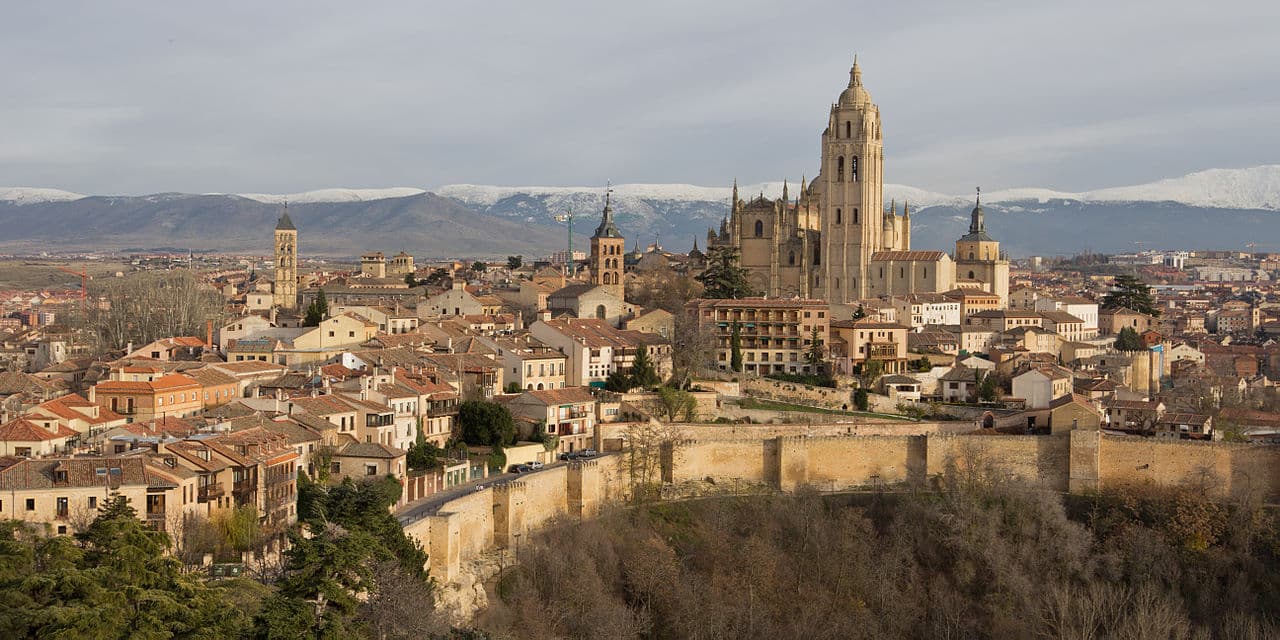
Segovia
The 28-metre Roman aqueduct (1st century AD, still standing without mortar), the Disney-castle Alcázar, and traditional cochinillo asado (roast suckling pig). Drives well as a day trip from Salamanca but easier from Madrid. UNESCO.
Ciudad Rodrigo
A small fortified Roman + medieval town near the Portuguese border — complete walls, a 12th-century cathedral, and the dramatic backdrop of the 1812 Peninsular War siege. Far less touristed than Salamanca; a perfect 4-hour stop on the way to/from Portugal.
Porto, Portugal
The closest major Portuguese city — direct ALSA bus 4 hr 15 min, €25–€45. Pair with Salamanca as a 7–10 day Iberian loop with Lisbon. Worth the journey for port wine cellars, the Ribeira waterfront, and a complete change in food culture.
Entry Requirements
Spain is in the Schengen Area — most Western passport holders enter visa-free for up to 90 days within any 180-day period for tourism. The 90/180 rule applies cumulatively across all 27 Schengen countries. The new EU-wide ETIAS travel authorisation is expected to apply from late 2026 for visa-free nationalities.
Entry Requirements by Nationality
| Nationality | Visa Required | Max Stay | Notes |
|---|---|---|---|
| US Citizens | Visa-free | 90 days in any 180-day period across Schengen | Visa-free for tourism. Passport must be valid 3+ months beyond intended departure. ETIAS authorisation expected from late 2026 (~€7, valid 3 years). |
| UK Citizens | Visa-free | 90 days in any 180-day period across Schengen | Post-Brexit, UK citizens are subject to standard third-country Schengen rules. Passport must be issued in the past 10 years and valid 3+ months beyond departure. |
| EU Citizens | Visa-free | Unlimited | Free movement under EU/EEA rules. National ID card sufficient for entry; passport not required. |
| Canadian Citizens | Visa-free | 90 days in any 180-day period across Schengen | Visa-free for tourism. Passport valid 3+ months beyond departure. ETIAS expected from late 2026. |
| Australian Citizens | Visa-free | 90 days in any 180-day period across Schengen | Visa-free entry. Passport valid 3+ months beyond intended departure. |
Visa-Free Entry
Tips
- •Schengen 90/180 rule is cumulative across all 27 Schengen countries — Spain days count alongside France, Italy, etc.
- •ETIAS travel authorisation expected from late 2026 for visa-free nationals (USA, UK, AU, CA etc.) — €7 fee, valid 3 years for multiple short stays
- •Passports must be issued in the last 10 years and valid 3+ months past your planned departure
- •No tourist tax in Salamanca (unlike Barcelona or Madrid)
- •Customs allowances entering EU from non-EU: €430 in goods (air arrivals), 200 cigarettes, 1L spirits
Shopping
Salamanca has more independent shops than chain stores in its centre — leather, books, traditional sweets, and the local Charra speciality foods (jamón ibérico from the Sierra de Béjar, hornazo meat pie, lemonade). The student economy keeps prices low. Major chains (Zara, Mango, El Corte Inglés) cluster on Calle Toro and Calle Azafranal.
Calle Toro & Calle Zamora
main shopping streetThe two parallel pedestrian shopping streets running north from Plaza Mayor — Spanish chains (Zara, Mango, Pull & Bear, Massimo Dutti), El Corte Inglés on Plaza España, and the bigger pharmacies and bookshops. Open 10:00–14:00 and 17:00–21:00 with a long siesta closure typical of Castilian Spain.
Known for: Spanish high-street chains, El Corte Inglés department store
Calle de la Compañía & Calle de los Libreros
independent / specialistThe University quarter's independent shops — second-hand bookshops, university-press editions, religious-art shops (rosaries, prints), and the ceramic shops along Rúa Mayor selling traditional Charra pottery. Almost no chain stores; the most distinctive small-shop retail in the city.
Known for: Books (new and second-hand), ceramics, religious art
Mercado Central de Abastos
food marketThe covered food market on Plaza del Mercado (1909, just south of Plaza Mayor) — 50+ stalls of jamón ibérico, chorizo zamorano, queso castellano, fresh fish trucked from the coast, vegetables. Many stalls have small bars at the front for lunch (€3–€8 plate). Open Monday–Saturday 08:00–14:00.
Known for: Castilian food: jamón ibérico, chorizo, cheese, lunch bars
Calle de la Rúa Antigua
tradition / souvenirsThe old medieval thoroughfare connecting Plaza Mayor to the Cathedrals — silversmiths, leather workshops (Salamanca-stamped leather is excellent value), and traditional sweet shops selling almendras garrapiñadas (caramelised almonds) and the local huesillos cookies. Some workshops still produce the Salamanca-style filigree silver jewellery.
Known for: Filigree silver, leather, traditional sweets
🎁 Unique Souvenirs to Look For
- •A leg of jamón ibérico de bellota from the Sierra de Béjar (the Salamanca province is one of the four officially DOP regions for jamón ibérico) — €120–€350 for a 7–8 kg leg from a Mercado Central stall; smaller portions also sold
- •A piece of Salamanca filigree silver jewellery (botón charro, large silver spherical earrings) from a Rúa Antigua silversmith — €40–€200 depending on size and silver content
- •A bag of almendras garrapiñadas (caramelised almonds) from the centuries-old Sweet Shop of Las Madres Carmelitas Descalzas behind Plaza Mayor — €10–€15 per bag, made by the cloistered nuns
- •A leather wallet or belt from a Rúa Antigua leather shop — €25–€80, hand-stitched and stamped with the Salamanca filigree pattern
- •A bottle of lemonade-flavoured wine (limonada serrana) for the local Easter celebrations — €5–€8, traditional drink of the Salamanca province
- •A copy of Miguel de Unamuno (rector of the University 1900–1914) in Spanish from a Calle de los Libreros bookshop — €5–€15 paperback
Language & Phrases
Spanish (Castilian, the standard) is universal. Salamanca's accent is one of the clearest in Spain — pronunciation textbooks for Spanish learners often use Salamantine speakers, and the city hosts dozens of language schools for foreign students. English proficiency is moderate among younger Salamantines and tourism workers, more limited among older locals and small-bar staff. Spanish basics open doors that English alone doesn't.
| English | Translation | Pronunciation |
|---|---|---|
| Hello | Hola | OH-lah |
| Good morning | Buenos días | BWEH-nos DEE-ahs |
| Good evening | Buenas tardes / Buenas noches | BWEH-nas TAR-des / NO-ches |
| Please | Por favor | por fa-VOR |
| Thank you | Gracias | GRA-thee-as |
| You're welcome | De nada | deh NAH-dah |
| Yes / No | Sí / No | see / no |
| How much? | ¿Cuánto cuesta? | KWAN-toh KWEH-stah |
| The bill, please | La cuenta, por favor | la KWEN-tah por fa-VOR |
| A small beer, please | Una caña, por favor | OO-nah CAN-yah por fa-VOR |
| Where is...? | ¿Dónde está...? | DON-deh es-TAH |
| Cheers! | ¡Salud! | sa-LOOD |
If you like Salamanca, you'll love…
4 cities with a similar vibe, outside of the same country.

Portugal · OVR 77
safe after dark · museum-dense old core

Croatia · OVR 75
compact, pedestrian-first layout · strong food culture

Poland · OVR 80
late-night stamina · deep artistic heritage

Portugal · OVR 77
you barely need transit · clean enough to relax